Doge’s Palace Review
Venice, Italy. The Doge’s Palace (Palazzo Ducale) in Venice stands as a symbol of the city’s unique political and cultural history. Serving as the residence of the Doge, the elected chief magistrate of the Venetian Republic,…
Venice, Italy. The Doge’s Palace (Palazzo Ducale) in Venice stands as a symbol of the city’s unique political and cultural history. Serving as the residence of the Doge, the elected chief magistrate of the Venetian Republic,…
Best forMuseum lovers, culture travelers, first-time visitors
Review focusCollections, visitor experience, and practical planning
Historical Context
The Doge’s Palace (Palazzo Ducale) in Venice stands as a symbol of the city’s unique political and cultural history. Serving as the residence of the Doge, the elected chief magistrate of the Venetian Republic, the palace was a seat of power for centuries. Its origins date back to the 9th century, with substantial reconstruction and expansion occurring in the 14th and 15th centuries. The building’s architectural style primarily reflects Gothic elements, with Renaissance and later additions shaping its current form. As the heart of Venetian governance, the palace housed not only the Doge’s apartments but also the government’s political chambers and courts, reflecting Venice’s complex system of checks and balances.
Beyond its political function, the Doge’s Palace was an administrative center processing maritime trade, military affairs, and diplomacy—critical aspects of Venice’s identity as a maritime republic. Following the fall of the republic in 1797, the building’s role shifted, becoming a symbol of Venice’s history rather than an active seat of power. Today, the palace operates as a civic museum, focusing on the art, governance, and social history of Venice. Its enduring architectural and artistic features provide a tangible link to the city’s past, illustrating its significance within the broader Renaissance and medieval periods.
What You See on Arrival
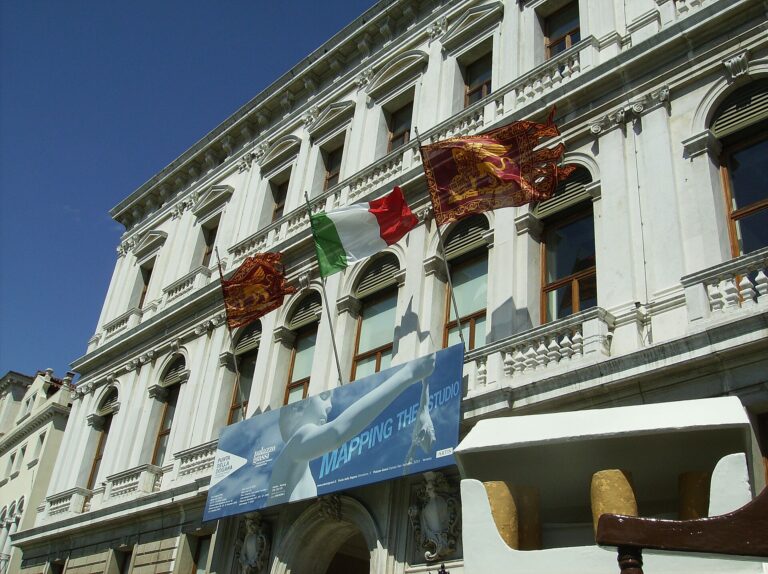
Approaching the Doge’s Palace, visitors encounter a striking Venetian Gothic façade that immediately conveys the building’s historical stature. Located on the Piazzetta San Marco, adjacent to St. Mark’s Basilica and overlooking the lagoon, its prominence within Venice’s civic landscape is unmistakable. The palace’s pink and white marble façade, with delicate tracery and open colonnades, creates a visual impression of elegance and power.
From the exterior, the building presents a clear identity as a former seat of government and a center of Venetian art. Visitors face a complex of interconnected spaces whose scale and ornamentation suggest the wealth and importance of the city’s leadership. The view from the adjacent waterfront allows a glimpse of the building’s loggias and, at a distance, the towering Campanile marks its proximity to other major Venetian landmarks. This positioning within the San Marco district roots the palace firmly in the social and historical fabric of the city, framing the upcoming experience as much more than a museum visit—it is a step into the heart of Venetian history.
Highlights and Key Exhibitions
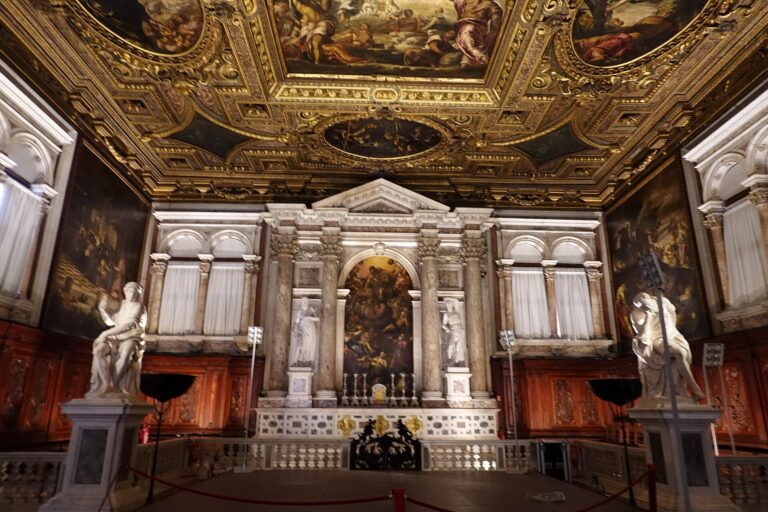
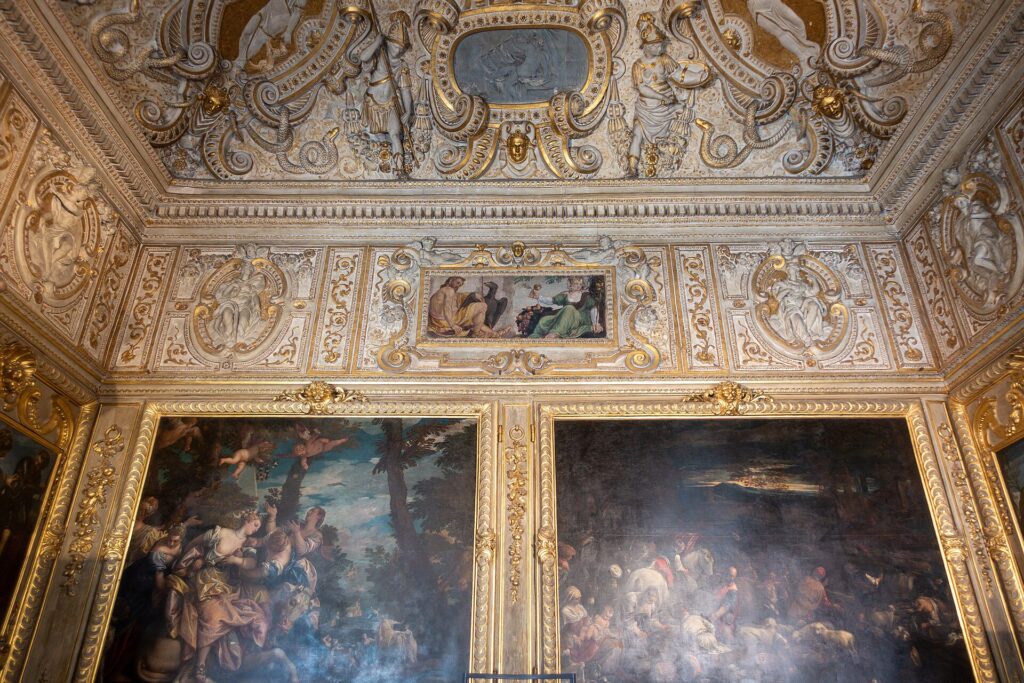
The Doge’s Palace’s exhibitions offer visitors access to one of Venice’s best-preserved civic architectural ensembles, combined with an extensive collection of Renaissance and Gothic art that reflects both the city’s political history and its artistic achievements. Central to the museum are the Doge’s private apartments, richly decorated with frescoes by prominent artists such as Giovanni Bellini, Tintoretto, and Veronese. These spaces emphasize the personal dimension of Venetian government, revealing the prestige and duties of the Doge himself.
Visitors encountering the institutional chambers gain insight into the complex structure of Venetian governance. The Sala del Maggior Consiglio (Hall of the Great Council) is particularly significant. It is one of the largest rooms in Europe, renowned for its vast ceiling painting by Tintoretto depicting the “Paradise.” This enormous work, along with the elaborate woodwork and political iconography throughout the chamber, underscores the grandeur and ideological underpinnings of Venetian republicanism.
The palace also includes the Council of Ten’s rooms, where political intrigue and justice were administered with great secrecy and severity. The displays provide context for Venice’s unique political mechanisms and its reputation for intelligence and surveillance. Nearby, the prisoners’ quarters and the famous Bridge of Sighs complete the narrative by illustrating the justice system and the fate of those condemned by it.
Artworks and decorative elements, including statues, tapestries, and painted ceilings across other chambers, show how art served political messaging and public ceremony. The collection draws on artists from several centuries, emphasizing continuity and change in Venetian society. While these works are the permanent focus, the museum does not present itself as an art gallery alone, but as a historical-political complex that uses art to communicate Venice’s identity.
Visitor Experience
The visitor experience at the Doge’s Palace is defined by the interweaving of architectural grandeur, political history, and Renaissance art. The palace’s layout spans multiple floors and wings, which offers a sequence of richly decorated rooms that can both inspire and overwhelm. Visitors with an interest in history, art, or architecture will appreciate the depth and authenticity of the spaces, from the solemn halls of power to the more intimate residential quarters.
Pacing can vary widely depending on the visitor’s focus. Some may linger in the large council chambers studying the paintings and symbolism, while others may move more quickly through less ornate rooms or the prison areas. The scale of the building encourages a measured visit, as the sheer size and detail demand attention. Museums of this nature often present challenges in terms of visitor flow; busy periods can affect one’s ability to closely examine delicate artworks or architectural details.
Interpretive materials, where provided, help frame the significance of the spaces and artworks without resorting to overly academic language. However, visitors without some prior knowledge of Venetian history might find certain political references and historical nuances difficult to fully grasp without external support. The museum’s focus remains strongly on the building and its permanent collections rather than offering a heavily curated, thematic narrative. This can be seen as a strength by those interested in a direct encounter with historical artifacts and spaces, but it may also feel slightly fragmented for casual visitors seeking a more guided, cohesive story.
Tickets, Access, and Planning
Planning a visit to the Doge’s Palace should begin with checking the official website for the most current information about hours, ticket availability, and any visitor regulations. As one of Venice’s major cultural sites, the museum can get crowded, particularly during peak tourist seasons. Therefore, advanced booking is advisable for those looking to avoid long lines or sold-out entry times. This is especially relevant for visitors aiming to time their visit in a less hectic moment.
Admission policies may vary, and while concessions might be available for eligible groups, this information should be verified directly through official sources. It is important to note that the museum is a historic building rather than a modern, universally accessible facility. Some parts of the palace may present challenges to visitors with mobility issues due to narrow staircases and uneven flooring, a common characteristic of heritage sites of this age. Checking access details in advance is prudent.
Visitors should also consider the museum’s location and its relationship to Venice’s broader historic core. The Doge’s Palace is easily reached on foot from most points in the city center and is often combined with visits to nearby St. Mark’s Basilica and the surrounding piazza. However, itineraries that include multiple major sites in quick succession should factor in time for walking and the potential for crowded conditions.
Final Verdict
The Doge’s Palace remains a cornerstone for understanding Venice at its height as a maritime republic, reflecting both its political complexity and artistic ambition. Its strengths lie in the authenticity of the site and the depth of its permanent collections, which together paint a multifaceted portrait of power, governance, and art. The building itself is an artifact, with its Gothic architecture and richly decorated interiors offering an immersive experience into Venetian society’s workings.
However, the museum’s scale and complexity mean it is best suited to visitors who can commit time and have an interest in historical context, or those who approach it as part of a broader exploration of Venice’s political and cultural past. Without a strong historical background or willingness to engage with the detailed symbolism on display, some may find the narrative incomplete or difficult to follow. The museum’s interpretation tends toward presentation rather than narrative storytelling, which both preserves the integrity of the site but may leave casual visitors seeking more thematic guidance.
In practical terms, the Doge’s Palace demands some planning due to its popularity and historical layout. Its central location facilitates inclusion in a wider Venetian itinerary but also makes it susceptible to the city’s well-documented tourist flows. Visitors looking for a deep dive into Venice’s governance, art commissioned for political purposes, and the lived experience of its rulers will find the palace richly rewarding.
In conclusion, the Doge’s Palace offers a substantial, if occasionally demanding, window into Venetian history. It stands as an essential visit for those interested in the intersections of art, politics, and architecture, though not necessarily for those seeking a light or quickly consumable museum experience. Checking operational details in advance is advisable to optimize the visit and navigate the site’s logistical considerations.