Musée de la Musique Review
Transport Museums · Paris, France. The Musée de la Musique, located in Paris, France, is part of the Cité de la Musique complex in the Parc de la Villette, a cultural project inaugurated in the late 20th century to…
Transport Museums · Paris, France. The Musée de la Musique, located in Paris, France, is part of the Cité de la Musique complex in the Parc de la Villette, a cultural project inaugurated in the late 20th century to…
Best forMuseum lovers, culture travelers, first-time visitors
Review focusCollections, visitor experience, and practical planning
Historical Context
The Musée de la Musique, located in Paris, France, is part of the Cité de la Musique complex in the Parc de la Villette, a cultural project inaugurated in the late 20th century to foster various forms of artistic expression. Established within this framework, the museum officially opened its doors in 1997. It was conceived to house and display a notable collection of musical instruments and related objects, tracing the historical and cultural development of music from the 16th century to the present. The museum is an initiative of the Philharmonie de Paris institution, whose broader mission is the promotion and preservation of both music heritage and contemporary music creation.
The foundation of the Musée de la Musique draws upon several earlier collections, including that of the Conservatoire de Paris, accumulations from the Musée Instrumental de la Cité de la Musique, and other private and institutional acquisitions. This layering of collections gives the museum a considerable depth in terms of historical range and geographical scope. Its holdings reflect both Western and non-Western musical traditions. The institution’s formation within the Parc de la Villette situates it within a modern cultural landscape designed to integrate music, architecture, and education, aiming to create a space where visitors can engage actively with the evolving story of music across continents.
Today, the museum serves both as a repository of musical artifacts and a resource for research and public education. It attempts to balance the display of historically significant pieces with newer instruments to present classical, folk, and contemporary music cultures. This combination situates the museum as a key site for understanding how musical instruments, craftsmanship, and performance have intersected over time and across cultures.
What You See on Arrival
Upon approaching the Musée de la Musique, visitors are greeted by a modern architectural environment characteristic of the Parc de la Villette complex. The building itself adopts contemporary lines and materials that distinguish it from the traditional Parisian landmark buildings, immediately signaling a progressive institutional profile focused on music rather than architectural historicism. The entrance area acts as a transitional space that sets the visitor’s expectations toward a blend of heritage and modernity.
The museum’s identity is underpinned by the presence of its collection, which is not limited to static display cases but often arranged in ways that suggest usage and musical function. Visitors will find that the framing of the exhibits emphasizes the stories behind the instruments themselves—the context of their creation, their geographical origins, and the types of music they produce. This is reinforced by strategically placed signage and multimedia presentations that guide visitors through chronological and thematic paths without overwhelming them with excessive information at the start.
The spatial organization encourages visitors to move naturally from one gallery to another, with visual continuity in lighting and design cues helping to focus attention on both individual objects and their broader context. Although the museum places musical instruments at the core, it simultaneously conveys the technological and cultural dimensions that give these objects meaning. Thus, on arrival, one can anticipate a museum that presents music history not merely as a timeline but as a living, multi-layered experience.
Highlights and Key Exhibitions
The core of the Musée de la Musique is its extensive musical instrument collection, which includes more than 8,000 items ranging from string, wind, and percussion instruments to early keyboard instruments and electronic music apparatuses. The collection’s chronological span covers the Renaissance to the current era, offering a comprehensive survey of instrument evolution.
A significant highlight is the museum’s array of historical violins, lutes, and harpsichords, some of which were made by renowned craftsmen such as Stradivari and Amati. These instruments not only display exceptional craftsmanship but also represent landmarks in the technological and aesthetic development of European music. Concentrations of rare instruments from the baroque and classical periods serve as critical points of interest for visitors interested in music history and instrument-making traditions.
Another prominent part of the collection is its extensive room dedicated to wind instruments, illustrating a variety of flutes, bagpipes, oboes, and clarinets from different regions. The museum’s holdings here emphasize both the technical innovations and diverse cultural practices associated with these instruments. The display also juxtaposes Western orchestral instruments with counterparts from Africa, Asia, and the Americas, highlighting the museum’s commitment to cross-cultural perspectives.
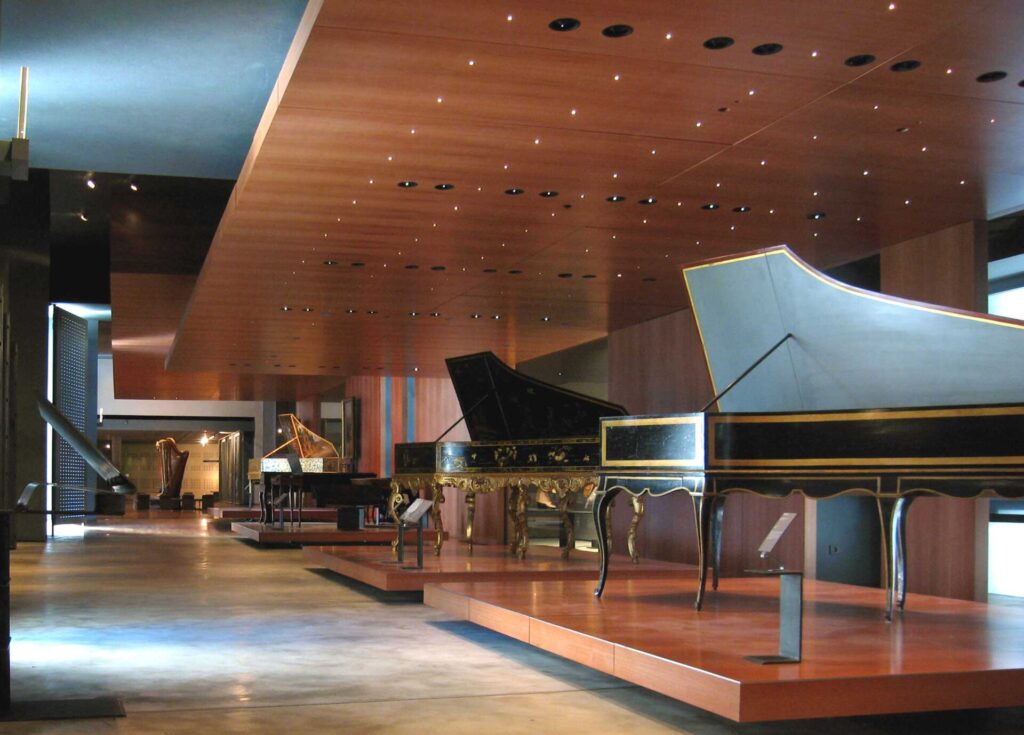
The museum’s sections devoted to keyboard instruments stand out for their breadth, including harpsichords, fortepianos, and early pianos, illustrating the evolution from Renaissance to modern keyboard instruments. The visual and acoustic design of these galleries often allows visitors to sense the transition in musical practice and social uses of these instruments across centuries.
Of particular interest is the integration of electronic and electroacoustic instruments, which documents how the 20th century radically transformed music production and performance. Synthesizers and experimental sound devices are set alongside traditional instruments, underscoring the museum's thematic narrative of continuous innovation.
Overall, the museum balances the display of high-art instruments with those linked to folk or popular traditions, offering a nuanced view of music as a social as well as artistic phenomenon. The chronological and thematic layout aids visitors in tracing developments over time and across regions without confining the narrative solely to Western classical music.
Visitor Experience
Visitors to the Musée de la Musique can generally expect a calm and contemplative atmosphere, well suited to those with an interest in musical history, craftsmanship, and cultural studies. The spatial organization is clear, allowing for self-guided tours that progress logically through different time periods and instrument families. The presence of well-marked sections encourages visitors to focus on particular areas of interest, whether that be Renaissance instruments or 20th-century electronic innovation.
The museum’s interpretive materials strike a balance between accessibility and detail. Text panels are concise yet informative, generally explaining key characteristics of objects, their historical period, and their cultural significance. Multimedia elements, such as sound stations where visitors can hear recorded samples of instruments, add an important sensory dimension. However, these installations may not be evenly distributed throughout the galleries, so visitors mainly rely on visual observation and printed descriptions.
The collection’s size and variety mean that the museum is best suited to audiences willing to spend time engaging with craftsmanship and details. It may appeal less to those seeking high-energy or highly interactive experiences. Families with children, for example, might find the experience less immediately engaging without additional programming geared toward younger audiences.
On the practical side, circulation is generally intuitive, though some visitors might find the transition between galleries on different floors a little abrupt or less clearly signposted. The lighting is carefully calibrated to protect delicate instruments, which can create dimmer environments that may challenge reading small print for some visitors. The museum’s integration into the wider Philharmonie de Paris complex situates it within a broader cultural destination but may also mean navigating separate venues for concerts or other events.
Tickets, Access, and Planning
The Musée de la Musique is located within the Parc de la Villette area in northeastern Paris, an area accessible by multiple public transportation options. Visitors planning a visit should consult the museum’s official website for the latest information on opening times, ticketing policies, and any special requirements related to health or security measures. Admission conditions, including prices and concessions, are subject to change and should be verified before arriving.
Given the museum’s extensive collection and the size of the galleries, visitors might plan for a visit duration that allows at least a couple of hours to appreciate the core exhibitions without rushing. However, the absence of detailed guided tour offerings in the public domain suggests that much of the visit will be self-directed, so visitors interested in thorough contextual understanding may want to prepare by reviewing educational materials or audio resources in advance if available.
Accessibility details for visitors with mobility or sensory impairments should also be confirmed directly. Although the museum operates in a relatively modern building, which tends to be more accessible than older Parisian museums, specific accommodations or services can vary.
Final Verdict
The Musée de la Musique occupies a distinctive niche among Paris’s cultural institutions. Its focus on the material history of music through instruments offers a specialized perspective not commonly found in general art or history museums. The breadth of its collection presents a clear narrative about musical innovation and cultural exchange that spans centuries and continents.
Its strengths lie predominantly in the quality and diversity of its musical instruments, and in the ways these objects are presented to highlight their function, craftsmanship, and cultural significance. For anyone interested in the physical and artistic dimensions of music, the museum offers a rich resource, combining historical depth with an acknowledgment of contemporary musical developments.
At the same time, the museum’s appeal is somewhat specialized, potentially limiting its draw for casual visitors or families without supplementary programming. The atmosphere is one of study and reflection rather than entertainment or spectacle. Additionally, planning a visit requires some forethought regarding access, opening times, and interpretation needs.
In summary, the Musée de la Musique successfully fulfills its role as a repository and exhibitor of musical heritage. It is well suited to those who wish to explore music through its tangible artifacts, and who appreciate a careful, measured presentation of cultural history. Prospective visitors, particularly those more familiar with traditional museum formats, should approach the museum prepared for a focused experience on the objects of music rather than broader cultural narratives or highly interactive formats.