Guggenheim Museum Bilbao Review
Guggenheim Museum Bilbao Modern & Contemporary Art · Bilbao, Spain Architecture as Catalyst The Guggenheim Museum Bilbao is rarely approached.
Guggenheim Museum Bilbao Modern & Contemporary Art · Bilbao, Spain Architecture as Catalyst The Guggenheim Museum Bilbao is rarely approached.
Best forMasterpieces, architecture, cultural history
Review focusCollection highlights, building, visitor flow
Historical Context
The Guggenheim Museum Bilbao opened in 1997 and quickly became one of the most influential museum projects of the late twentieth century. It was conceived as part of a broader effort to transform Bilbao from an industrial city into a cultural destination. Designed by architect Frank Gehry, the museum became a defining example of how architecture and culture could reshape an entire urban identity. The success of the project was so significant that it introduced what is often referred to as the “Bilbao effect,” where a single cultural building can drive economic and cultural renewal.
The museum is part of the Solomon R. Guggenheim Foundation, linking it to a wider network of institutions dedicated to modern and contemporary art. However, Bilbao is not simply a branch of a larger system. It has developed its own identity, combining international contemporary art with site-specific installations that respond to the building’s scale and structure. From the beginning, the museum was designed not just to house art, but to redefine how art is experienced in relation to architecture.
Since its opening, the Guggenheim Bilbao has remained central to discussions about museum design, cultural investment, and the role of contemporary art in public life. It represents a moment when museums shifted from being primarily repositories of objects to becoming destinations in their own right. The building itself is inseparable from the institution’s identity, and any visit inevitably engages with both art and architecture at the same time.
What You See on Arrival
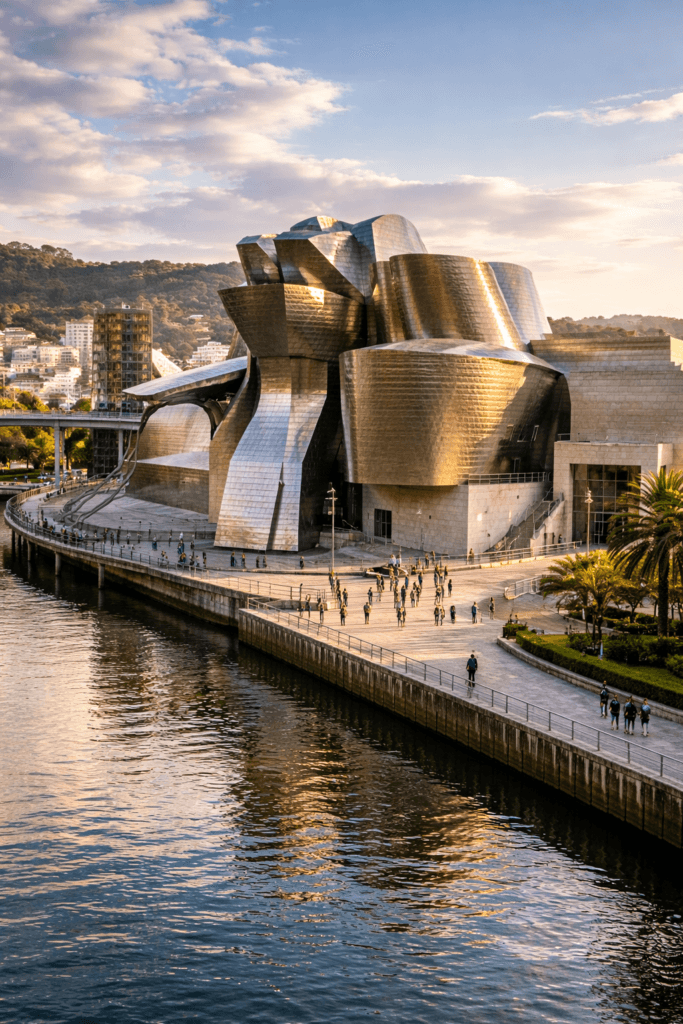
Arrival at the Guggenheim Museum Bilbao is immediate and dramatic. The building does not gradually reveal itself; it dominates the surroundings with its flowing titanium curves and sculptural presence. Located along the Nervión River, the museum interacts directly with its environment, reflecting light and changing appearance depending on the weather and time of day. Even before entering, the experience begins outside.
The first impression is one of movement. The structure appears almost fluid, with no single fixed viewpoint. Walking around the building reveals constantly shifting perspectives, making the exterior itself an essential part of the visit. Large-scale outdoor artworks, including installations positioned around the museum, extend the experience beyond the interior galleries.
Inside, the central atrium creates a powerful sense of scale. The space rises dramatically, connecting multiple levels and acting as a visual anchor for the museum. From here, visitors can orient themselves before moving into the galleries, which vary in size and shape. Some are more traditional, while others are vast and irregular, designed to accommodate large installations.
The mood on arrival is dynamic and visually intense. Unlike more restrained museums, Bilbao emphasizes impact. The architecture demands attention, and this shapes how visitors approach the art. There is a clear sense that the building is not neutral. It actively participates in the experience, influencing movement, perception, and expectation from the very beginning.
Highlights and Key Exhibitions
The Guggenheim Bilbao is known for its combination of large-scale installations, contemporary works, and selected pieces from the Guggenheim collection. One of the defining features of the museum is how it accommodates art that would be difficult to display elsewhere. The scale of certain galleries allows for immersive works that rely on space as much as on form.
Richard Serra’s installation The Matter of Time is one of the museum’s most important highlights. Located in a dedicated gallery, the series of monumental steel sculptures creates a spatial experience that visitors move through rather than simply observe. The work demonstrates how the museum’s architecture supports art that engages directly with movement and perception.
The collection also includes works by major contemporary artists such as Jeff Koons, whose Puppy stands outside the museum, and Louise Bourgeois, whose spider sculpture adds another dimension to the exterior space. Inside, rotating exhibitions and selected pieces from the Guggenheim network provide variety, ensuring that the museum remains dynamic rather than fixed.
While the museum does not present a traditional chronological narrative of art history, it offers strong thematic and spatial experiences. The emphasis is less on historical progression and more on how contemporary art interacts with scale, material, and environment. This approach makes the visit less about following a linear story and more about engaging with individual works in depth.
Temporary exhibitions play a key role in maintaining the museum’s relevance. These shows often bring international artists and themes into the space, complementing the permanent installations and ensuring that the museum continues to evolve.
Visitor Experience
The visitor experience at the Guggenheim Bilbao is defined by its integration of architecture and art. Movement through the museum is not strictly linear, and visitors often navigate between galleries based on visual cues rather than a fixed route. This creates a sense of exploration, but it can also require some adjustment, especially for first-time visitors.
Pacing is generally manageable because the galleries are large and well-distributed. Even when the museum is busy, the scale of the spaces helps reduce the feeling of crowding. Visitors can often find moments of quiet, particularly in the larger installation rooms where the focus shifts from viewing to experiencing.
Signage is clear, but the building itself plays a major role in orientation. The central atrium acts as a reference point, allowing visitors to return and reorient before continuing. This structure supports both short visits focused on highlights and longer, more comprehensive explorations.
The atmosphere is energetic and visually engaging. Unlike museums that emphasize quiet contemplation, Bilbao encourages interaction with space. Visitors are often moving, looking, and responding to both the art and the architecture simultaneously. This creates a more active form of engagement, where the experience is shaped as much by physical movement as by observation.
Overall, the museum offers a balance between accessibility and depth. It is possible to enjoy the building and major works without extensive prior knowledge, but those who spend more time will find layers of complexity in how the art and architecture interact.
Tickets, Access, and Planning
The Guggenheim Museum Bilbao is located within walking distance of the city center and is easily accessible by public transport. Its position along the river makes it a natural focal point for visitors exploring the city.
Planning ahead can enhance the visit, particularly during peak tourist seasons when the museum is busiest. Purchasing tickets in advance and arriving early in the day can help avoid queues and provide a more comfortable experience.
The museum’s layout supports flexible visit lengths. A shorter visit can focus on the building and key installations, while a longer visit allows for deeper engagement with exhibitions and temporary shows. Allocating at least two to three hours is recommended for a balanced experience.
Comfortable pacing is important. While the museum is not overwhelming in terms of the number of objects, the scale of the spaces and installations can be visually intense. Taking time to pause between galleries helps maintain focus and enjoyment throughout the visit.
Final Verdict
The Guggenheim Museum Bilbao is one of the most important examples of how architecture and contemporary art can combine to create a unified cultural experience. Its impact extends beyond its collection, influencing how museums are designed and understood globally.
Who should visit? The museum is ideal for visitors interested in contemporary art, architecture, and large-scale installations. It is also suitable for those who may not typically visit museums, as the building itself provides a strong entry point into the experience.
Why visit? Because it offers a unique combination of architectural innovation and contemporary art that cannot be replicated elsewhere. The Guggenheim Bilbao is not just a place to see art. It is a place to experience how art, space, and design interact at the highest level.
For those seeking a museum that goes beyond traditional display and engages directly with space and perception, it remains one of the most compelling destinations in Europe.