Museo Larco Review
Andean Civilisations · Lima, Peru Intimacy as Authority Some museums prove importance through scale. Museo Larco proves it through precision. The mansion.

Andean Civilisations · Lima, Peru Intimacy as Authority Some museums prove importance through scale. Museo Larco proves it through precision. The mansion.
Best forMasterpieces, architecture, cultural history
Review focusCollection highlights, building, visitor flow
Intro
Museo Larco is one of the most important archaeological museums in Lima, Peru, known for its extensive collection of pre-Columbian art and artifacts. Located in the Pueblo Libre district, the museum presents thousands of years of history through a carefully organized exhibition that explains the development of ancient civilizations along the Peruvian coast and in the Andean region. The museum is housed in an eighteenth-century vice-royal mansion built over the remains of an earlier pyramid, creating a setting where different periods of history exist in the same space. The visit focuses on clear presentation rather than spectacle, allowing the objects themselves to explain how people lived, worked, and believed in ancient Peru.
How the Site Works
Museo Larco is arranged as a chronological journey through more than five thousand years of cultural history. Visitors move through galleries that show the rise of different civilizations, beginning with early coastal societies and continuing through the major cultures that existed before the Inca Empire. The layout is logical and easy to follow, with each room explaining a specific period or region. This structure makes the visit understandable even for people who are not familiar with Peruvian history. One of the most distinctive features of the museum is the open storage area, where thousands of catalogued ceramics are displayed on shelves. This allows visitors to see the scale of the collection and understand how archaeological objects are preserved and studied.
Exhibitions and Collection
The collection at Museo Larco contains tens of thousands of objects, with ceramics forming the largest part of the exhibition. These pieces show scenes from daily life, religious ceremonies, and political power, giving a detailed picture of how ancient societies functioned. Gold and silver ornaments, textiles, stone tools, and carved figures are also displayed, each placed in context so visitors can understand their use. The museum is known for presenting objects in a factual way, without dramatic effects, allowing the historical meaning of the artifacts to remain clear. One of the most talked-about sections is the gallery of erotic pottery, which is shown as part of the cultural and symbolic traditions of ancient Peru rather than as a curiosity.
Architecture / Space
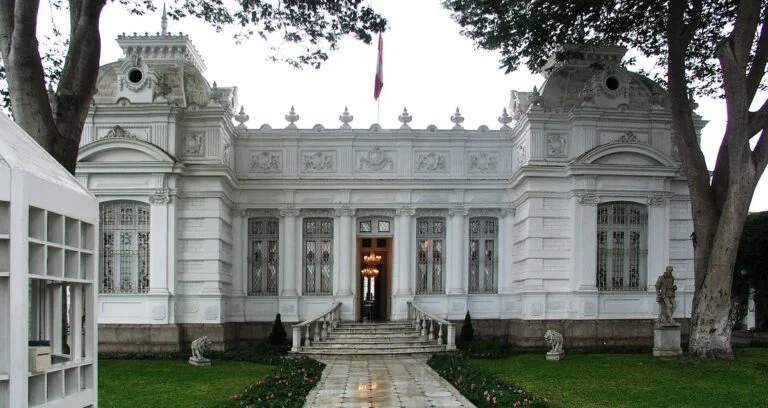
The museum building itself is part of the experience. The vice-royal mansion has white walls, wooden balconies, and interior courtyards that create a calm atmosphere, very different from large modern museums. The galleries are arranged around open patios with plants and flowers, which gives visitors time to pause between sections. The building stands on top of a much older pyramid, showing how different historical periods exist in the same location. This combination of architecture makes the museum feel both formal and personal at the same time, and the smaller rooms allow objects to be viewed closely without feeling crowded.
Visitor Experience
A visit to Museo Larco is quiet and easy to follow, with clear labels and well-lit displays. Most visitors spend one to two hours in the galleries, although the open storage rooms and outdoor areas can make the visit longer. Because the museum is not extremely large, the experience feels focused rather than overwhelming. Information is presented in a straightforward way, and the exhibition does not try to create emotional effects. Instead, the visit relies on the strength of the collection itself. The calm setting, combined with the detailed displays, makes the museum suitable both for casual visitors and for people with a serious interest in history.
Historical Context
Museo Larco was founded in 1926 by Rafael Larco Hoyle, an archaeologist who collected objects from sites across Peru in order to preserve them for research and public display. At the time, many artifacts were being removed without documentation, and the museum was created to build a collection that could show the full history of the region. Over the years the collection grew into one of the most important private archaeological museums in Latin America. The museum covers civilizations that existed long before the Inca Empire, giving visitors a broader understanding of Peruvian history than is possible in many national museums.
Additional Notes on the Collection
Another notable aspect of Museo Larco is the way the collection is documented and preserved. Many of the objects have been carefully catalogued with detailed information about where they were found and how they were used. This makes the museum valuable not only for visitors but also for researchers who study ancient Peruvian cultures.
The visible storage rooms are especially unusual, because they allow visitors to see thousands of additional ceramics that are not part of the main exhibition. Instead of hiding these objects, the museum presents them in a way that shows the scale of archaeological work in Peru. Walking through these shelves gives a better understanding of how large the collection really is and how many different cultures existed over time.
The museum also places strong emphasis on education. Exhibits are arranged so that visitors can follow the development of technology, religion, and daily life across different civilizations. This approach makes the museum easier to understand than many larger institutions where objects are shown without clear context.
Practical Information
The museum is located in the Pueblo Libre district of Lima and can be visited easily from the historic center of the city. The exhibition is indoors and can be seen at any time of year. Photography is usually allowed in most areas, although some galleries may have restrictions. Because the museum is smaller than many national institutions, it is possible to see the entire collection in one visit without feeling rushed. A café and garden area are also part of the museum, making it a comfortable place to spend time during a day of sightseeing in Lima.
Museum Significance
Museo Larco is often considered one of the most accessible museums in Peru because the exhibition explains complex history in a clear and structured way. Instead of focusing only on famous objects, the museum shows how different cultures developed over time and how daily life, religion, and technology were connected.
The decision to display both exhibition pieces and storage collections makes the museum unusual. Visitors are able to see how large archaeological collections really are, which gives a better understanding of how much material has been discovered in Peru. This approach also shows the scientific work behind the museum, not only the finished displays.
Because of this combination of research, clear presentation, and historical depth, Museo Larco is often recommended as one of the best museums to visit in Lima for anyone interested in ancient civilizations.
Final Verdict
Museo Larco is one of the most informative museums in Lima because it presents the history of ancient Peru in a clear and structured way. The chronological layout, the quality of the objects, and the calm setting make it easy to understand how different cultures developed over thousands of years. The museum does not rely on dramatic presentation, and the focus remains on the artifacts themselves. For visitors interested in archaeology, history, or pre-Columbian cultures, this is one of the most rewarding museum visits in the city.