Canadian Museum of History Review
History Museums · Gatineau, Canada. The Canadian Museum of History, located in Gatineau, Quebec, occupies an important place in the cultural landscape of Canada. Established in 1989 as the successor institution to the former National Museum of Man, its…
History Museums · Gatineau, Canada. The Canadian Museum of History, located in Gatineau, Quebec, occupies an important place in the cultural landscape of Canada. Established in 1989 as the successor institution to the former National Museum of Man, its…
Best forHistory lovers, cultural travelers, local heritage
Review focusHistorical collections, local context, and visitor planning
Historical Context
The Canadian Museum of History, located in Gatineau, Quebec, occupies an important place in the cultural landscape of Canada. Established in 1989 as the successor institution to the former National Museum of Man, its mission is to preserve, study, and communicate the history and culture of the Canadian nation and its peoples. The museum is operated by the Canadian Museum of History Corporation and is situated directly across the Ottawa River from the capital city of Ottawa, allowing it to serve as a significant site of national reflection outside the federal core.
The development of the museum traces back to a mid-20th-century effort to create a centralized national museum dedicated to anthropology and human history. Over the decades, this focus broadened to include wider aspects of Canadian history, including Indigenous cultures, immigrant stories, and the country's political and social development. The building itself, designed by architect Douglas Cardinal, opened in 1989 and is often noted for its expressive organic form, intended to evoke the natural landscape and Indigenous motifs. Since its founding, the museum has expanded its collections, exhibitions, and public programming, establishing itself as a leading institution for understanding Canada’s diverse past.
What You See on Arrival
Approaching the Canadian Museum of History, visitors encounter a structure that makes a deliberate architectural statement. The building’s curvilinear forms, warm sandstone façade, and asymmetrical lines diverge sharply from more traditional museum designs. This visually distinctive edifice frames the institution’s identity as culturally rooted and connected to land and place, reflecting Indigenous architectural influences and natural elements. The museum’s setting on the banks of the Ottawa River further enriches the arrival experience with views of water and the adjacent Canadian capital skyline.
The visitor entryway is designed to prepare guests for a cultural journey, linking the physical environment with the thematic ethos inside. The museum presents itself neither as a sterile repository of artifacts nor as a purely academic venue but as a space committed to telling human stories across the sweep of Canadian history and its Indigenous roots. Signage, design cues, and layout on the front approach aim to orient visitors and introduce them to the museum’s wider purpose. This combination of architecture and landscape sets a tone of engagement with history as a living conversation between past and present.
Highlights and Key Exhibitions
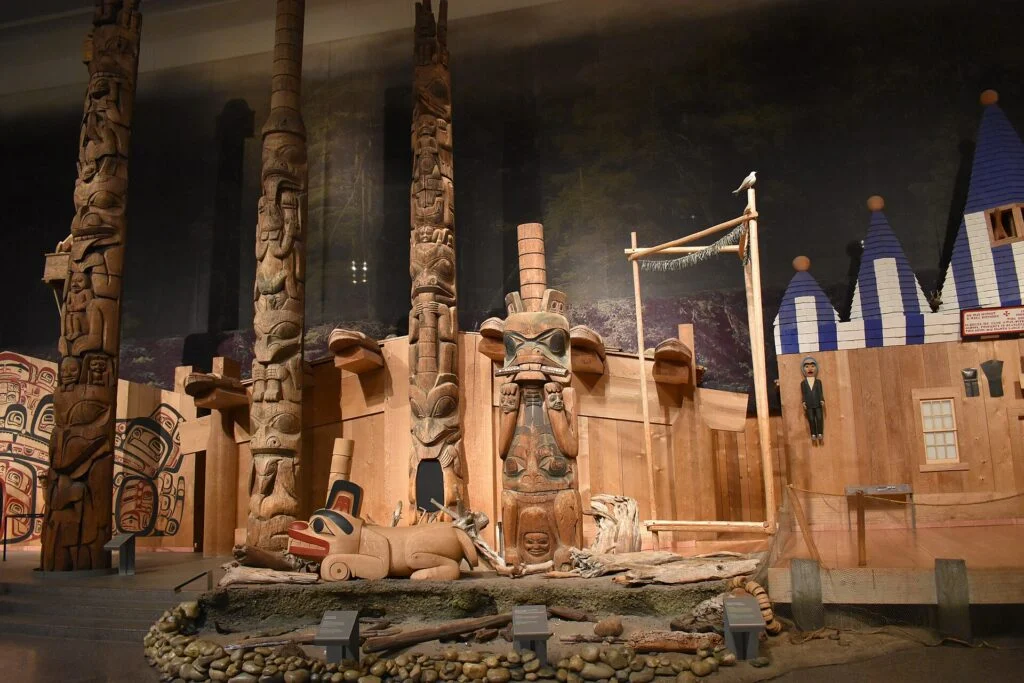
The Canadian Museum of History is best known for its comprehensive permanent exhibitions covering a broad range of themes centered on Canada’s history, Indigenous cultures, and national identity. Among the most significant is the Grand Hall, featuring the world’s largest indoor collection of totem poles. This space serves both as a striking visual introduction and as a focal point representing Indigenous artistic and cultural traditions of the Pacific Northwest. The totem poles exemplify the museum’s commitment to respectful presentation of Indigenous heritage as central to Canadian history.
Another cornerstone of the collection is the Canadian History Hall. Through detailed displays and artifacts, it traces the country’s development in chronological order—from early Indigenous societies, through European colonization, confederation, industrial growth, immigration waves, to contemporary Canada. The exhibition is structured into distinct eras and themes allowing visitors a modular exploration of political, social, and cultural transformations over centuries. The hall attempts a balanced narrative by incorporating Indigenous perspectives alongside settler and immigrant stories.
The artifact collections include a diverse range of objects: historical clothing, tools, documents, architectural models, photographs, and multimedia elements. One notable section addresses the fur trade, a crucial chapter in Canada’s economic and cultural foundation. Items related to this period, including trade goods and Indigenous-European interaction artifacts, illustrate the complexity of cross-cultural exchange and its lasting impact.
Another important area focuses on the history and culture of Indigenous peoples from various regions of Canada, not limited to the Northwest Coast, but covering the Eastern Woodlands, Plains, and Arctic communities. This includes archaeological objects, traditional regalia, and contemporary Indigenous art, reflecting continuity and change in multiple lifeways.
The museum also houses the Canadian Children’s Museum, geared towards younger audiences, which explores cultural diversity and everyday life in interactive ways aimed at education and engagement. Though somewhat separate from the historical exhibitions, it complements the museum’s educational role by fostering early understanding of cultural differences and history.
Temporary exhibitions and traveling shows have historically provided additional thematic depth, but the core experience remains focused on permanent holdings. These exhibitions sometimes enhance discussion on contemporary cultural questions, though details on current or upcoming temporary exhibitions should be checked on the official website, as they vary over time.
Visitor Experience
Visitors to the Canadian Museum of History can expect an experience that blends visual spectacle with intellectual content. The museum’s layout encourages a semi-structured flow through the key galleries, balancing chronological and thematic organization. This approach is intended to guide visitors through a national narrative while allowing room for reflection on particular regions, peoples, and issues.
Interpretation is generally clear and varied, combining traditional labels and panels with multimedia presentations. The use of digital displays, videos, and audio elements helps diversify modes of engagement, potentially suiting different learning styles. However, some parts of the museum rely heavily on text-based information, which might present challenges for visitors with limited time or language proficiency. On balance, the museum balances academic rigor with public accessibility, but it may reward visitors willing to spend time reading and considering the detailed explanations.
The museum’s approach to Indigenous history and cultures is notable for its effort to present these on their own terms rather than as mere prelude to settler narratives. However, expectations should be moderated regarding depth—given the breadth of Canada’s Indigenous diversity and multi-millennial history, not all communities or histories can be covered comprehensively in a single institution.
The Canadian Children’s Museum adds an element of interactive learning well suited to families and younger audiences. It breaks up the often text-heavy nature of the wider museum and caters to different age groups effectively.
In terms of crowd management, the museum is generally designed to accommodate significant visitor numbers without feeling congested, though peak times such as weekends or school holidays may lead to localized crowding, especially around popular displays like the Grand Hall totem poles.
Tickets, Access, and Planning
The Canadian Museum of History welcomes a wide range of visitors, including local residents, domestic tourists, and international guests, particularly given its proximity to Ottawa. Practical considerations such as opening hours, admission fees, discounts, tour offerings, audio guides, and accessibility features should be verified on the official website prior to a visit, as this information can change.
Visitors should be prepared for an experience that is both contemplative and educational. Those with specific interests in Indigenous cultures, Canadian political history, or material culture will find much to engage with. Conversely, travelers seeking entertainment-oriented or art-centric museums may find the historical emphasis more sober.
Planning a visit should take into account that the museum covers extensive subject matter and is housed in a sizable building. Time management is advisable to avoid fatigue, especially for visitors wanting to see all permanent exhibitions as well as the Canadian Children’s Museum. If traveling with young children, scheduling breaks or prioritizing certain galleries may be appropriate.
The location in Gatineau, on the Quebec side of the Ottawa River, means visitors should anticipate the route and transportation method carefully, especially if relying on public transit or crossing provincial borders. Language considerations may also be relevant: signage and interpretation are provided primarily in English and French.
Final Verdict
The Canadian Museum of History stands as a fundamental institution for those seeking to understand the complex and layered story of Canada. Its architectural setting and the breadth of its permanent collections aim to articulate how diverse peoples and historical forces have shaped the nation. Its particular strength lies in presenting Indigenous histories with relative prominence alongside more conventional narratives, offering a more integrated view of the past.
While the museum’s scope and content can be demanding due to the wealth of information and wide chronological range covered, its exhibitions are generally accessible and thoughtfully presented. It should be particularly rewarding for visitors interested in social history, cultural diversity, and national identity.
That said, the museum’s emphasis on historical content and its sometimes text-heavy displays may limit appeal for those expecting a more casual or purely visual museum experience. Its location in Gatineau might require careful planning for visitors more accustomed to Ottawa-centered tourism.
In sum, the Canadian Museum of History is a substantial cultural institution. It fulfills a crucial educational role by providing a comprehensive overview of Canadian history and Indigenous cultures in a distinctive environment. Visitors who approach with curiosity and adequate time to engage with the exhibits will find it an informative and considered institution, situated thoughtfully at the confluence of geography and history.