Mucem Review
Archaeology Museums · Marseille, France. The Museum of European and Mediterranean Civilisations, better known as Mucem, opened in Marseille in 2013. It emerged from a larger cultural initiative tied to Marseille’s designation as European Capital of Culture that year.…
Archaeology Museums · Marseille, France. The Museum of European and Mediterranean Civilisations, better known as Mucem, opened in Marseille in 2013. It emerged from a larger cultural initiative tied to Marseille’s designation as European Capital of Culture that year.…
Best forMuseum lovers, culture travelers, first-time visitors
Review focusCollections, visitor experience, and practical planning
Historical Context
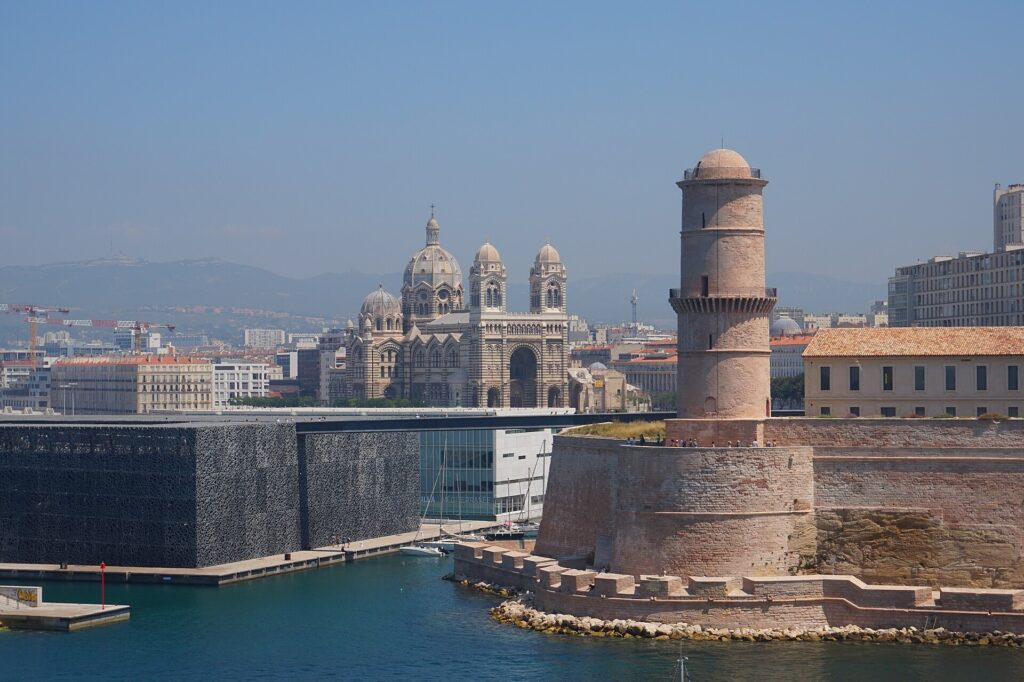
The Museum of European and Mediterranean Civilisations, better known as Mucem, opened in Marseille in 2013. It emerged from a larger cultural initiative tied to Marseille’s designation as European Capital of Culture that year. Its founding mission was to provide a dedicated space to explore the history, culture, and societies of the Mediterranean basin. This region, long marked by maritime trade, migration, and cultural exchange, has shaped much of European, North African, and Middle Eastern history. The museum sits on the water’s edge, near the historic Fort Saint-Jean, linking it physically and thematically with Marseille’s identity as a port city.
Mucem occupies a distinctive architectural footprint, designed by Rudy Ricciotti, whose work emphasized integrating the museum into its coastal urban landscape. The building is noted for its concrete latticework façade that allows light and sea breezes to permeate the structure—intended to reflect Mediterranean forms and climate. Mucem’s establishment represented a shift from traditional national or ethnographic museums toward a more transnational, cross-cultural focus. It attempts to engage with Mediterranean civilizations not as isolated entities but in their long-standing interactions and evolving global contexts. Positioned in Marseille, a city historically shaped as a Mediterranean crossroads, the museum anchors this perspective in a living urban environment shaped by migration and cultural negotiation.
What You See on Arrival
Approaching Mucem, visitors first encounter a striking contrast between the venue’s modern architecture and the older military fortifications nearby. The museum’s main building extends onto a pier that juts into the sea, emphasizing both physical and symbolic openness toward the Mediterranean basin. The intricate concrete web façade immediately signals a departure from traditional glass or stone museum exteriors, setting an expectation for contemporary design and unconventional presentation.
The adjacency and connection to Fort Saint-Jean allow visitors to see two eras of Mediterranean engagement: the military and colonial past juxtaposed with the cultural and social focus inside the museum. This unique setup provides an immediate visual introduction to one of the museum’s ongoing themes—how cultures meet, merge, clash, and coexist across time and geography. The space outside also doubles as an urban promenade, inviting casual visitors and locals alike, which hints at Mucem’s role as both cultural institution and public gathering place.
Inside, the museum’s layout guides visitors through a combination of permanent galleries and flexible spaces meant for reassessing Mediterranean identities. The collection is anchored in history but seeks to be relevant to contemporary discussions about migration, trade, religion, and daily life. Visitors should expect a fluid spatial experience with a balance of architectural openness, controlled climate conditions for preservation, and carefully curated displays.
Highlights and Key Exhibitions
Mucem’s strength lies in its thematic approach to Mediterranean civilizations over millennia, covering archeology, anthropology, arts, and social history together. Its permanent collection includes artifacts ranging from prehistoric tools to Islamic decorative arts and contemporary visual culture. One central intent is to break down traditional separations between Europe, Africa, and the Middle East by situating objects within their ongoing cultural networks.
A foundational element in the displays involves exploring the Mediterranean as a crossroads of commerce and cultural transmission. Visitors might expect exhibitions addressing ancient trade routes, the spread of religions, and the mixing of artistic traditions across coastal cities. For example, artifacts relating to Phoenician seafaring, Greek colonization, Roman imperial legacies, and Ottoman influence stretch the chronological narrative from antiquity into the early modern period.
Ethnographic materials from Mediterranean societies illustrate daily life, social structures, and rituals. Traditional textiles, ceramics, and tools stand alongside audiovisual recordings and contemporary artworks that trace Mediterranean society into the present. This multiperspective approach challenges visitors to think about tradition not as static but as continuously remade.
The museum also attends to major historical processes such as colonization, migration, and identity formation, acknowledging the Mediterranean as a contested space. The collections do not shy away from difficult themes, including the legacy of slavery and the ongoing experiences of displacement. However, this treatment is generally measured and integrated rather than confrontational.
Temporary exhibitions have highlighted contemporary Mediterranean creativity and cultural dialogue, further completing the picture of a diverse and evolving region. Though not constant, these exhibitions are important supplements to the permanent galleries that focus predominantly on historical material.
Visitor Experience
Visitors likely find Mucem suited for those interested in cultural history with a strong regional focus but broad thematic ambitions. The museum’s intellectual approach leans towards a narrative of connectivity rather than isolated national or ethnic histories, which can enrich those with prior knowledge but also challenge casual museumgoers unfamiliar with Mediterranean complexity. Content often assumes some awareness of the interplay between Mediterranean peoples.
The architectural design influences visitor flow significantly, with open galleries and terraces offering views across the sea and the city. This can create a welcomed sense of spaciousness but may also make a visit feel less tightly curated than more traditional museums with dense displays. The design encourages attendees to linger and reflect but can sometimes scatter attention among multiple viewpoints.
Interpretive materials generally aim for clarity but can be detailed. Labels and panels deploy scholarly language balanced with accessibility, though some sections might benefit from more extended explanations of cultural references or historical contexts. Multimedia installations enhance understanding without overwhelming the narrative.
Mucem’s location and concept attract diverse audiences, from local residents to international tourists and academic visitors. At peak seasons, visitor flow can be heavy in larger galleries or popular external spaces, but the museum’s layout allows some relief into less crowded areas. Overall, the experience balances education with contemplation, physical and intellectual openness with moments of intimacy.
Tickets, Access, and Planning
As with any major public institution, information on practical matters like admission, opening hours, and visitor services must be verified through the museum’s official resources before planning a visit. Mucem’s waterside location and connection with historic Fort Saint-Jean create a single complex that requires some walking between points, which may be a consideration for mobility-impaired visitors.
Given the museum’s dual architectural and urban setting, trips at times of limited daylight or inclement weather might impact the visit experience. Many visitors may appreciate combining a museum visit with a broader exploration of Marseille’s port district or nearby cultural sites. However, those with tight schedules should be aware that particularly in busy periods, queues and crowding can affect pacing.
Beyond the core exhibitions, the museum hosts lectures, workshops, and other cultural events that contribute to its mission. Availability and schedules for these should be checked separately for up-to-date information.
Final Verdict
Mucem offers a thoughtful and ambitious attempt to present Mediterranean civilizations through a lens of interconnectedness and ongoing cultural dialogue. Its thematic focus and blend of historical and contemporary collections make it a significant institution for understanding one of the world’s most complex regions. The museum’s architecture and site establish a distinctive sense of place and invite reflection on the interplay between local identity and broader Mediterranean currents.
The museum will particularly appeal to visitors with an interest in history, anthropology, and cultural studies who welcome presentations that resist simplistic narratives. Highly contextualized exhibits might be less immediately accessible to casual or first-time visitors without some background knowledge. The design prioritizes open, contemplative spaces that do not rush audiences but also demand active engagement.
Practical considerations about timing, weather, and mobility should be part of advance planning. Visitors looking for a strictly chronological or national history museum may find the approach unconventional. Still, those seeking a nuanced and multilayered exploration of Mediterranean life—from antiquity to the present—will find Mucem a rich resource. It stakes a serious claim as a cultural institution rooted in Marseille’s port identity while engaging a shared Mediterranean heritage that stretches beyond borders.