NASCAR Hall of Fame Review
Historical Context
The NASCAR Hall of Fame, located in Charlotte, North Carolina, is dedicated to preserving the history and celebrating the personalities associated with the National Association for Stock Car Auto Racing (NASCAR). Established in 2010, the institution serves as both a museum and a shrine to a sport deeply tied to the American South, particularly its automotive and racing culture. NASCAR itself originated in the late 1940s, growing out of regional racing traditions and a post-World War II car culture that prized speed and mechanical innovation. The Hall of Fame was conceived not only as a place to honor the sport’s most influential drivers, team owners, crew chiefs, and other contributors but also as a resource for education and public engagement with stock car racing’s heritage.
Charlotte's status as a central hub for NASCAR teams and industry made it a natural location for the Hall. The city hosts many prominent NASCAR team headquarters and is close to the Charlotte Motor Speedway, one of the key venues on the racing calendar. The Hall of Fame reflects this regional significance while addressing a national audience of motorsport enthusiasts and cultural historians. Its foundation responded to a demand both to document the sport’s evolution and to provide a physical space that connects fans and newcomers alike with the personalities, technology, and narratives that have shaped stock car racing over the past eight decades.
What You See on Arrival
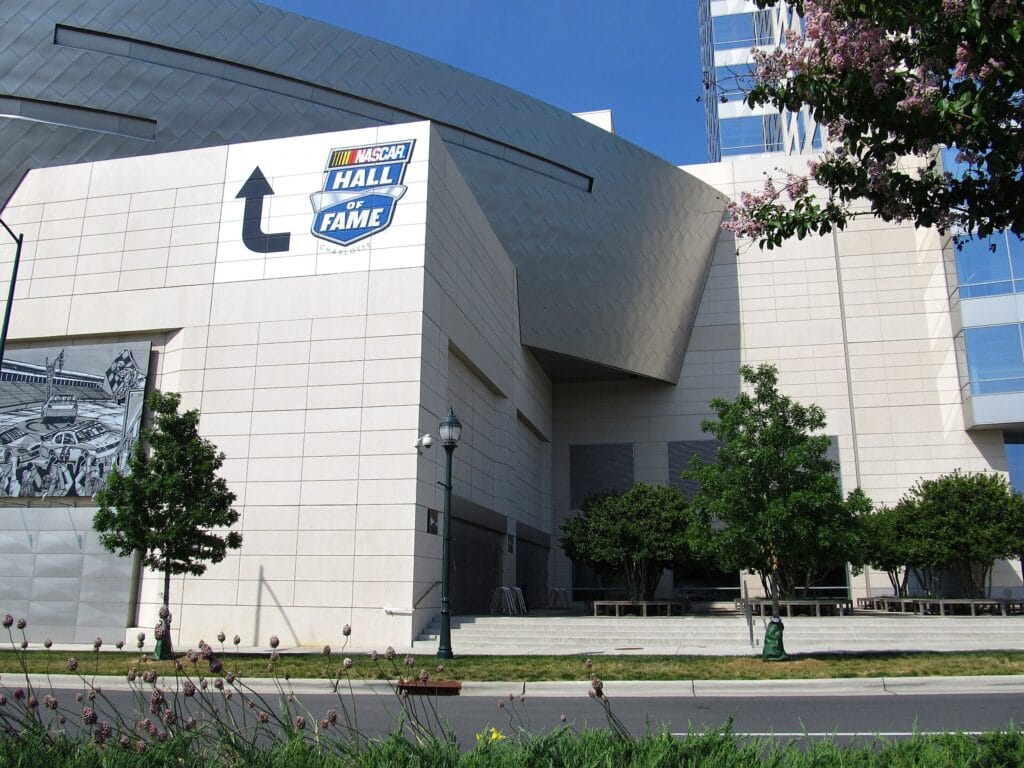
From the moment visitors approach the NASCAR Hall of Fame, its identity as a specialized museum dedicated to motorsports becomes evident. The building itself is designed with elements that call back to racing culture—architectural details suggestive of speed and motion, combined with large areas of glass and steel. The exterior presents a modern, streamlined appearance that speaks to the technological aspects of stock car racing while signaling an accessible, public institution.
Inside, the Hall of Fame creates a direct dialogue with visitors through initial galleries focused on the sport’s origins and key figures. The entry area offers an orientation into NASCAR’s distinct place within American sports, framed by images, trophies, and introductory exhibits. This framing makes clear that the experience will revolve around personalities and technological development; it sets expectations for a museum that balances storytelling about athletes with thematic displays of cars, gear, and memorabilia.
Visitors first encounter a mix of chronological and thematic presentations. The museum clearly defines itself as a place to honor those inducted into the NASCAR Hall of Fame, but it also aims to provide a broader context by linking changes in racing with cultural and mechanical shifts over time. The arrival experience thus anchors visitors in what NASCAR means historically and culturally before proceeding into more detailed and immersive exhibits.
Highlights and Key Exhibitions
The primary strength of the NASCAR Hall of Fame lies in its comprehensive treatment of the sport’s key figures and milestones, offering a detailed narrative that traces NASCAR’s roots through to the present day. Inductees—drivers, crew chiefs, owners—are spotlighted through personal artifacts, biographical panels, and interactive displays, providing a human dimension to the history. This focus on individuals allows the museum to offer compelling stories that extend beyond mere statistics, illuminating the risks, rivalries, and triumphs that give NASCAR its emotional and cultural appeal.
A highlight for many visitors is the collection of race cars spanning various eras. The museum features several vehicles that are not only historically important but visually striking, allowing visitors to appreciate both the aesthetic design and mechanical evolution of stock cars. These exhibits display how innovations in safety, speed, and technology have changed over time. There is also attention to the craftsmanship involved in the sport, including exhibits on pit crew work and car customization. This aspect enhances understanding of NASCAR as a complex, team-oriented enterprise rather than just individual driver heroics.
In addition to personal and mechanical histories, the museum provides exhibits centered on NASCAR’s wider cultural impact, especially in the American South. Through photographs, video footage, and media retrospectives, visitors gain insight into how NASCAR developed a passionate fan base and evolved in response to societal changes. While the museum’s narrative is largely celebratory, it also touches on challenges and controversies within the sport, giving a balanced picture that avoids simplistic hagiography. There is a clear effort to present NASCAR as both enduringly popular and subject to ongoing transformation.
The Hall of Fame section itself is a focal point, with inductee portraits, plaques, and awards positioned to honor excellence and legacy. This section is designed for visitors interested in the competitive history and the individuals who have shaped the sport at the highest level. The museum’s cataloging of inductees, from pioneers to modern champions, forms a historical timeline that ties into broader exhibits on NASCAR’s growth.
Visitor Experience
The visitor experience at the NASCAR Hall of Fame is structured to accommodate a wide range of interests and levels of familiarity with stock car racing. The layout balances chronological and thematic exhibitions, allowing visitors to follow the narrative of NASCAR’s history or engage with specific topics such as automotive technology or fan culture. For newcomers, the clear introductory galleries offer enough context to appreciate subsequent exhibits, while seasoned fans can delve into detailed displays rich in statistics, memorabilia, and oral histories.
Interpretation is largely straightforward and accessible. Text panels are generally concise and supported by multimedia elements including video screens, interactive touchpoints, and soundtracks that enrich the storytelling. The museum avoids overly technical language, which helps maintain engagement for a general audience but also ensures that information remains precise and fact-based. The integration of multimedia helps break up the text and adds a dynamic element that suits a sport defined by action and spectacle.
One notable strength is how the museum manages crowd flow and visitor pacing. The spatial design considers lines of sight to major exhibits and offers rest opportunities, which is important given the diversity of the audience; there are families, older visitors, and racing enthusiasts all visiting simultaneously. Separate spaces allow visitors to linger at their own pace without feeling rushed or overwhelmed.
At the same time, the museum’s highly specialized subject matter might limit its broader appeal. Visitors with little or no interest in motorsports may find the focus too narrow or the detailed coverage of race strategy and car mechanics less engaging. There is also relatively little interactive engagement for younger children beyond visual appeal, which suggests the museum targets a more mature audience or fans already somewhat familiar with NASCAR.
Tickets, Access, and Planning
Practical details around tickets, access, and opening schedules should be confirmed in advance at the official website. The museum is situated in downtown Charlotte, a location that is generally accessible by public transit and road, but as with many urban cultural institutions, visitors may want to plan for parking and transit options depending on time and mode of travel.
Admission policies, including ticket prices, discounts, and any group arrangements, are subject to change, making it advisable to consult official sources before planning a visit. Similarly, while the museum likely offers some form of interpretive materials or tours, their availability and format may fluctuate, so prior inquiry is sensible. Accessibility provisions for visitors with disabilities are noteworthy for any contemporary museum, and the NASCAR Hall of Fame should be checked for specific accommodations to ensure a smooth visit.
The layout and design aim to accommodate a steady visitor flow without excessive crowding, but peak times—particularly around major NASCAR events in Charlotte or on weekends—may affect the experience. Planning visits outside major sporting weekends could result in a quieter, more focused engagement with the exhibits.
Final Verdict
The NASCAR Hall of Fame in Charlotte performs a valuable role in documenting a uniquely American sporting culture with deep regional roots and national resonance. It provides a detailed, well-organized narrative of stock car racing’s history, its major figures, and technological development. The museum is particularly well-suited to visitors who have an existing interest in motorsports or who wish to understand NASCAR beyond surface-level spectacle.
Strengths include the clear thematic organization, a substantial collection of race cars and memorabilia, and an interpretive approach that balances story-telling with factual content. The emphasis on inductees and their personal stories humanizes the sport, while exhibits on automotive technology and culture add layers to the understanding of NASCAR’s complexity.
The museum’s specialist nature, however, means that those without some interest in NASCAR or car racing may find the subject matter less engaging. Interactive elements are present but generally oriented toward enthusiasts and older visitors rather than families with young children. Visitors are advised to check the official website for current visitor information, including tickets and hours, to optimize their experience.
Overall, the NASCAR Hall of Fame is a focused, well-curated institution that achieves its goal of honoring the sport’s past and connecting it to contemporary audiences. It stands as an important cultural archive of a sport that, while occasionally dismissed as niche, is a significant part of American popular culture and automotive history. Visitors interested in racing or American sporting traditions will find much to appreciate here, while others might reserve their visit for when curiosity about NASCAR and its legacy stirs.