Bardo National Museum Review
Intro The Bardo National Museum in Tunis is one of the essential museum visits in North Africa because it offers a concentrated account of the region’s.
Intro The Bardo National Museum in Tunis is one of the essential museum visits in North Africa because it offers a concentrated account of the region’s.
Best forMasterpieces, architecture, cultural history
Review focusCollection highlights, building, visitor flow
Intro
The Bardo National Museum in Tunis is one of the essential museum visits in North Africa because it offers a concentrated account of the region’s ancient history through original material of exceptional quality. Most famous for its Roman mosaics, the museum could easily have relied on that reputation alone. Instead, its real strength lies in the way it turns Tunisia’s archaeological richness into a broader historical narrative. Visitors come for the mosaics, but they leave with a clearer understanding of how Punic, Roman, Byzantine, and Islamic layers shaped the country’s past.
The institution’s importance also comes from context. Tunisia contains some of the most important archaeological sites in the Mediterranean world, and the Bardo functions as the museum that helps make sense of them. It is not merely a storehouse of finds. It is a key to reading the country’s wider historical landscape.
How the Site Works
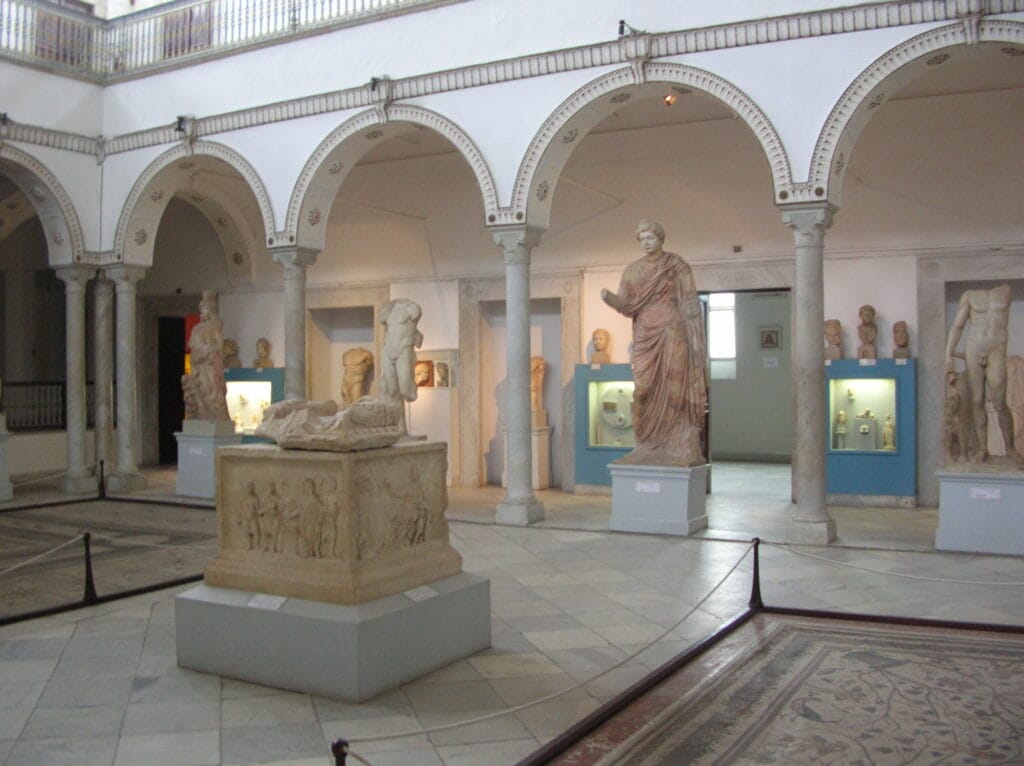
The museum is arranged through a sequence of galleries that combine monumental display with chronological and thematic interpretation. Visitors encounter mosaics in large halls, but also move through rooms that present sculpture, inscriptions, funerary material, ceramics, and objects from different periods. This arrangement works well because it prevents the museum from becoming a single-subject experience, even though mosaics remain the obvious focal point.
The route is readable without being overly rigid. Visitors can move with some freedom, yet the progression still makes clear that Tunisia’s past was shaped by multiple overlapping civilizations. That flexibility is useful in a museum where individual masterpieces can easily draw attention away from the wider story.
Exhibitions and Collection
The mosaics are extraordinary, both in scale and in quality. They are not simply decorative survivals. They preserve scenes of myth, agriculture, hunting, domestic life, and public culture that reveal how Roman North African elites represented themselves and their world. Seeing so many at full scale in one place changes the way visitors understand Roman art, because mosaic shifts from a supporting medium to a dominant one.
Just as important, the museum does not stop there. Sculpture, inscriptions, sarcophagi, lamps, ceramics, and Punic material widen the perspective and show that Tunisia’s historical significance cannot be reduced to Roman remains alone. This breadth gives the museum more staying power than institutions built around a single category of famous object. Visitors can trace change in religion, language, funerary practice, and urban life across multiple eras.
Architecture / Space
The former palace setting contributes greatly to the museum’s atmosphere. It gives the institution a sense of official and historical weight that suits a national archaeological collection. The galleries are varied in size, allowing both monumental mosaic display and more concentrated viewing of smaller objects. This variation helps the visit maintain rhythm rather than becoming a succession of equally scaled rooms.
The architecture also matters because it frames the museum as part of Tunisia’s civic and political history, not only its archaeological one. The building is more than a container. It adds to the sense that this is a central institution of public heritage.
Visitor Experience
The visitor experience is highly rewarding, though it depends on pacing. The museum can impress immediately through the scale of its mosaics, but its deeper value emerges through slower looking and comparison. Visitors who rush through will remember the major images. Visitors who take more time will come away with a much stronger understanding of how different layers of Tunisian history connect.
The museum works well for general visitors because its visual highlights are so strong, but it is especially satisfying for anyone interested in archaeology, Roman Africa, or the wider Mediterranean. There is enough material here to support both a first-time overview and more specialized attention.
Historical Context
Tunisia was a central zone of the ancient Mediterranean, shaped by Carthaginian power, Roman conquest, Christian and Byzantine continuities, and later Islamic transformation. The Bardo National Museum makes this layered history visible through objects rather than abstract summary. It shows that North Africa was not peripheral to the Roman world, but one of its important and productive regions.
This historical framing is part of what makes the museum so valuable. It corrects the tendency to see Mediterranean archaeology mainly through Italy and Greece by showing the wealth and sophistication of Roman Africa in its own right.
Practical Information
The museum is located in Tunis and can usually be reached without difficulty from central parts of the city. Most visitors will want around two hours, though those with a stronger interest in Roman art may want longer. Because the museum serves as context for many archaeological destinations in Tunisia, it is especially useful early in an itinerary. Practical details should be checked before arrival.
Final Verdict
The Bardo National Museum is one of the most important archaeological museums in Africa and one of the most rewarding museum visits in Tunisia. Its mosaics are justifiably famous, but the institution’s lasting strength lies in its wider account of North African history. For visitors interested in archaeology, Roman art, and the historical complexity of the Maghreb, it is indispensable.
Plan your visit
Visit with enough time to go beyond the famous mosaic galleries and spend attention on sculpture, inscriptions, and smaller archaeological displays. The museum works best as a foundation for understanding Tunisia’s wider historical sites. A measured visit of around two hours is a good minimum for a first experience.
The museum is also valuable because it shifts attention toward Roman North Africa as a central part of Mediterranean history rather than a marginal extension of better-known sites elsewhere. That perspective stays with visitors long after the visit ends and gives the museum greater historical force than a collection of famous mosaics alone would provide.