Bardo National Museum
The Bardo National Museum in Tunis, Tunisia, is one of the most important archaeological museums in North Africa and one of the leading.

Best forMasterpieces, architecture, cultural history
Setting / nearbyAfrica
Overview
The Bardo National Museum is one of the most important museums in North Africa and one of Tunisia’s essential cultural institutions. For many visitors, it is the clearest place to understand how deeply layered Tunisian history really is. Rather than representing only one civilization or one dynastic period, the museum brings together material from Punic, Roman, early Christian, Islamic, and later periods, showing Tunisia as a crossroads shaped by many cultures over centuries. That breadth gives the museum unusual historical richness and makes it far more than a simple archaeological collection.
What makes the Bardo especially compelling is the quality of that historical layering. Tunisia is a place where ancient urban life, imperial power, religious change, trade, and regional identity all left strong material traces, and the museum turns those traces into a readable story. Visitors can see how the country’s past was shaped by contact across the Mediterranean as well as by local continuity. This broader frame is one of the museum’s greatest strengths. It allows Tunisia to appear not at the margin of classical history, but at one of its most important junctions.
The museum is also especially well known because of its Roman material, which has given it an international reputation far beyond Tunisia. Yet the Bardo is strongest when it is understood as more than a museum of Rome outside Rome. It is a museum of Tunisia’s full historical complexity. Roman works may be the most famous element, but they gain much more meaning when seen alongside the other cultures, periods, and identities that shaped the region.
For travelers in Tunis, this makes the Bardo one of the most rewarding museums in the country. It offers scale, historical depth, and some of the finest ancient material in the region, but it also provides a framework for understanding Tunisia itself. After a visit here, archaeological sites, old cities, and historic landscapes across the country tend to feel much more connected and much more legible.
Collection Highlights
The museum’s most celebrated strength is its collection of Roman mosaics. These are among the main reasons the Bardo has become internationally famous, and they remain one of the most memorable parts of a visit. Mosaics often survive with a visual clarity that makes ancient life feel unexpectedly close, and in the Bardo they do much more than decorate floors. They show mythology, domestic life, religious imagery, marine scenes, hunting, public identity, and the tastes of elite households. That variety gives the collection both visual force and historical depth.
What makes these mosaics especially compelling is their scale and preservation. In many archaeological museums, ancient fragments can feel distant because so much has been lost. Mosaics are different. They often retain composition, movement, and decorative impact in ways that still communicate immediately. At the Bardo, this allows visitors to feel something of the richness and ambition of Roman domestic interiors in North Africa. The mosaics are not simply beautiful objects. They are evidence of wealth, identity, belief, and cultural exchange.
The museum is also strong in sculpture, inscriptions, and archaeological material from earlier and later periods. This wider range is important because it prevents the visit from becoming too narrowly focused on one art form or one chapter of history. Punic material, early Christian evidence, and Islamic-era objects broaden the historical frame and remind visitors that Tunisia’s past cannot be reduced to Roman grandeur alone. A museum of this quality becomes most rewarding when it shows continuity as well as change.
Another strength lies in the smaller objects that reveal daily life and belief. Ceramics, funerary pieces, carved details, and decorative fragments may not draw the same instant attention as the great mosaics, but they often provide the texture that makes the larger history feel real. These quieter objects help turn the museum from a hall of masterpieces into a fuller portrait of a society and its long development.
Building and Setting
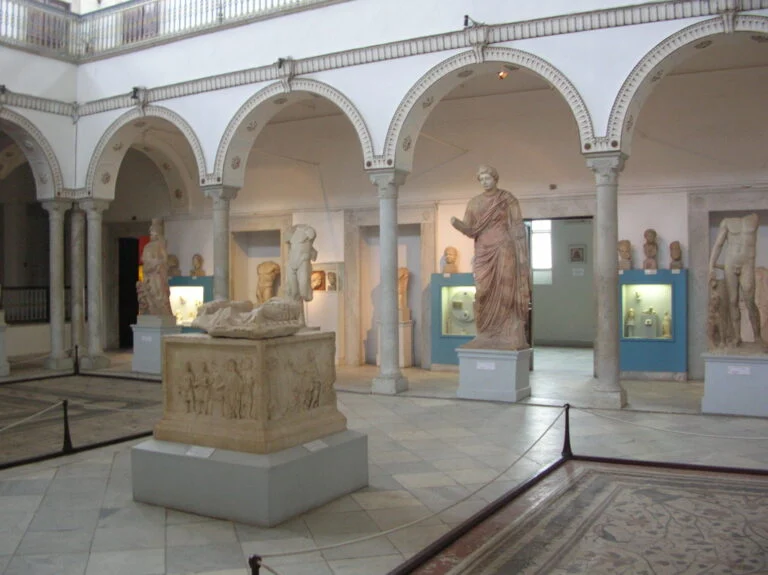
The setting of the Bardo contributes greatly to the experience. A museum of this significance needs a building that carries presence, and the Bardo has that. The institution is housed in a former palace complex, and this gives the visit a sense of historical layering even before the collection is considered. Ancient material displayed within a former seat of later political and courtly life creates a fittingly layered atmosphere for a museum devoted to Tunisia’s long past.
This architectural setting matters because it changes how the collection is perceived. Ancient mosaics, sculpture, and archaeological fragments do not appear in a purely neutral box. They are encountered in spaces that themselves carry historical and cultural weight. This makes the museum feel more rooted and more distinctive than a standard archaeological museum might feel. The building becomes part of the interpretation, even when it is not the explicit subject of the display.
Its location in Tunis also adds to the museum’s civic importance. As one of the country’s major museums, the Bardo does not feel like a remote specialist site. It feels central to the cultural life of Tunisia. For visitors, that creates a strong sense that this is not only a museum for tourists, but an institution that belongs to the broader historical self-understanding of the country.
The atmosphere inside is usually most rewarding when approached slowly. Museums rich in mosaics and archaeological material often reveal themselves through careful looking rather than one overwhelming visual climax. The Bardo has famous highlights, certainly, but its real power often lies in the accumulation of rooms, periods, and details that gradually build a fuller image of Tunisia’s past.
Practical Information
The Bardo National Museum is best visited with enough time to move beyond the most famous mosaics. It is easy to focus only on the major highlights, but the museum becomes much more rewarding when visitors allow themselves time to explore the broader archaeological and historical range of the collection. A slower visit helps reveal how Punic, Roman, Christian, and Islamic materials relate to one another and to the wider history of Tunisia.
It is especially rewarding for visitors interested in archaeology, Roman North Africa, Mediterranean history, and the historical complexity of Tunisia. At the same time, it is also accessible to general travelers because the mosaics are so visually immediate. Even those without specialist knowledge can respond strongly to the scale, color, and storytelling found in the collection.
Because museum arrangements can change, it is sensible to check current official visitor information before going. In practical terms, though, the Bardo is one of those museums that deserves real time in an itinerary rather than a brief stop. It works best as a major cultural visit, not as an afterthought.
Why Visit
The Bardo National Museum is worth visiting because it offers one of the richest archaeological museum experiences in North Africa. It combines extraordinary Roman mosaics with a much broader story about Tunisia as a place shaped by many civilizations. That gives the museum both immediate visual power and lasting historical depth.
It is also worth visiting because it helps correct narrow ideas of Mediterranean history. The museum makes clear that Tunisia was not peripheral to ancient and medieval history, but central to major political, artistic, and cultural developments. That perspective alone makes the visit valuable.
If you want a museum in Tunis that combines masterpieces, historical range, and a strong sense of place, the Bardo National Museum is one of the clearest choices. It is one of the country’s most important cultural institutions and one of the most rewarding museum visits in the region.