Stibbert Museum Review
Florence, Italy. The Stibbert Museum in Florence, Italy, originates from the life and passion of Frederick Stibbert, a 19th-century collector of Anglo-Italian descent. Born in 1838, Stibbert inherited a substantial fortune that he dedicated primarily to…
Florence, Italy. The Stibbert Museum in Florence, Italy, originates from the life and passion of Frederick Stibbert, a 19th-century collector of Anglo-Italian descent. Born in 1838, Stibbert inherited a substantial fortune that he dedicated primarily to…
Best forMuseum lovers, culture travelers, first-time visitors
Review focusCollections, visitor experience, and practical planning
Historical Context
The Stibbert Museum in Florence, Italy, originates from the life and passion of Frederick Stibbert, a 19th-century collector of Anglo-Italian descent. Born in 1838, Stibbert inherited a substantial fortune that he dedicated primarily to amassing a vast and diverse collection of arms, armor, and art objects. His collecting activity began early in life and continued until his death in 1906. Recognizing the value of his amassed treasures, he commissioned the design of a purpose-built villa in Florence’s hilly outskirts to house the collection and bequeathed it to the city as a public museum.
Situated in the Villa Montughi district, the museum reflects Stibbert’s eclectic and internationalist interests. It presents a distinctive alternative to Florence’s concentration on Renaissance art and sculpture, focusing instead on militaria and historical arms from Europe, Asia, and beyond. The museum’s establishment at the turn of the 20th century situates it within a broader context of Victorian and post-Renaissance European collecting practices, where private passion for chivalric and martial objects shaped new forms of public heritage. Yet the museum’s founding vision, to educate and inspire through tangible historical artifacts, remains evident today in its layout, displays, and interpretive style.
What You See on Arrival
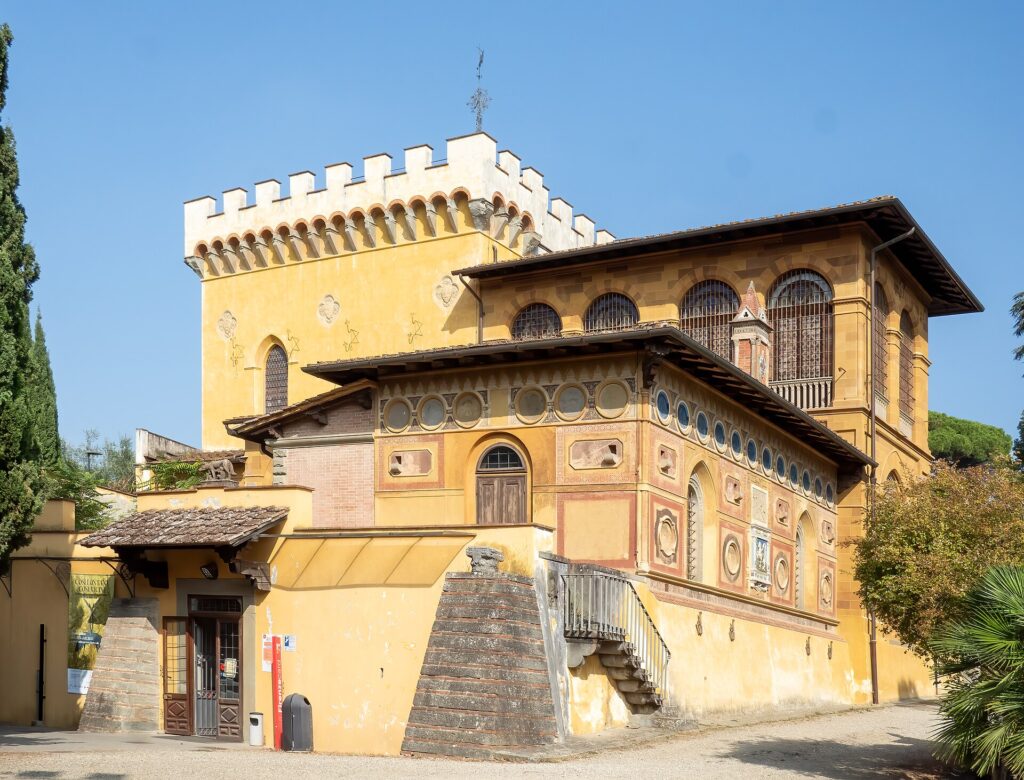
Approaching the Stibbert Museum, visitors encounter a stately villa set within expansive grounds that evoke the atmosphere of a private historic home rather than a conventional public museum. The building’s architecture combines Tuscan villa elements with ornate Victorian eclecticism, mirroring the collector’s diverse tastes. Outside, formal gardens and wooded areas surround the site, establishing a peaceful setting that contrasts with the intense historical narratives contained inside.
At the entrance, the visitor initially encounters the impression of a lavishly curated private collection rather than a traditional art gallery. The museum’s identity revolves around Stibbert’s personal vision, which influences the spatial arrangement and decorative choices throughout. Unlike the grand, linear presentation of some museums, the Stibbert Museum feels intimate and somewhat labyrinthine, with rooms and galleries flowing into each other to create an exploratory experience.
Signage and introductory information offer context about the collector and the museum’s unusual focus on arms and armor—dominated by objects that extend beyond Italian history to cover Asian and European martial cultures. This early framing helps visitors transition from the broader Florentine art scene to the museum’s specialized scope, preparing them to engage with objects that, while at times visually spectacular, require historical and cultural grounding to fully appreciate.
Highlights and Key Exhibitions
The core of the Stibbert Museum lies in its extensive arms and armor collection, which includes approximately 36,000 artifacts spanning five centuries and multiple continents. Notable are the European medieval and Renaissance armor sets, particularly those from Italy, Germany, and England. These pieces illustrate technological and stylistic developments in armor-making, reflecting variations from fully articulated battle armor to richly decorated parade wear.
One of the museum’s strongest aspects is its presentation of mounted knights in full armor, arranged in lifelike, dramatic poses that convey a sense of historical combat or ceremony. Visitors can observe nuanced features such as etching, gilding, and intricate metalwork that demonstrate the craftsmanship and social importance of armor in European aristocratic contexts. The museum’s comprehensive holdings also include arms such as swords, firearms, crossbows, and various edged weapons, illustrating the evolution of battlefield tools alongside armor.
Beyond European arms, the Stibbert Museum offers a significant selection of Asian armors, primarily from Japan, the Middle East, and India. The Japanese samurai armor collection stands out for its completeness and the opportunity to study materials like lacquer, silk, and iron combined in functional yet artistic ensembles. This section provides insight into the martial ethos of other cultures and broadens the museum’s narrative from European chivalry to a global panorama of fighting traditions.
Ancillary collections within the museum include paintings, sculptures, costumes, and decorative arts that complement the arms and armor displays. Among these, portraits of historical figures clad in armor and period furniture help recreate the social milieu surrounding martial practices. Occasionally, elaborately decorated weapons and armor pieces provide a window into ceremonial and symbolic uses of these items beyond the battlefield.
What the Stibbert Museum does not emphasize is broader historical storytelling or political context. Interpretive materials tend to focus on the objects themselves—their form, function, and provenance—rather than situating them within complex historical events or social movements. For visitors interested in military history as an evolving societal phenomenon, this may feel limiting, though it also invites direct engagement with the objects as individual cultural artifacts.
Visitor Experience
The museum’s layout and presentation style naturally shape the visitor experience. The intimate villa setting means that some galleries have lower ceilings and limited natural light, which can affect the visibility and appreciation of certain details. The arrangement of objects—especially the life-size armor displays—is often theatrical, sometimes grouped in crowded display cases or arranged to emphasize visual impact rather than chronological progression.
Pacing through the Stibbert Museum requires some flexibility. The dense concentration of objects, combined with detailed decorative elements, invites slow, attentive viewing for connoisseurs or those with specific interest in arms and armor. On the other hand, general visitors or those less familiar with martial artifacts may find the museum challenging to navigate without focused interpretive support.
The museum caters best to an audience with particular enthusiasm for craftsmanship, historical weaponry, and cross-cultural comparisons of martial traditions. It may be less immediately accessible to those seeking wide-ranging context or a broad narrative about Florence or European history. The texts accompanying exhibits can be concise and occasionally assume a baseline familiarity with technical terms related to armor and weaponry. Visitors without prior background might need to supplement their visit with external reading.
Interpretation within the museum emphasizes material culture and aesthetic detail, allowing objects to speak for themselves. This approach benefits from the museum’s rich holdings and the visual presence of the artifacts. However, the absence of extensive multimedia or interactive elements may make the visit feel static for audiences expecting modern museum technology.
Tickets, Access, and Planning
Exact information concerning ticket prices, opening hours, discounts, or tour availability at the Stibbert Museum should be confirmed through its official website before planning a visit. Given the museum’s location in a residential area of Florence and its origins as a villa, access may differ from more central city museums, and opening schedules can reflect this status.
Visitors should prepare for a museum experience that favors close engagement with objects rather than large exhibition spaces or thematic groupings. Those with mobility concerns may want to verify accessibility arrangements, as older buildings sometimes present challenges related to stairs or uneven floors. Similarly, the relatively secluded setting means public transit options may be less frequent compared to downtown Florence.
For travelers combining visits to major Florentine sites, the Stibbert Museum represents a thematic detour toward military and material culture. Planning visits around days and times of lower foot traffic could enhance the experience, enabling more relaxed viewing.
Final Verdict
The Stibbert Museum offers a focused and substantial collection of arms, armor, and related artifacts that stands apart from Florence’s dominant art historical offerings. Its strength lies in the breadth and depth of martial objects from Europe and Asia, presented in a domestic historic villa devoted to a single collector’s vision. This creates an unusually intimate environment for appreciating the artistry and craftsmanship of historical weaponry and armor.
However, the museum’s appeal is specialized. Visitors with an interest in martial history, decorative metalwork, or cross-cultural collections will find rich rewards here, while those seeking broad historical narratives or standard art museum experiences may find the presentation narrowly focused. The museum’s interpretation prioritizes the objects themselves over bigger contextual stories, which may require visitors to come prepared or supplement their visit with outside research.
Physically, the museum’s relatively compact and historic setting influences both display and accessibility, calling for cautious planning. It is wise to consult current official information before visiting to ensure up-to-date details on hours and services. The Stibbert Museum is a distinctive resource for understanding the material culture of arms and armor across centuries and continents and will serve best a visitor prepared to engage with its particular strengths and constraints.