State Hermitage Museum Review
State Hermitage Museum Imperial Scale Without Apology The State Hermitage Museum does not unfold gradually. It asserts itself immediately. Occupying the.
State Hermitage Museum Imperial Scale Without Apology The State Hermitage Museum does not unfold gradually. It asserts itself immediately. Occupying the.
Best forMasterpieces, architecture, cultural history
Review focusCollection highlights, building, visitor flow
Historical Context
The State Hermitage Museum in Saint Petersburg is one of the great imperial museums of Europe, but its significance lies in more than scale alone. Founded in the 18th century under Catherine the Great, the institution began as a royal collection shaped by Enlightenment ambition, diplomatic competition, and aristocratic taste. Like several major European museums, it grew from court collecting, but in the Hermitage that origin still remains unusually visible. The museum is inseparable from the Winter Palace and from the larger political history of the Russian Empire. This means a visit is never only about paintings, sculpture, and decorative arts. It is also about monarchy, ceremony, and the conversion of imperial space into public culture.
Over time, the collections expanded dramatically, drawing in European painting, classical antiquities, archaeological material, decorative arts, and objects from across Eurasia. The museum later survived revolution, war, ideological change, and the long transformation from dynastic palace to national institution. That layered history matters because it shapes the experience of the Hermitage today. Visitors do not encounter a neutral container for artworks. They encounter a former seat of power filled with collections that reflect centuries of political ambition, cultural aspiration, and historical upheaval. The result is one of the richest and most complex museum environments in the world.
What You See on Arrival
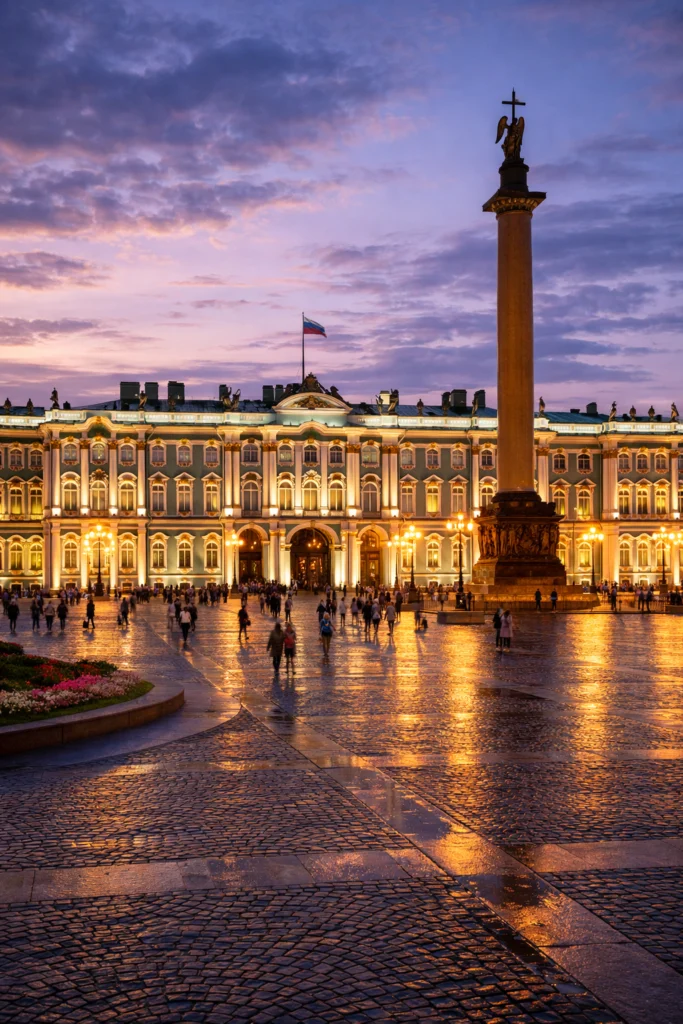
Arrival at the Hermitage is part of the experience. The exterior of the Winter Palace, with its long baroque façade, decorative white columns, green walls, and monumental scale, immediately signals that this is not a museum built as a modern exhibition hall. It is a palace first, and that identity never disappears. Standing before it, most visitors feel the weight of imperial display before they see a single object inside. The building does not promise intimacy. It promises scale, ceremony, and a certain excess of historical space.
Inside, the first impression is usually one of visual overload. Staircases, gilded details, polished floors, chandeliers, painted ceilings, and long ceremonial rooms quickly establish that the architecture itself will compete with the collection for attention. This can be exhilarating or slightly disorienting depending on the visitor. Unlike museums where the building recedes behind the objects, the Hermitage constantly reminds you that art is being shown inside rooms designed to impress. That is part of its power, but also part of the challenge.
The layout can feel vast from the beginning. Corridors open into halls, halls lead into suites of rooms, and the sense of direction is not always immediate. Yet this complexity also creates one of the museum’s great pleasures: the feeling of discovery. The mood on arrival tends to combine excitement, historical awe, and the practical awareness that no single visit can fully contain the whole museum. This is an institution that asks visitors to choose a path through abundance.
Highlights and Key Exhibitions
The Hermitage is so large that “highlights” must be approached selectively. Still, some areas define the visit and explain why the museum holds such an important place in world culture.
The Italian and broader European painting collections are among the major draws. Works by artists such as Leonardo, Raphael, Titian, Rembrandt, Rubens, and others give the museum international stature on the level of the great western European institutions. What is especially striking is not just the fame of individual names, but the fact that these paintings are embedded in palace rooms that carry their own visual authority. The encounter is never purely formal. You are seeing major works in a setting shaped by imperial collecting, and that changes the tone of the experience.
Rembrandt is particularly significant in the Hermitage. The museum holds an impressive group of works that reveal the emotional and technical depth of his painting. These rooms often become anchors for visitors trying to find concentration within the broader scale of the museum. They provide moments where the palace setting recedes slightly and the intensity of the paintings comes forward.
The decorative arts and ceremonial interiors are another major highlight. For some visitors, these become even more memorable than individual canvases. State rooms, elaborate furniture, porcelain, gilt decoration, and courtly display objects reveal the Hermitage not only as an art museum, but as a preserved environment of imperial representation. This is where the museum becomes especially distinctive. Many institutions hold masterpieces; fewer allow visitors to understand how art, luxury, power, and space once functioned together.
The classical antiquities and archaeological collections add another dimension. Greek and Roman sculpture, ancient objects, and artifacts from different historical cultures broaden the experience beyond European painting. These sections remind visitors that the Hermitage is encyclopedic in ambition. It is not organized around one national school or one artistic era, but around the larger imperial desire to gather the world into one institution.
Temporary exhibitions and special installations can also shape the visit, but even without them the museum is dense enough to feel almost inexhaustible. One of the strongest qualities of the Hermitage is that different visitors will come away with different defining memories: a Rembrandt, a gilded hall, a staircase, a Roman sculpture, a sequence of palace rooms, or a quiet corner unexpectedly found in the middle of one of the world’s busiest museums.
Visitor Experience
The visitor experience at the State Hermitage Museum is shaped by two things above all: scale and atmosphere. This is a museum that can overwhelm if approached without a plan, but it can also reward visitors more deeply than many smaller and easier institutions because of the richness built into every level of the visit.
Pacing matters enormously. Trying to “see the Hermitage” as a whole in a single visit is usually a mistake. The museum works better when approached through priorities: a focus on painting, on palace interiors, on specific historical periods, or on a selected route through the most important rooms. Visitors who accept that they will only see part of it often come away more satisfied than those who attempt full coverage and end up exhausted.
Signage and orientation are helpful, but the building’s original palace character means that navigation can still feel more complex than in a purpose-built modern museum. This is not always a weakness. In fact, some of the pleasure comes from the museum’s layered and slightly labyrinthine quality. Still, first-time visitors will benefit from maps, route planning, or a conscious decision to concentrate on particular sections rather than moving aimlessly.
Crowds can be substantial, especially in the most famous rooms and during peak travel periods. The museum’s reputation ensures a steady flow of visitors, and some spaces can feel busy enough to reduce the sense of contemplation. Yet the Hermitage is large enough that quieter stretches can still be found. One of the museum’s understated strengths is that it repeatedly shifts between crowd-heavy and unexpectedly calm zones, allowing attentive visitors to reclaim concentration after busier sequences.
Atmospherically, the Hermitage is extraordinary. It does not feel like a neutral museum of white walls and carefully separated objects. It feels historical, theatrical, ceremonial, and sometimes almost excessive. For some visitors this makes it unforgettable. For others it may occasionally distract from the collection. But even that tension is part of what makes the museum distinctive. You are not simply consuming art. You are moving through an old system of display, prestige, and power that still shapes how the art is seen.
Tickets, Access, and Planning
Planning is essential for the Hermitage. Because the museum is so large, visitors benefit from deciding in advance what kind of visit they want. A first visit focused on major European painting and the most important palace rooms is often a sensible approach. Visitors with a stronger interest in decorative arts or archaeology may want an entirely different route, and the museum supports both.
Allowing enough time is crucial. Even a selective visit generally requires several hours, and many visitors will feel that half a day is the minimum for a meaningful first experience. A full day is not excessive, especially for those who want to combine famous highlights with slower looking. Repeat visits are ideal where possible, because the museum reveals itself more clearly over time than in a single rushed pass.
Practical planning also matters because the scale of the building makes physical energy part of the visit. Comfortable shoes, occasional pauses, and realistic expectations improve the experience considerably. The Hermitage is not difficult in an intellectual sense, but it is demanding in terms of movement, decision-making, and visual concentration.
Access arrangements, ticketing procedures, and opening schedules should always be checked before visiting, especially for such a major institution. The museum’s popularity means that timing can influence the quality of the visit. Earlier hours or less crowded periods often allow a better experience of the main galleries and ceremonial spaces.
Final Verdict
The State Hermitage Museum is one of the great museum experiences of the world because it combines two things at the highest level: a major international art collection and one of the most historically charged architectural settings in Europe. Its significance does not rest only on famous names, though it has many. It rests on the way art, palace life, imperial history, and cultural ambition remain visible together in the same institution.
Who should visit? Anyone seriously interested in European painting, imperial history, decorative arts, or large-scale museum culture will find it essential. It is especially rewarding for visitors who enjoy museums as environments, not just as collections of isolated masterpieces. Those looking for a quick or simple art visit may find it demanding, but even they are likely to remember it.
Why visit? Because the Hermitage offers something few museums can match: the chance to experience world-class collections inside rooms that still carry the visual and political weight of their original purpose. It is vast, sometimes overwhelming, occasionally difficult to navigate, but consistently rich. For many visitors, that combination is precisely what makes it unforgettable.