National Taiwan Science Education Center Review
Science Museums · Taipei, Taiwan. The National Taiwan Science Education Center in Taipei adopts a purpose-driven mission: to promote public understanding of science and technology primarily through hands-on learning and interactive exhibits. Unlike traditional science museums or…
Science Museums · Taipei, Taiwan. The National Taiwan Science Education Center in Taipei adopts a purpose-driven mission: to promote public understanding of science and technology primarily through hands-on learning and interactive exhibits. Unlike traditional science museums or…
Best forScience fans, families, hands-on learning
Review focusScience exhibits, innovation, and visitor planning
A Museum with a Clear Point of View
The National Taiwan Science Education Center in Taipei adopts a purpose-driven mission: to promote public understanding of science and technology primarily through hands-on learning and interactive exhibits. Unlike traditional science museums oriented toward encyclopedic display or historical narrative, this center concentrates on experiential science education targeted mainly at younger audiences and school groups. Its identity is marked by a focus on basic physics, natural sciences, and emerging technologies as tools for informal learning rather than comprehensive scientific scholarship.
This clarity of vision limits the center’s appeal for those seeking in-depth scientific history or specialized collections, but it sharpens its value as an informal educational resource. The center functions less as a repository of artifacts or scientific archives and more as a laboratory for experimentation and discovery. Its central purpose is to spark curiosity and build foundational scientific ideas through direct involvement rather than contemplation. For that reason, it occupies a distinctive niche within Taiwan’s museum landscape.
What Defines the Collection
The collection consists primarily of interactive exhibits, demonstrations, and scientific models that illustrate fundamental principles of science. These include displays on optics, motion, electricity, astronomy, and biology. Unlike museums whose collections prioritize rare or historic objects, this center trades in replicas, models, and multimedia installations designed to explain abstract concepts in a physical and tangible way. There are real meteorites and specimens as tactile anchors, but the majority of “objects” are more pedagogical tools than artifacts with provenance.
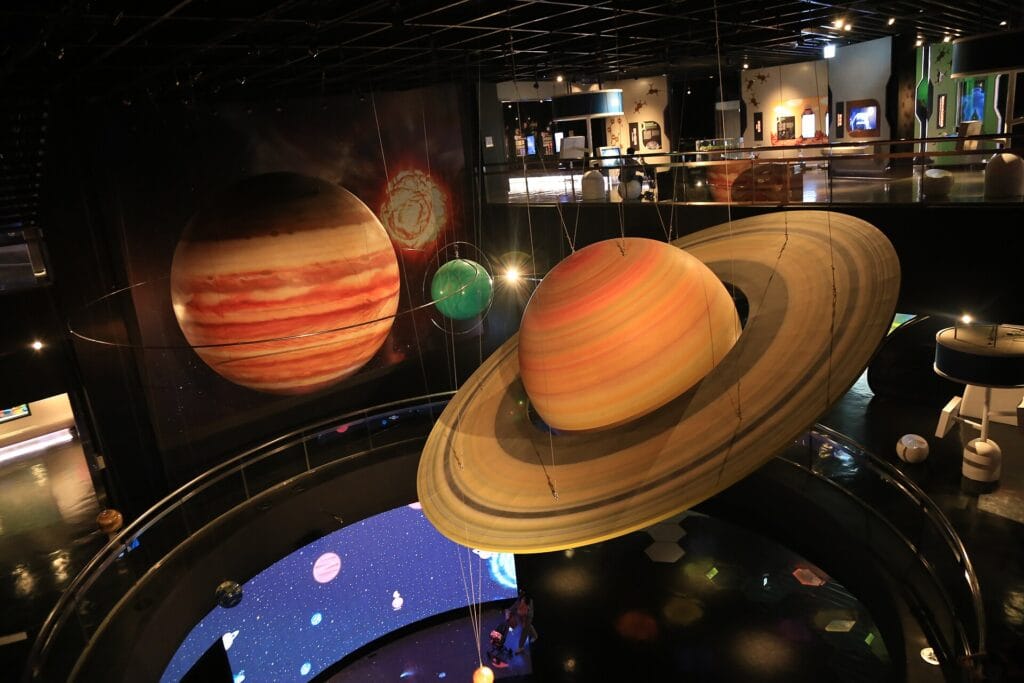
Its holdings emphasize accessibility over rarity. For example, the optics section features hands-on lenses and mirrors to manipulate light and reflection, rather than antique scientific instruments. The astronomy exhibits offer scale models of the solar system and interactive projected star maps. Biological sciences illustrate anatomy and physiology through models and transparent displays rather than collections of preserved specimens. This approach foregrounds function and understanding, but leaves little for those interested in the history of science as a discipline or scientific instruments as historic objects.
In sum, the center operates with a collection defined by utility for learning rather than a traditional curatorial focus on material culture or scientific heritage. This reinforces its educational mission, but constrains its appeal for visitors desiring traditional museum objects or chronological narratives of scientific development.
Standout Galleries and Themes
Certain galleries stand apart for their effectiveness and thematic coherence. The astronomy gallery provides a clear sense of scale and structure, supported by immersive projections and models that map the solar system and constellations. This section makes good use of technology to translate complex ideas into concrete, visual formats accessible to a wide audience.
The physics gallery emphasizes interactive exhibits that demonstrate principles such as motion, force, and electricity. Kinetic installations, pulleys, and circuits allow visitors to experiment with cause and effect. The design is straightforward but effective, reinforcing scientific method through immediate feedback and trial.
Another theme is environmental science, where exhibits on weather patterns, ecology, and energy consumption encourage reflection on human interactions with nature. These displays underline scientific facts but also integrate sustainability concerns, linking science education with contemporary global challenges. The focus on Taiwan’s natural environment adds a local contextual layer uncommon in more generic science museums.
While the anatomy and biology sections provide useful visualizations of human and animal physiology, they do not reach the same depth of investigation as specialized natural history or medical museums. The models serve an introductory purpose rather than detailed scientific study.
Overall, the exhibitions articulate a curriculum of foundational science topics appropriate for school-age learners and families rather than advanced researchers or collectors.
Pacing, Interpretation, and Atmosphere
The center’s style encourages exploration at an informal pace, suited to group visits and repeat engagement. The interactivity demands participation, so visitors generally move from installation to installation with a focus on active learning rather than passive observation. This creates an atmosphere of experimentation rather than reverence, which will satisfy audiences open to tactile and visual interaction.
Interpretation relies heavily on clear, concise signage in Mandarin and English, often accompanied by graphic instructions and diagrams aimed at facilitating independent discovery. The explanatory texts avoid jargon and emphasize direct cause-effect relationships, making complex topics approachable. However, the intellectual depth rarely goes beyond the high school level.
The venue’s environment is designed for functionality over spectacle. Lighting and layout support hands-on work rather than display vitrines. Exhibition spaces are often organized around specific principles or processes rather than chronological or thematic storytelling, which suits laboratory-style learning but may challenge those expecting a narrative progression.
Because the science center prioritizes interactivity, narrative continuity may slip; visitors may find the transitions between topics somewhat abrupt. This can result in an experience that feels segmented and modular rather than cohesive in a museum sense. The atmosphere is educational and practical, not contemplative or immersive.
Strengths and Limitations
The strength of the National Taiwan Science Education Center lies in its clear educational focus and successful deployment of interactive exhibits that translate scientific concepts into hands-on activities. The science concepts covered are broad enough to provide a solid introduction to several disciplines, and the integration of localized environmental science adds distinction.
The center performs especially well as a space for group learning, particularly for school groups who benefit from concrete experimentation. It fills a gap between classroom science and everyday understanding, offering something closer to direct experience than lectures or textbooks.
However, it offers little for those interested in scientific history, the development of scientific ideas over time, or scientific instruments as cultural artifacts. The collections are not designed to impress scholars or collectors. Its use of replicas and models rather than original historic objects or specimens restricts its appeal to those seeking authenticity in museum objects.
The interpretation is accessible but limited in complexity. Visitors with prior scientific knowledge might find the content overly elementary and the experience insufficiently challenging or deep. The layout and flow emphasize activity over narrative, which some may find disjointed or even superficial.
In practical terms, it cannot be considered a comprehensive science museum in the sense of housing substantial archival collections or significant research holdings. Its remit is educational facilitation rather than knowledge conservation.
Before You Go
The official website should be consulted for up-to-date information on opening hours, admission fees, tour availability, and visitor services. Given its strong focus on school groups, booking or timing might vary according to educational schedules or special programming.
The center is located within Taipei, which makes it accessible by the city’s transport systems. However, facilities and crowding patterns are best understood closer to the visit date since such factors can fluctuate with school terms and public holidays typical for a science education venue.
Visitors interested in basic-but-practical science demonstrations, especially in physics and environmental studies, will find the center meets those needs well. Those searching for deeper exploration of scientific history or a museum experience resembling a gallery of prestigious objects should consider other institutions.
Final Assessment
The National Taiwan Science Education Center stands apart through its focused role as a hands-on learning hub dedicated to making science tangible and accessible to younger audiences and educators. It does so by concentrating on foundational science concepts presented through interactive models, demonstrations, and environmental themes tied closely to Taiwan’s context.
This focus means it is neither a comprehensive science museum nor a place for serious historians or collectors of scientific instruments and artifacts. Its strengths emerge most clearly as an educational resource emphasizing physical experimentation and visual clarity over object-based storytelling or scientific historiography.
The center is effective within its chosen remit but narrower than the general concept of a science museum might imply. Visitors should approach it as an educational laboratory designed to stimulate basic understanding and curiosity about science rather than as a museum for deep scientific scholarship or a traditional collection experience.