National Museum Prague Review
Czech History & Culture · Prague, Czech Republic A Monument to National Memory The National Museum Prague is one of those institutions where the.

Czech History & Culture · Prague, Czech Republic A Monument to National Memory The National Museum Prague is one of those institutions where the.
Best forMasterpieces, architecture, cultural history
Review focusCollection highlights, building, visitor flow
Czech History & Culture · Prague, Czech Republic
A Monument to National Memory
The National Museum Prague is one of those institutions where the building shapes the visit before the collection even begins. Rising above Wenceslas Square, it occupies one of the most visually dominant positions in the city, and that prominence suits its purpose. This is not a modest local museum tucked into a side street. It is a national statement in stone, intended to embody historical continuity, civic dignity, and cultural identity.
That sense of purpose remains one of the museum’s greatest strengths. The National Museum is not simply a place where objects are stored and displayed. It is a museum built to explain a nation to itself and to others. For visitors, that creates a more coherent experience than many large state institutions manage. Rather than feeling like a random accumulation of departments, the museum feels directed by a clear cultural mission.
Architecture & Spatial Presence
The museum building is one of Prague’s most recognizable landmarks. Its monumental neo-Renaissance design, broad stairway, sculptural façade, and commanding dome give it the authority expected of a major national institution. Standing in front of it, the museum already feels ceremonial. It marks the city skyline in a way that prepares visitors for a collection concerned not only with artefacts, but with public memory.
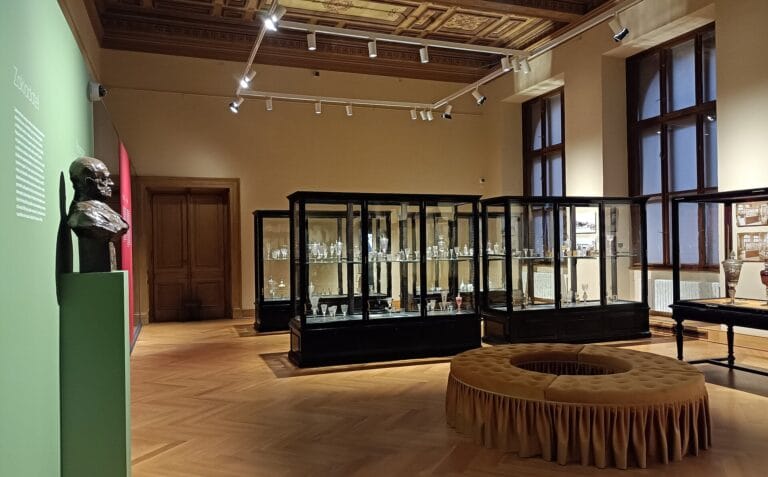
Inside, the museum’s grand interiors reinforce that impression. Staircases, vaulted halls, decorative surfaces, and formal symmetry create a visit defined by stateliness rather than informality. This is a building that asks the visitor to slow down and look upward as much as forward. The architectural rhythm matters because it shapes how the collection is received. Objects do not appear in neutral white-box spaces. They appear in rooms that actively announce historical significance.
The layout is broad enough to support different kinds of visitors. Some will move through the museum as an architectural experience first and a collection second. Others will focus more intensely on the displays. The building supports both approaches well.
The Collection: National Story with Broad Scope
The National Museum Prague is strongest when presenting the long arc of Czech history and culture. Archaeological, historical, and natural history displays combine to form a broader portrait of the lands and people that shaped the modern Czech Republic. This breadth gives the museum a different character from more narrowly specialized institutions. It works not by isolating a single period, but by showing how landscape, science, politics, and identity interconnect.
The historical collections are particularly effective because they make state and society feel grounded in material evidence. Objects linked to daily life, political development, scholarship, religion, and national culture create a layered view of the country rather than a single heroic narrative. This makes the museum rewarding even for visitors without detailed prior knowledge of Czech history.
Archaeological and prehistoric material deepen the experience further. These galleries remind visitors that national museums work best when they present not only modern identity, but the much longer human timeline behind it. The transition from ancient material into later historical development gives the museum narrative depth.
Natural history sections add another dimension. While some visitors may come primarily for national history, these galleries broaden the institution’s scope and reinforce its identity as a major central museum rather than a single-subject house. That variety can be especially valuable for travelers who want one substantial museum experience in Prague.
Visitor Experience & Rhythm
One of the museum’s best qualities is its sense of scale without complete overload. It is a major institution, but it remains more manageable than some enormous national museums elsewhere in Europe. Visitors can have a satisfying experience in a focused half-day visit, yet still leave with the sense that they have engaged with something substantial.
The atmosphere depends partly on visitor flow, but the museum generally retains a composed tone. The building’s grandeur naturally slows movement. Even when there are many people present, the large ceremonial spaces help preserve a sense of order. That makes the visit feel calmer than the museum’s central location might suggest.
For travelers in Prague, the museum also works well as a cultural anchor. Wenceslas Square and the surrounding city are full of energy, commerce, and public life. Entering the museum creates a shift in tempo. It turns the broader city visit into something more historically grounded. Afterward, Prague feels easier to read as a place shaped not only by picturesque beauty, but by layered political and cultural memory.
Atmosphere & Intellectual Tone
The National Museum Prague feels serious in the right way. It does not rely on gimmicks or spectacle to justify itself. Its authority comes from architecture, institutional confidence, and the breadth of its collections. The result is a museum that feels trustworthy and stable.
That seriousness does not make the museum inaccessible. Its role as a national institution actually helps first-time visitors, because the framework is clear. You understand quickly that the museum is presenting a long historical and cultural narrative. Even without specialist knowledge, that gives the visit direction.
For more experienced museumgoers, the pleasure lies in how the building and collection reinforce one another. The museum is not only about what is shown, but about how the nation has chosen to stage its historical self-image. That makes the institution interesting both as a collection and as a cultural document in its own right.
Who Will Appreciate It Most
The National Museum Prague is ideal for:
• Visitors interested in Czech history and cultural identity
• Travelers who appreciate monumental museum architecture
• First-time visitors to Prague seeking deeper historical context
• Visitors who enjoy broad national collections rather than narrow specialization
Those looking only for a small, highly focused museum may find it more expansive than necessary. But for travelers seeking a major central institution, it is one of Prague’s strongest choices.
Practical Considerations
A visit of two to three hours is enough for a solid overview, though architecture enthusiasts and visitors with stronger historical interest may want longer. Because of its location, the museum fits easily into a day exploring central Prague. It also works well in changing weather, making it a reliable cultural stop regardless of season.
Final Verdict
The National Museum Prague succeeds because it unites architecture, history, and national identity in a convincing way. It is not just a container for exhibitions. It is itself part of the national story the museum aims to tell.
Handled thoughtfully, the visit becomes more than a sequence of displays. It becomes an encounter with how a country chooses to represent its past, its culture, and its public memory.
It is a museum built on civic presence.