National Museum of Azerbaijan History Review
History Museums · Baku, Azerbaijan. The National Museum of Azerbaijan History in Baku occupies a key position in documenting and showcasing the country's long and complex past. What makes this museum stand out is its effort to trace Azerbaijan’s…
History Museums · Baku, Azerbaijan. The National Museum of Azerbaijan History in Baku occupies a key position in documenting and showcasing the country's long and complex past. What makes this museum stand out is its effort to trace Azerbaijan’s…
Best forHistory lovers, cultural travelers, local heritage
Review focusHistorical collections, local context, and visitor planning
Why This Museum Matters
The National Museum of Azerbaijan History in Baku occupies a key position in documenting and showcasing the country's long and complex past. What makes this museum stand out is its effort to trace Azerbaijan’s evolution from ancient to modern times within a single institution, emphasizing the continuity and transformation of diverse influences on the land and its people. It is more than a collection of artifacts; it is a detailed chronicle of a nation located at the crossroads of east and west, subjected to waves of empire, trade, and culture that have left tangible marks. In a country where history is often intertwined with questions of identity, ethnicity, and geopolitics, this museum presents a valuable resource for understanding the historical layers that shape modern Azerbaijan.
The museum’s significance also stems from its role in preserving artifacts that might otherwise be scattered or relatively inaccessible to the public and researchers alike, encompassing objects sourced from excavations, donations, and historical holdings. Its narrative is necessarily shaped by Azerbaijan’s unique position on the Caspian Sea, stretching from prehistoric settlements to the Soviet era and independence. While this is a national history museum and thus nationalizing in scope, the result is an institution that attempts, with varying degrees of depth and success, to integrate archaeology, ethnography, political history, and art history into a coherent story.
The Collection in Focus
This museum’s holdings range widely, covering prehistoric tools, archaeological finds from Bronze and Iron Age sites, intricately decorated medieval ceramics, Islamic manuscripts, and ethnographic items like traditional clothing and weaponry. One of the collection’s defining strengths lies in the artifacts from Azerbaijan’s ancient and medieval periods, including objects found at Gobustan, known for its prehistoric rock art, and items recovered from archaeological sites spanning the Caucasus region. The inclusion of numismatics—coins from different eras—and weaponry lends a tangible sense of the changing power dynamics and economic history that underpin the nation’s past.
The museum also preserves objects from the Safavid, Qajar, and Russian imperial periods, helping to situate Azerbaijan within broader imperial histories that influenced its cultural and political development. Another focus is the Soviet era, not just in terms of political change but also through art and social history, which documents transformation in daily life and governance until independence in 1991. This chronological breadth is ambitious and can occasionally create a challenge in narrative cohesion, as the sheer range can dilute focus in certain galleries.
Few institutions provide such a concentrated view of Azerbaijan’s history, though the collection is inherently shaped by what survives and what has been prioritized for display. The presence of large historical documents, photographs, and maps adds to the depth of the collection by providing context beyond the physical objects, portraying a multifaceted view of the country’s past.
How the Story Is Told
Exhibition design choices affect the way visitors can engage with this extensive collection. The narrative follows a fairly traditional chronological layout, organized by major historical periods. This approach is useful for understanding a linear timeline but may underplay the complexities and overlaps that characterize much of Azerbaijan’s history, especially its multicultural and multi-ethnic dimensions. The entanglement of different religious, social, and political influences is addressed to some extent, but the exhibition’s framing often highlights the national storyline above more contested or nuanced interpretations.
Interpretative materials include text panels in Azerbaijani and Russian, with some information in English. The availability of English-language text impacts accessibility for international visitors, though it varies in depth and style. Labels often stay descriptive rather than analytical. Photographic and cartographic displays complement some sections well, helping to situate artifacts in broader contexts. However, audio-visual or interactive elements are limited, which might reduce engagement for visitors accustomed to more dynamic presentations.
One area that might benefit from expansion is the contextualization of complex historical phases, such as the Soviet period and the fluctuating borders and identities in the Caucasus region. The museum’s tended focus on the nation as a unified subject risks underrepresenting the local diversity and historical tensions that challenge this image. This is a common challenge for national history museums positioned in politically sensitive contexts, balancing scholarly rigor with patriotic narratives.
The Visitor Experience
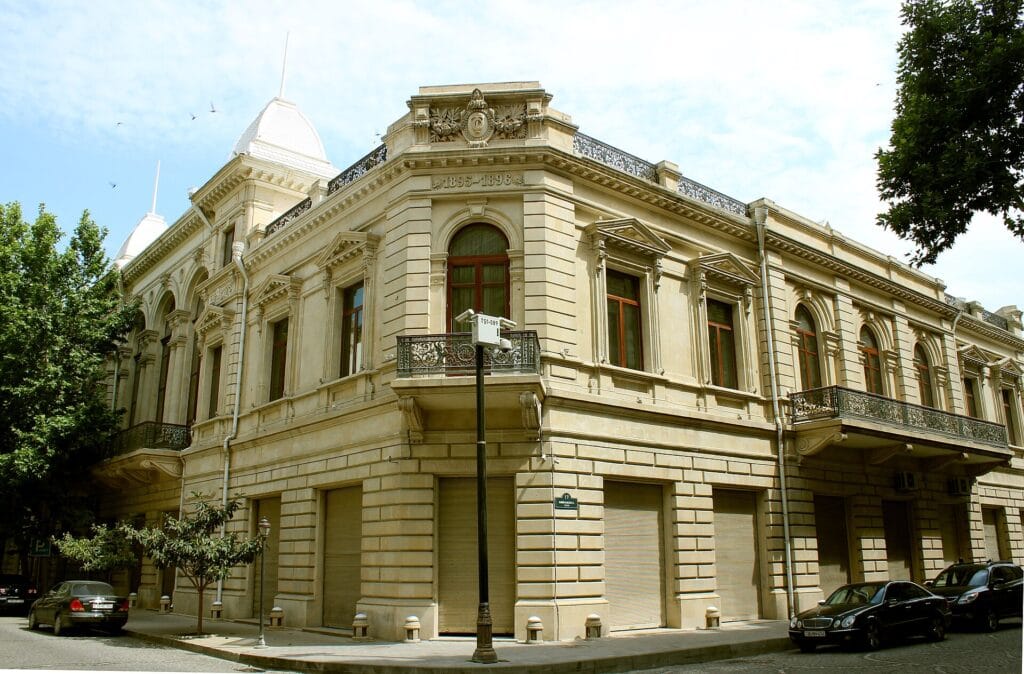
The museum is housed in a visually notable building in central Baku, which was once an oil baron’s mansion, providing a historic atmosphere that complements the content. Its location near other cultural attractions adds convenience for visitors looking to explore Baku’s history more broadly. The interior spaces allow for a sequential flow through the galleries, but available information does not specify detailed visitor logistics such as capacity or crowd management.
Information on visitor services shows the museum is accessible to a broad public, but language support beyond Azerbaijani and Russian is relatively limited. There are reportedly no standard audio guides in multiple languages, which could impact the experience of foreign visitors. Accessibility for those with mobility impairments is not fully documented, and interested readers will need to consult the official website for current provisions.
Practical facilities such as cafes, rest areas, or shops are not consistently mentioned in available sources, suggesting they either are minimal or absent. The absence of these amenities may affect comfort for prolonged visits, especially for those wanting a more accommodating break during a sizable exhibition.
Who Will Enjoy It Most
The museum suits those with a serious interest in the history of Azerbaijan specifically, and the Caucasus region more broadly. Researchers, students, and locals with an interest in national history will find copious material spanning many eras. The collection offers productive ground for those curious about archaeology, medieval Islamic art, imperial politics, or Soviet social history in this geographical area. Its strong archaeological component also assists specialists in prehistoric studies and early civilizations of the region.
Tourists with general curiosity about Azerbaijan’s past can benefit from the broad overview, but without extensive interpretative support in English, the experience may feel less accessible unless supplemented by a knowledgeable guide. Art and cultural historians will appreciate the artifacts with decorative, numismatic, and manuscript value, though these are presented within fairly traditional museum formats, without much interactive or experiential interpretation.
The museum is less suitable for visitors seeking a contemporary, multimedia-heavy museum experience or thematic exhibitions focused on narrower topics such as cultural identity or minority histories. Those interested in Azerbaijan’s current culture or future-facing subjects will need to look elsewhere.
Planning the Visit
Information on opening times and ticketing policies should be verified through official sources due to changing schedules and administrative updates. Details about group tours, guided visits, or audio guide rentals are not reliably documented, so planning for self-guided exploration is safest unless confirmation is obtained directly.
The museum’s central location in Baku makes it accessible by public transport or private vehicle. Since practical visitor services are not extensively highlighted, potential visitors might prepare for a straightforward visit without expecting extensive amenities or visitor aids.
The museum’s website presence as of now is minimal or difficult to locate, so advance preparation from third-party travel or cultural sources could be worthwhile when arranging a visit.
Editorial Verdict
The National Museum of Azerbaijan History serves as an essentially comprehensive repository of the country's historical artifacts and narratives, spanning prehistory to Soviet times. Its strength lies in the collection’s reach and the attempt to present a continuous historical narrative interwoven with political and cultural milestones specific to Azerbaijan. For anyone interested in the nation’s past or the Caucasus region in general, it provides irreplaceable material evidence and historical outlines.
That said, the museum’s traditional exhibition style and limited English interpretation restrict its wider appeal, particularly for international visitors without specialized background knowledge. The narrative tends toward a nationalistic framing that might gloss over some complexities inherent in the region’s history. Physical facilities and visitor services appear modest, suggesting the museum prioritizes preservation and display over tourism infrastructure.
This institution is primarily a resource for focused study and historical reference rather than a visitor experience tailored around extensive interactivity or thematic innovation. When approached with this understanding, it offers solid returns in depth and coverage. Readers interested in Azerbaijan’s history should regard it as a foundational place to engage with the country’s tangible past.