Museo Reina Sofía Review
Museo Reina Sofía Modern & Contemporary Art · Madrid, Spain Modernism with Political Weight The Museo Reina Sofía does not present modern art as.
Museo Reina Sofía Modern & Contemporary Art · Madrid, Spain Modernism with Political Weight The Museo Reina Sofía does not present modern art as.
Best forMasterpieces, architecture, cultural history
Review focusCollection highlights, building, visitor flow
Historical Context
Museo Reina Sofía occupies a central position in the story of modern and contemporary Spanish art. Although the museum in its current form is relatively recent, the building itself has a longer history, originally serving as a hospital before being adapted into a museum space. That layered background matters because the institution is not simply a neutral container for twentieth-century art. It is a historic structure transformed to house works that reflect some of the most turbulent political, social, and artistic developments in Spain and beyond.
The museum formally emerged in the late twentieth century as part of Spain’s effort to give modern and contemporary art a dedicated national platform. Where the Prado is associated with earlier painting traditions and the Thyssen-Bornemisza broadens the European narrative, the Reina Sofía focuses on the twentieth century forward, with particular strength in Spanish modernism, the avant-garde, and the political dimensions of art. Its importance is inseparable from artists such as Pablo Picasso, Salvador Dalí, and Joan Miró, but it also extends well beyond these names. The museum addresses civil war, dictatorship, exile, experimentation, and democratic transition, making it one of the most historically charged art museums in Europe. A visit here is therefore not only about style or formal innovation. It is also about how art responded to crisis, ideology, and modern life.
What You See on Arrival
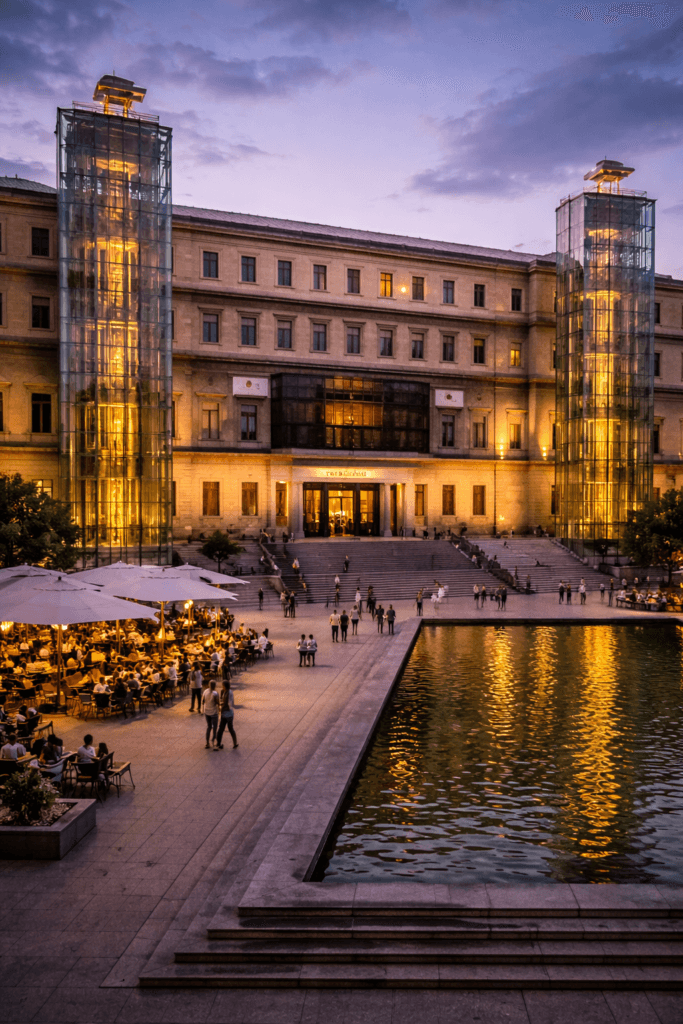
Arrival at Museo Reina Sofía feels different from approaching a more decorative or palace-like museum. The exterior is more restrained, and the atmosphere is shaped by the building’s institutional past and later architectural additions. The historic structure gives the museum a sense of seriousness, while the modern interventions signal that this is a place concerned with more recent art and changing cultural narratives. The famous glass elevator towers on the outside immediately establish that the museum is willing to place old and new in direct contact rather than trying to hide the tension between them.
Inside, the first impression is often one of openness and movement rather than spectacle. The museum does not overwhelm through ornamental grandeur. Instead, it introduces itself through circulation, clean lines, and the awareness that visitors are entering a space built to support concentration. The courtyards and transitions between older architecture and newer gallery areas help the museum breathe. There is room to orient yourself before going deeper into the collections.
The mood on arrival is usually quieter and more focused than at some larger blockbuster museums, though it can still be busy. Visitors often arrive with a particular destination in mind, especially Picasso’s Guernica, and that creates a sense of direction from the beginning. Yet the museum quickly makes clear that it is more than a single-painting stop. The layout suggests multiple routes through modern Spanish and international art, and the atmosphere encourages a slower, more thoughtful pace. It feels like a museum in which context matters. Even before reaching the galleries, there is a sense that the experience will be shaped as much by history and ideas as by visual recognition.
Highlights and Key Exhibitions
The single most important work in the museum is undoubtedly Picasso’s Guernica, and it remains one of the defining artistic encounters in Europe. Its scale, political force, and historical importance make it more than a museum highlight. It is the emotional and intellectual core of the institution. Seeing it in person is different from seeing it reproduced. The size, monochrome intensity, and fractured energy of the composition create an impact that no image in a book can fully convey. Just as important is the way the museum surrounds it with related material and contextual works, helping visitors understand the painting as part of a broader response to violence, war, and modern catastrophe rather than as an isolated icon.
Beyond Guernica, the museum’s holdings in Spanish modernism are exceptionally strong. Works by Dalí and Miró help show how surrealism, symbolism, and abstraction took on distinctive forms in Spain. These galleries often work best when approached not as a sequence of famous names, but as a network of experiments in image-making, identity, and psychological tension. The Reina Sofía is especially effective at revealing how Spanish artists engaged with international avant-garde movements while still remaining closely tied to specific political and cultural pressures at home.
The museum’s broader modern and contemporary displays also deserve attention. Photography, installation, conceptual works, and later twentieth-century art expand the visit beyond early modernism and into more recent forms of artistic inquiry. One of the strengths of the museum is that it does not freeze modern art into a single heroic narrative. Instead, it presents shifting movements and debates, often emphasizing the relationship between art and social change. The result is a museum that feels intellectually alive rather than purely canonical.
Temporary exhibitions often add another layer to the experience. When well selected, they reinforce the museum’s strengths by connecting the permanent collection to broader issues in contemporary culture, politics, and visual language. These shows can make the visit feel especially dynamic, particularly for return visitors.
What stands out overall is the museum’s ability to combine masterpiece-driven appeal with a deeper curatorial argument. The strongest displays are not only about individual works, but about the conditions that produced them. This gives the Reina Sofía unusual seriousness and depth.
Visitor Experience
The visitor experience at Museo Reina Sofía is generally strong, especially for those willing to move beyond the most obvious highlights. The museum is large, but it is not incomprehensible. Its layout can require some adjustment at first because of the relationship between the older building and newer extensions, yet once that structure is understood, the visit becomes manageable and often rewarding in a sustained way.
Pacing matters here because the museum is conceptually dense. This is not a place best experienced through rushing from one famous object to another. The strongest visit usually comes from allowing time for context, reading enough to understand how the galleries are structured, and accepting that some rooms will ask for more concentration than others. Visitors who move too fast may leave with only a partial sense of what the museum does well. Those who slow down will notice that the institution is carefully built around historical and artistic relationships rather than simple fame.
Signage is generally clear, and room transitions often support a logical understanding of the collection. Interpretive texts tend to matter more here than in some traditional painting museums, because the works often depend on political, historical, or conceptual frameworks. That does not mean the museum is inaccessible, but it does mean that viewers benefit from engaging with the information provided. This is especially true in galleries devoted to civil war, exile, social critique, or later conceptual practice.
Crowds tend to concentrate around Guernica and the most famous sections, but quieter rooms are usually available elsewhere. This makes it possible to reclaim attention even during busy visiting periods. The atmosphere overall is more reflective than theatrical. Many visitors arrive with serious interest, and the museum’s tone supports that. It feels less like a place for quick visual consumption and more like one for deliberate engagement.
Tickets, Access, and Planning
Planning ahead improves a visit to the Reina Sofía. Because the museum is one of Madrid’s major cultural institutions and sits within a wider museum district, it can easily be combined with other major sites. That convenience can tempt visitors into trying to compress it into a short stop, especially if they are also visiting the Prado. In practice, the museum deserves more time than that. Even a highlights-focused visit should allow enough room to experience Guernica properly and move through several surrounding galleries with attention.
A useful strategy is to decide in advance whether the visit is centered on Spanish modernism, on the political history of twentieth-century art, or on a broader exploration of the museum’s modern and contemporary displays. This helps prevent the experience from becoming too diffuse. Visitors with limited time should still build in slower looking around the most important sections rather than trying to cover everything.
The museum is centrally located and generally straightforward to access. Ticketing, hours, and entry procedures should be checked before visiting, especially when temporary exhibitions are involved. Comfortable pacing matters as well. The museum is not physically exhausting in the same way as some encyclopedic institutions, but it does demand mental attention. Short pauses between galleries help maintain the quality of the visit.
Final Verdict
Museo Reina Sofía is one of Europe’s essential museums for modern and contemporary art because it combines artistic significance with historical urgency. Its value does not rest only on famous names, although it has them in abundance. Its real strength lies in the way it presents modern art as something inseparable from the crises and transformations of the twentieth century. It is a museum where form, politics, and memory constantly intersect.
Who should visit? Anyone interested in Picasso, Spanish modernism, surrealism, politically engaged art, or twentieth-century museum culture will find it rewarding. It is especially strong for visitors who want more than a parade of masterpieces and are interested in how art responds to war, ideology, modernity, and social change.
Why visit? Because the Reina Sofía offers one of the clearest and most powerful museum experiences of modern art in historical context. It gives visitors the chance to encounter Guernica where it belongs, but it also offers much more than that: a sustained, thoughtful, and often challenging view of modern visual culture. For Madrid, it is not simply the “modern museum” next to older institutions. It is a necessary counterpart to them, and one of the city’s most serious and rewarding cultural destinations.