John F. Kennedy Presidential Library and Museum Review
Boston, United States. The John F. Kennedy Presidential Library and Museum, located in Boston, Massachusetts, holds a distinct place among American presidential libraries for its dedicated focus on the life, career, and legacy of the 35th president…
Boston, United States. The John F. Kennedy Presidential Library and Museum, located in Boston, Massachusetts, holds a distinct place among American presidential libraries for its dedicated focus on the life, career, and legacy of the 35th president…
Best forMuseum lovers, culture travelers, first-time visitors
Review focusCollections, visitor experience, and practical planning
Historical Context
The John F. Kennedy Presidential Library and Museum, located in Boston, Massachusetts, holds a distinct place among American presidential libraries for its dedicated focus on the life, career, and legacy of the 35th president of the United States. Established in the late 20th century, the library is both a repository of archival materials and a museum designed to document and interpret the political and personal trajectory of John F. Kennedy. It serves not only to preserve historical documents but also to explore the broader complexity of the Kennedy administration during a turbulent era marked by Cold War tensions, the Civil Rights Movement, and the dawn of the American space program.
The institution was built in honor of JFK soon after his assassination in 1963, fulfilling the intent to create a space where researchers, historians, and the public could engage with original source materials related to his presidency. Its design and location alongside the University of Massachusetts Boston signify a connection to the city where Kennedy was politically rooted and to a community interested in education and public affairs. Over the years, the library has evolved both in its curatorial scope and public programming, allowing visitors access to a wealth of primary documents, photographs, and artifacts, while also framing Kennedy’s era within the ongoing narrative of 20th-century America.
What You See on Arrival
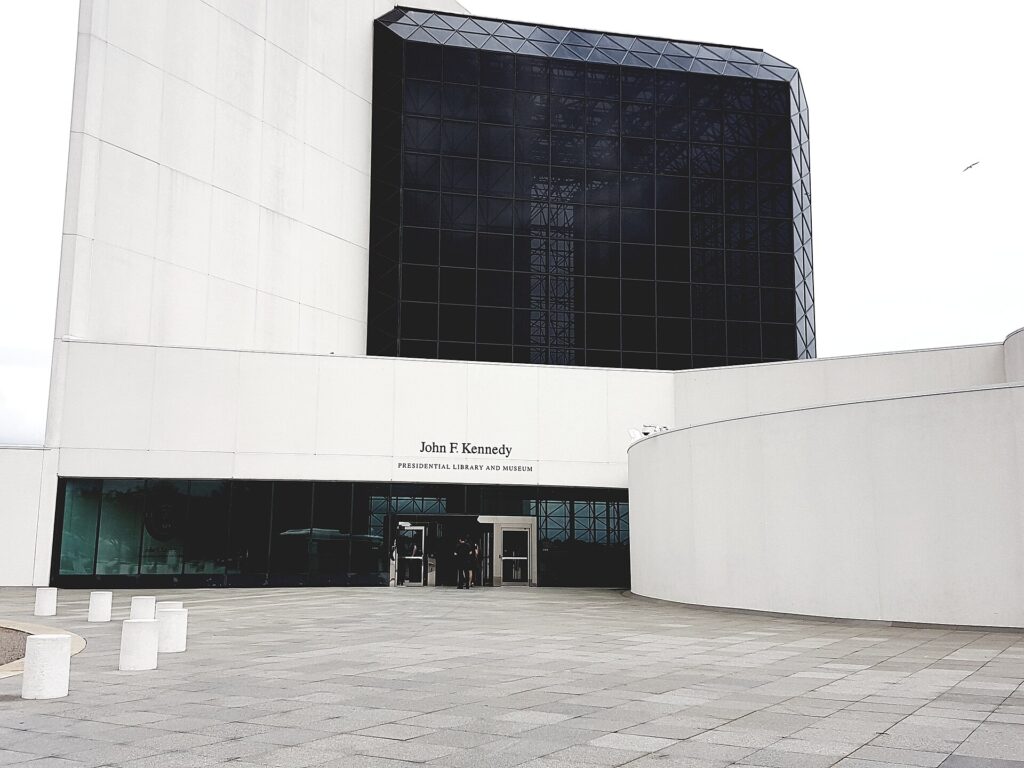
Visitors approaching the John F. Kennedy Presidential Library and Museum encounter a modernist structure characterized by clean lines and a prominent glass pavilion set against the Boston skyline and Boston Harbor. The building's architecture reflects a minimalist aesthetic, which intentional or not, underscores the transparent and accessible spirit the library seeks to promote about Kennedy’s life and work. On arrival, the setting is both contemplative and commanding, with views of the harbor providing a quiet but powerful backdrop.
The entrance space itself suggests a serious institutional focus, designed to orient visitors toward the museum’s mission of historical preservation and public education. Early displays and signage tend to emphasize context, immediately positioning JFK within the broader social and political frameworks of the early 1960s. This initial framing prepares visitors to engage with a collection built more on documentary evidence and political storytelling than on personal memorabilia or nostalgic displays.
Inside, the space feels contemplative rather than crowded or overly theatrical, signaling a museum that balances scholarly respect with public accessibility. The museum’s identity is clearly tied to the archival mission, evidenced by a careful calibration between exhibition space and reference facilities. Visitors can thus expect a venue oriented toward both casual inquiry and serious research, an important distinction that shapes the overall atmosphere.
Highlights and Key Exhibitions
The core of the museum is its extensive archival collection, which covers multiple facets of Kennedy’s life—from his early biography and naval service to his political campaigns and presidential initiatives. The exhibits foreground original documents, including correspondence, policy papers, speeches, and photographs, offering visitors a direct encounter with historical materials rarely seen outside of academic settings.
Among the highlights is a detailed presentation of the Cuban Missile Crisis, one of the defining moments of JFK’s presidency. The museum lays out the chronology of this 1962 confrontation with the Soviet Union through a combination of declassified government documents, filmed recordings, and interactive timelines. These materials reveal the tension and complexity of decision-making during this episode, providing a nuanced picture of both the political stakes and the personal challenges Kennedy faced in navigating Cold War brinkmanship.
The space program also receives significant attention at the museum. Kennedy’s famous commitment to landing a man on the moon before the decade’s end—and the political and cultural energy driving this ambitious goal—are represented through NASA materials, technology exhibits, and multimedia presentations. These displays contextualize the space race as both a scientific endeavor and a component of Cold War competition, highlighting Kennedy’s role as a catalyst for national ambition and technological innovation.
Another major section covers the domestic policies and social issues of the Kennedy administration. The museum addresses the Civil Rights Movement, notably Kennedy’s evolving position and some of the administration’s key legislative efforts and responses. This area of the museum does not shy away from Kennedy’s limitations or political struggles, providing a balanced overview of achievements and criticisms during a period of intense social change.
The personal dimension of the museum is more restrained but present. Several exhibits discuss Kennedy’s family background, personal charisma, and public image, with photographs and audio recordings of speeches adding a humanizing element without drifting into hagiography. The library’s archival holdings also include materials related to Jacqueline Kennedy, reflecting her role in shaping the First Lady’s public profile and preservation of presidential legacy.
Visitor Experience
The experience at the John F. Kennedy Presidential Library and Museum can be described as intellectually engaging and structured for thoughtful exploration rather than casual browsing. The presentation style uses clear, straightforward interpretation, avoiding overly elaborate theatricality or spectacle. This approach suits visitors with an interest in American history, politics, or archival research, and particularly those with a focus on mid-20th-century developments.
The flow through the museum’s exhibitions generally encourages a linear progression from Kennedy’s early years through to his presidency and legacy. This arrangement supports narrative coherence and assists visitors in understanding the chronological and thematic connections between different policy areas and historical events.
One strength is the museum’s careful balance between textual information and visual materials. While the displays lean heavily on documents and photographs, video footage and audio play important supplementary roles in bringing the historical figures and moments to life. The measured use of interactive elements, such as timelines and digital panels, offer accessibility and engagement without overwhelming the visitor.
On the other hand, the museum’s tone and depth may feel somewhat restrained for those seeking a more emotive or sensational take on Kennedy’s presidency. The lack of a focus on temporary exhibits that would refresh the experience for returning visitors could also limit repeat visits or appeal to a broader audience looking for contemporary or local historical connections.
For families or visitors with less background in Cold War politics or American history, some of the detailed policy discussions might require attentive reading to fully appreciate. The museum is therefore best suited to visitors willing to allocate time for focused learning rather than a quick overview.
Tickets, Access, and Planning
Practical details about admission and access to the John F. Kennedy Presidential Library and Museum should be verified through its official website, as these can change over time. Potential visitors should confirm opening hours, ticketing requirements, discounts, and any special arrangements directly from the source before planning their trip.
Access to the site from central Boston involves transit options that vary in convenience depending on starting locations. The waterfront location adds some travel considerations, but also offers an appealing setting for those combining the visit with other nearby cultural institutions or harbor views.
Given the museum’s nature and layout, visitors interested in the archival resources may need to plan ahead for research appointments or access guidelines. Casual visitors might find the museum’s approach best suited to a moderate time commitment, although those with a strong interest in JFK or mid-century history could spend longer periods immersed in the exhibits and surrounding materials.
While no detailed information is stated here about facilities such as guided tours or audio guides, interested parties should check ahead on availability and any special programming that could enhance the visit. Similarly, information about onsite services like cafés or shops is generally provided by the museum’s own resources.
Final Verdict
The John F. Kennedy Presidential Library and Museum serves as an important institutional repository and exhibition space focusing on one of America’s most studied presidential figures. Its strengths lie in its comprehensive archival collections and clear, methodical interpretive approach that presents JFK’s era with both documentary depth and reasonable contextual framing.
It is a site that will appeal primarily to those interested in political history, Cold War dynamics, and the legacy of Kennedy’s presidency from an intellectual or academic standpoint. The museum combines material that supports serious research with a respectful public exhibition style, highlighting key moments such as the Cuban Missile Crisis, the space program, and domestic policy in ways grounded in archival evidence rather than spectacle.
At the same time, the institution might not satisfy visitors looking for more interactive or emotionally charged experiences. Its emphasis on documentation and formal presentation can come across as reserved, and the static nature of its core exhibitions may mean it is less suited for frequent repeat visits or for audiences seeking broad cultural entertainment.
In practical terms, prospective visitors should consult the official website for the most current details on visiting logistics. The museum’s location offers a contemplative and visually appealing environment but requires some planning for access.
Overall, the John F. Kennedy Presidential Library and Museum remains a significant resource for engaging with a key chapter of 20th-century American history. It presents a thoughtful, fact-based narrative that respects the complexity of Kennedy’s presidency, balancing the ambition, challenges, and contradictions of that critical period.