Dunhuang Museum Review
Archaeology Museums · Dunhuang, China. The Dunhuang Museum is located in the city of Dunhuang, in China’s northwestern Gansu Province. This region historically served as a key junction on the ancient Silk Road, linking China with Central Asia and…
Archaeology Museums · Dunhuang, China. The Dunhuang Museum is located in the city of Dunhuang, in China’s northwestern Gansu Province. This region historically served as a key junction on the ancient Silk Road, linking China with Central Asia and…
Best forMuseum lovers, culture travelers, first-time visitors
Review focusCollections, visitor experience, and practical planning
Historical Context
The Dunhuang Museum is located in the city of Dunhuang, in China’s northwestern Gansu Province. This region historically served as a key junction on the ancient Silk Road, linking China with Central Asia and beyond. Dunhuang was a vital cultural and commercial crossroads where different civilizations and religions met, particularly between the Han and Tang dynasties of China and various Central Asian powers. The city gained particular prominence with the development of the Mogao Caves, a vast complex of Buddhist cave temples renowned for their murals and sculptures, which effectively preserve nearly a millennium of religious, artistic, and social history in the region.
Established to showcase the heritage of Dunhuang and its pivotal role in Silk Road history, the Dunhuang Museum’s collections emphasize the cultural richness of this area and period. The museum helps contextualize Dunhuang’s archaeological finds, including artifacts related to the Silk Road trade, Buddhist art, and the manuscript discoveries that have illuminated medieval Central Asian life. Through these connections, the museum situates itself as a repository not only of local but also of transcontinental history and art, reflecting the long-standing exchanges along this ancient route.
What You See on Arrival
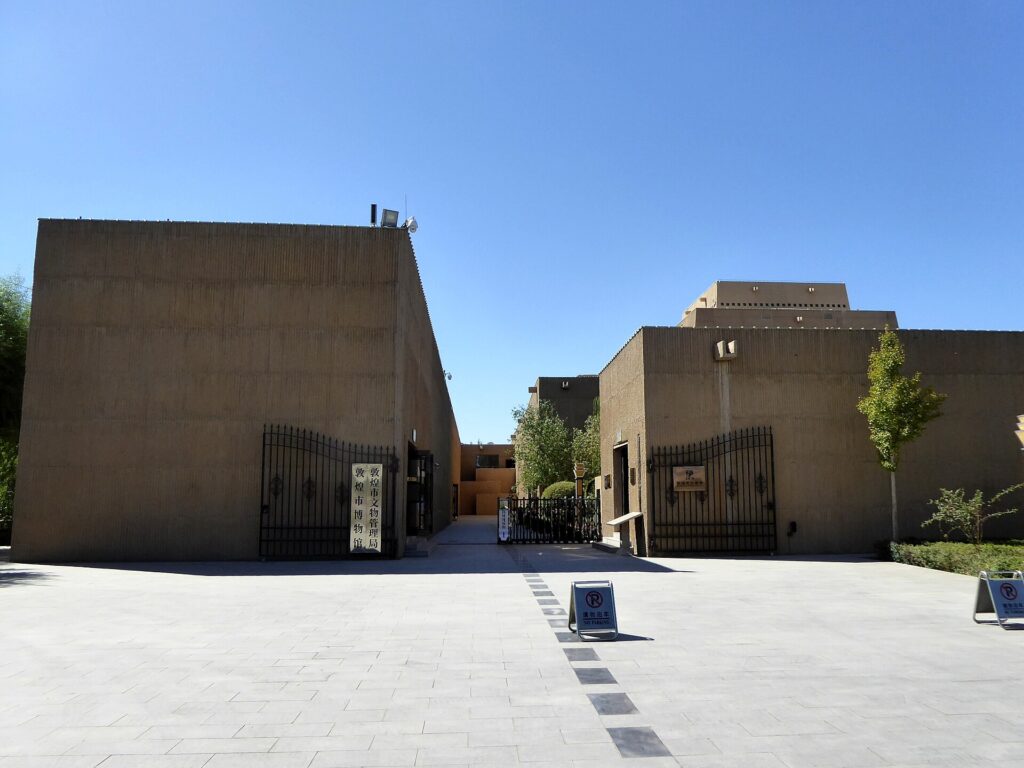
Upon approaching the Dunhuang Museum, visitors are likely met with a structure designed to evoke the geographical and cultural landscape of the region. Architecturally, the building tends to blend traditional design elements with contemporary features, creating a site that visually ties the past with the present. The surrounding environment, often arid with desert influences, provides a tangible sense of place, underscoring the museum’s connection to the Silk Road’s harsh yet historically rich terrain.
The museum’s identity is clearly framed by its focus: it serves as an introduction and gateway to the history and art of Dunhuang. Rather than functioning as an isolated modern art or general history museum, it presents itself primarily as a site for exploring Dunhuang’s role in Silk Road heritage and Buddhist culture. The entrance area usually includes orienting information that prepares visitors for the depth and range of the collection, highlighting key themes like trade, religion, and cultural exchange. This framing positions the museum as a focused institution aimed at educating visitors on the unique historical significance of Dunhuang rather than offering a broad survey of Chinese history or art across multiple periods and locations.
Highlights and Key Exhibitions
The core strength of the Dunhuang Museum lies in its extensive presentation of the Dunhuang Silk Road heritage and Buddhist art. While the museum is not the site of the Mogao Caves themselves, it complements visits there by providing detailed contexts and displays that make the caves’ art and artifacts more approachable.
Among the key objects are reproductions and some original pieces that reflect the religious art of the Mogao Caves. The painted murals and Buddha statues are among the most compelling components, revealing not only spiritual beliefs but also technical and artistic developments over centuries. By showing examples of these religious artworks, the museum offers insights into the development of early and medieval Buddhist iconography, which influenced artistic traditions across Asia.
Another substantial part of the museum is dedicated to Silk Road trade artifacts. Items such as ceramics, textiles, coins, and tools illustrate the material culture that passed through Dunhuang. These objects document the city’s role as a commercial hub where goods from East and West met and were redistributed. Don’t expect a glossy, broadly universal presentation of the Silk Road here; instead, the emphasis is local and specific, focusing on how Dunhuang’s people lived, traded, and interacted with various cultures.
The museum also presents displays relating to historic manuscripts recovered from the Dunhuang caves. While the original manuscripts are stored elsewhere and highly sensitive, the museum uses replicas and explanatory panels to introduce the significance of these texts, which include Buddhist scriptures, administrative documents, and secular writings in multiple languages. This element sheds light on the multilingual, multicultural environment of Dunhuang across centuries and the academic importance of these materials.
Finally, archaeological finds compiled from the surrounding region form a less publicized but crucial part of the collection. These can include clothing fragments, weaponry, and items related to daily life. Together, these objects help round out the narrative—not only focusing on religious or economic history but also illustrating local human experiences in past eras.
Visitor Experience
The Dunhuang Museum is designed to serve an audience broadly interested in the Silk Road, Buddhism, and Central Asian archaeology. Visitors with knowledge of Chinese history or Buddhism may find a strong complement to other regional sites in Gansu and Xinjiang. Those with less familiarity may need to approach the exhibits with some background reading or guide support to fully appreciate the detailed connections on display.
Interpretative materials generally include bilingual signage (Chinese and English) with clear explanations and photographs. The museum tends to adopt a descriptive rather than interpretative style. This can benefit visitors preferring straightforward factual contexts but may limit engagement for visitors looking for interactive or highly narrative-driven exhibitions. For scholars and informed visitors, the museum supplies a solid foundational presentation, though it does not offer deep academic rigor on-site through multimedia or further interpretive programs.
Spatially, the museum is organized to guide visitors chronologically and thematically through Dunhuang’s story. This aim aids pacing but can sometimes feel segmented, especially for casual visitors who might prefer more thematic cohesion or stories that connect unrelated objects more explicitly. The space does not rely heavily on technology or interactive displays, which may feel conventional compared with some recent museum developments elsewhere in China or internationally.
The museum’s scale and layout appear to manage visitor flow efficiently. Large groups and individual visitors can circulate without congestion, allowing ample time to view objects without rush. However, the contemplative nature of many items, such as detailed murals, may require quiet environments that the museum typically maintains well.
Tickets, Access, and Planning
Information on ticketing policies, opening hours, and accessibility is not comprehensively published online in international languages, which means visitors should consult the official museum website or local tourist information prior to planning a visit. Given its location and focus, international travelers might benefit from checking language accommodations in advance.
The museum does not appear to rely heavily on booking requirements or timed entry, but visitors should confirm this as policies can shift. Also, considerations of accessibility for people with limited mobility or other needs are not prominently detailed in widely available sources and thus require direct inquiry to the museum.
Because of Dunhuang’s position in a desert region, climate and seasonal factors can affect visitor comfort and local travel logistics. Nearby accommodation and transport options may be limited outside of peak tourism periods, so advanced planning is advisable for those traveling specifically to visit the museum and surrounding historic sites.
Final Verdict
The Dunhuang Museum serves as a purposeful and focused institution dedicated to the history and culture of this pivotal Silk Road city. Its strength lies in its clear emphasis on Dunhuang’s religious art, commerce, and multicultural heritage, particularly through artifacts linked directly or indirectly to the Mogao Caves and Silk Road exchanges. The museum presents these elements in an accessible format for a general audience while maintaining sufficient substance to interest historians and archaeologists.
However, the museum is not without its limitations. Its interpretative approach is largely straightforward and factual, lacking the interpretive depth and multimedia engagement found in some contemporary museums. This might somewhat diminish appeal for visitors seeking more interactive or immersive experiences. The museum also makes no pretense of offering a broad or comparative history of Silk Road cultures, instead concentrating tightly on local context, which both defines its purpose and limits its scope.
Practical details concerning tickets, accessibility, and visitor services remain scattered, and prospective visitors should rely on official sources for current information before visiting. Similarly, the museum works best as part of a broader itinerary that includes the Mogao Caves and other Silk Road sites. By focusing on the specific cultural and historical environment of Dunhuang, the museum functions as a complementary resource rather than a standalone draw.
For those interested in understanding the intersection of religion, trade, and cultural exchange in one of the Silk Road’s most important centers, the Dunhuang Museum offers a solid, informative experience. It is less appropriate for visitors expecting broad overviews of Chinese or Silk Road history or for those looking for cutting-edge museum technology. In sum, the museum is a valuable institution for specialists and engaged travelers willing to approach it with measured expectations and some preparatory knowledge.