Blanton Museum of Art Review
Art Museums · Austin, United States. The Blanton Museum of Art, located on the University of Texas at Austin campus, represents one of the principal repositories of art in the American Southwest. Established in the 1960s and later expanded into…
Art Museums · Austin, United States. The Blanton Museum of Art, located on the University of Texas at Austin campus, represents one of the principal repositories of art in the American Southwest. Established in the 1960s and later expanded into…
Best forArt lovers, visual culture, architecture
Review focusCollections, curatorial focus, and visitor planning
Historical Context
The Blanton Museum of Art, located on the University of Texas at Austin campus, represents one of the principal repositories of art in the American Southwest. Established in the 1960s and later expanded into a dedicated facility in 2006, the museum reflects the university’s commitment to visual arts education and public engagement. Its foundations lie in a growing collection acquired over decades by the university and individual donors, including notable pieces in European, American, and Latin American art. The museum's development parallels the broader cultural growth of Austin, a city that has evolved into a hub not only for technology and music but also for arts and academia.
The Blanton’s architectural design by Kallmann McKinnell & Wood emphasizes a modern aesthetic that contrasts yet complements the traditional campus surroundings. The institution was conceived to serve not just as a gallery but as a center for research, teaching, and cultural exchange. Over time, it has grown in stature with significant acquisitions and donations, shaping a diverse collection that spans from the Renaissance to contemporary art. One of its noted strengths is its focus on Latin American art, an area still comparatively underrepresented in many American art museums, reflecting both the geographic and cultural particularities of Texas.
What You See on Arrival
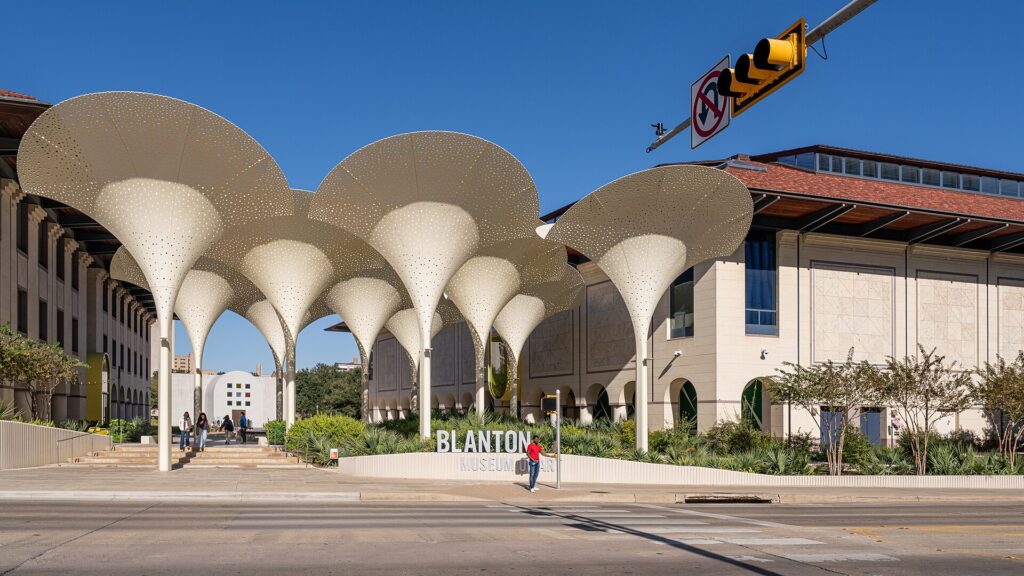
Visitors approaching the Blanton Museum encounter a striking, angular building facing a quiet academic precinct. The entryway is marked by a large, open courtyard that sets a tone of spaciousness and accessibility. The museum does not rely on ostentatious signage; instead, its identity emerges through architectural clarity and subtle branding. This approach often signals to visitors that what lies inside is intended for close viewing and contemplation rather than grand spectacle.
The entrance leads directly into a sun-filled lobby with sightlines extending into parts of the collection galleries. This framing allows an immediate connection to the art, reinforcing the museum’s educational mission. Visitors can expect a layout that encourages exploration in a series of connected galleries with natural light modulating the viewing experience. The building’s modernist lines and materials—glossy concrete, stone flooring, and expansive glass—create a neutral backdrop intended to foreground the artworks rather than compete with them.
What is clear is that the Blanton prioritizes clarity and legibility in its visitor flow, avoiding labyrinthine corridors or overly complex floor plans. This straightforward architectural approach helps orient visitors quickly, making the collection approachable for those who may not be museum veterans while allowing art enthusiasts to move through the spaces at their own pace.
Highlights and Key Exhibitions
The Blanton’s collection is anchored in several core areas that define its distinctive character within the landscape of American art museums. European paintings from the Renaissance through the 20th century feature but do not dominate; rather, the collection adopts a broad lens with notable strengths in prints and drawings that often resonate with the museum’s academic ties. Key Old Master works offer a foundational context, but the museum’s real distinction lies in its holdings related to modern and contemporary art.
American art is another focal point, specifically through 19th and 20th-century pieces that reflect both canonical and regional narratives. The museum is particularly noted for its collection of prints and drawings by artists such as Jasper Johns, Ellsworth Kelly, and others associated with movements like Abstract Expressionism and Post-Painterly Abstraction. These works stand out for their subtle evolution of form and color and are often on display in rotations that allow for a more focused presentation. Because of the strong university affiliation, there is also a pedagogical layer in how these works are curated, balancing accessibility with depth.
Latin American art constitutes perhaps the most significant differentiator of the Blanton. The collection includes colonial-era paintings, modernist works from the early 20th century, and strong contemporary pieces. This diversity reflects the intertwined histories of the United States and Latin America and acknowledges Austin’s geographic and cultural position. Visitors can expect to see works by figures such as Rufino Tamayo, Diego Rivera, and Carmen Lomas Garza. Murals, prints, and sculptures within this sector provide insight into the political and social themes prevalent in Latin American art, including identity, revolution, and indigenous histories.
The museum’s contemporary collection also encompasses new media and installation art, though these are often presented in smaller exhibitions. These later acquisitions reveal an openness to challenging traditional boundaries of art, highlighting voices and perspectives from diverse communities. However, the Blanton’s contemporary holdings do not rival larger metropolitan institutions in scale or international prominence; rather, they serve to underline the museum’s commitment to a broad, inclusive narrative.
While the museum also houses collections of prints and drawings, its holdings in these mediums are more comprehensive than what visitors might expect from the main galleries alone. These selections enable a more intimate viewing experience and are rotated with some frequency to provide variety and depth to the overall narrative.
Visitor Experience
The Blanton Museum’s layout and interpretive strategy cater well to visitors with a moderate interest in art—those who appreciate a coherent narrative but are not necessarily specialists. The flow between permanent and temporary galleries is logical, generally moving from historical to contemporary works, which assists with pacing and content digestion. The scale of the museum is manageable; it avoids overwhelming with excessive gallery space or collection volume, which can be a challenge at larger institutions.
Interpretation is provided through labels, wall texts, and occasionally multimedia supplementation. These materials tend to be concise and well-written, aiding comprehension without oversimplifying. The museum’s academic environment informs a thoughtful, measured tone in text panels, which may require some patience from casual visitors but rewards those willing to engage. This offers an educational dimension broadly aligned with university standards, balancing accessibility and scholarly rigor.
For families or visitors with limited time, the Blanton may seem more focused on depth than entertainment. The absence of large-scale interactive exhibits or extensive multimedia installations might be seen as a limitation for those expecting a sensory-rich experience. Conversely, the museum’s quieter and more contemplative atmosphere suits visitors looking for reflection or those interested in specific art historical subjects.
The range of the collection supports multiple visit profiles—from those drawn by Latin American art to contemporary collectors interested in emerging media. However, some visitors may find the museum’s strength in prints and drawings less immediately engaging than large paintings or sculptures, particularly in the main galleries. The Blanton does not emphasize theatrical display but rather careful curation that respects the individual art objects and their context.
Tickets, Access, and Planning
Specific and up-to-date details on tickets, discounts, guided tours, audio guide availability, and opening hours should be verified on the Blanton Museum of Art’s official website prior to visiting. The museum’s location on a university campus brings typical considerations such as campus parking regulations, potential crowds during academic events, and proximity to public transportation options.
Given the institution’s educational orientation, it may offer group and school visits, but these are best confirmed with museum staff or official channels. Visitors planning their time should consider the size of the museum and the scale of the collection when estimating visit duration. Since the Blanton does not overwhelm in either size or content density, a focused visit of one to two hours is commonly sufficient, though more time may be needed for those wishing to study particular works more closely.
Access accommodations and services are usually documented online, with prospective visitors advised to check for the latest information regarding accessibility, especially for mobility or sensory considerations.
Final Verdict
The Blanton Museum of Art stands as a well-curated institution with a clear identity rooted in its university context and its geographic-cultural positioning in Texas. Its strengths lie in a carefully chosen collection emphasizing Latin American art, American modernism, and print-based works, which together offer a narrative that diverges from typical regional museums without forsaking either scholarly depth or visitor accessibility.
While it does not feature blockbuster exhibitions or an extensive range of interactive or multi-sensory experiences, its quiet, reflective spaces provide room for focused engagement with art. The museum’s architectural approach underlines clarity and a neutral presentation, putting the art at the forefront without unnecessary distraction or spectacle.
Its limitations are those of scope and scale; the Blanton is best suited for visitors with a particular interest in its main collection areas or a desire for an educational art experience rather than a broad, comprehensive tour of all art historical periods or styles. Casual visitors hoping for high entertainment value or dramatic visual spectacles may find the museum more subdued than anticipated.
Ultimately, the Blanton is a thoughtful institutional resource that contributes meaningfully to the art scene in Austin and the wider region. For those drawn to its specialties, it offers a distinctive and coherent narrative with careful curation and an academic underpinning that distinguishes it from other university-affiliated museums. Prospective visitors should plan with attention to current hours and visitor information but can expect a clear and considered presentation of some important facets of the art world.