Biomuseo Review
Panama City, Panama. The Biomuseo, located in Panama City, Panama, opened its doors in 2014 as the country’s first museum dedicated primarily to natural history, biodiversity, and the ecological significance of the Panama Isthmus. Its founding aligned…
Panama City, Panama. The Biomuseo, located in Panama City, Panama, opened its doors in 2014 as the country’s first museum dedicated primarily to natural history, biodiversity, and the ecological significance of the Panama Isthmus. Its founding aligned…
Best forMuseum lovers, culture travelers, first-time visitors
Review focusCollections, visitor experience, and practical planning
Historical Context
The Biomuseo, located in Panama City, Panama, opened its doors in 2014 as the country’s first museum dedicated primarily to natural history, biodiversity, and the ecological significance of the Panama Isthmus. Its founding aligned with a growing global interest in ecological awareness and conservation but also sought to establish a distinct narrative grounded in Panama’s unique geological past. The building itself was designed by Frank Gehry, a name more frequently associated with art museums and cultural landmarks rather than scientific institutions, which adds an architectural curiosity to its identity.
Panama’s isthmus, a narrow land bridge connecting North and South America, played an outsized role in shaping the planet’s biodiversity. Its formation around three million years ago dramatically altered ocean currents, climate patterns, and terrestrial animal migrations, making the region a crucial point for studying evolution and environmental change. The Biomuseo sets out to communicate this natural history through a panoply of exhibits emphasizing the isthmus’s role as a biological crossroads. It functions within the broader context of regional conservation initiatives and scientific research, positioning itself as an educational resource for both local communities and international visitors.
The museum’s inception marked an effort to shift Panama’s cultural narrative towards environmental appreciation alongside its rich human history. Given Panama’s importance in global maritime trade—due in large part to the Panama Canal—this natural history focus offers a complementary lens linking nature and human development. Consequently, the Biomuseo is both a public education center and a contribution to ongoing dialogues about ecological stewardship.
What You See on Arrival
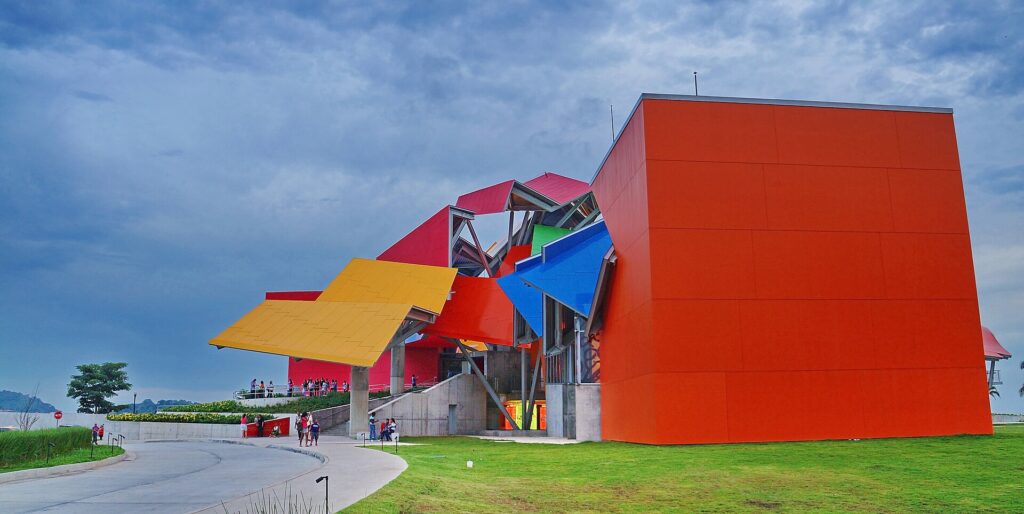
Visitors approaching the Biomuseo encounter a striking structure on the Amador Causeway, with a design immediately signaling that this is not a conventional museum setting. The building’s colorful, angular roof panels, characteristic of Gehry’s architectural style, catch the eye and contrast with the surrounding natural environment and the nearby shipping lanes. While the architecture is visually arresting, it also firmly plants the museum’s identity as a space of creativity that intersects nature with human-made form.
From the outset, the museum frames itself as an institution about biodiversity and geological change, preparing visitors for a content experience deeply rooted in science and natural history. The approach, both literal and thematic, prompts curiosity about the isthmus and entices the visitor towards an exploratory journey. The setting on the causeway not only offers scenic views of the city and sea but situates the museum in a geopolitical and ecological zone pivotal for global biodiversity.
However, the contemporary style and non-traditional layout might not provide the instantly recognizable cues of a natural history museum for all visitors. The use of bright colors and sculptural forms may lead some toward expecting a more art-focused experience, so potential visitors looking specifically for conventional museum design should be aware of this difference upfront.
Highlights and Key Exhibitions
The core strength of the Biomuseo lies in its thematic coherence and focus on the formation and impact of the Isthmus of Panama. The permanent exhibitions broadly explore four main themes: the geological origins of the isthmus, its biodiversity, human interaction with the environment, and ongoing conservation efforts.
One of the museum’s most notable features is its explanation of the isthmus’s geological formation and the dramatic consequences that followed. Detailed panels and dioramas trace how the emergence of this land bridge separated the Atlantic and Pacific Oceans, effectively altering ocean currents and global climate systems. This comprehensive presentation anchors the visitor’s understanding of why Panama holds extraordinary ecological significance.
The biodiversity section offers a thorough introduction to the flora and fauna shaped by this geological event. Exhibits showcase the merger of two previously separated biogeographical regions, highlighting species migration, adaptation, and the resulting ecological richness. This includes visuals and specimens that cover a range from microscopic plankton to large mammals, emphasizing diversity at multiple scales.
A further important component addresses the interplay between humans and nature in Panama. These sections explore indigenous knowledge, the colonial era’s environmental transformation, and contemporary challenges such as habitat loss and species extinction. This human dimension offers a calibrated counterbalance to the natural history, acknowledging both cultural context and ecological impact.
Throughout the exhibitions, the museum employs various interpretative tools including multimedia installations, interactive stations, and vivid biological displays. These aim to engage different ages and learning preferences, with particular attention to making complex scientific subjects accessible. Specimens, models, and illustrative maps are employed carefully to avoid over-cluttering, though some may find certain displays dense due to content richness.
While the permanent exhibitions are well-conceived and authoritative, the Biomuseo’s emphasis remains narrowly focused on Panama’s region and its ecological narrative. Visitors seeking a broader natural history covering global evolution or paleontology more generally may find the scope limited. In addition, temporary exhibitions are not a frequent highlight, which can reduce repeated visit incentives for locals or long-stay tourists.
Visitor Experience
For visitors interested in natural history from an ecological and geological angle, the Biomuseo offers a solid and engaging experience. The narrative is coherent and carefully structured, making it suitable for families, students, and anyone with a general interest in biodiversity. The museum’s design encourages an exploratory approach, using its architecture as an introductory gesture towards the themes inside.
Interpretation balances scientific rigor and accessibility. Panels and displays employ clear language without oversimplifying critical concepts, which suits visitors with some background knowledge while remaining approachable. The presence of interactive elements enhances engagement, especially for younger audiences, though highly specialized naturalists may desire more detailed taxonomic or ecological information.
The layout of the museum and visitor flow generally support a logical progression through the core themes. However, given the building’s architectural complexity, some wayfinding challenges may exist for first-time visitors or those with mobility limitations, though official information on accessibility is worth consulting before planning a visit.
The atmosphere is contemplative rather than noisy or bustling, which suits scholarly or quiet family visits but may be less appealing for social groups seeking high-energy or entertainment-oriented museums. The emphasis remains firmly on education about the environment rather than spectacle.
Tickets, Access, and Planning
The Biomuseo’s location on the Amador Causeway places it within accessible reach of central Panama City, though visitors should consider transportation options as public transit coverage in that area may be limited. For those planning a visit, it is advisable to check the museum’s official website before arrival to confirm current opening hours, admission costs, and the availability of any guided tours or audio aids.
Due to the museum’s focused thematic nature, it may not appeal equally to all visitor types. Those with an interest in science, natural history, and environmental topics will find it rewarding. Tourists looking primarily for art museums, broad historical overviews, or general entertainment may not find the Biomuseo aligns with those expectations.
The museum’s architectural design and physical layout may present some difficulties for visitors with mobility needs, so prior inquiry about accessibility features is recommended. Similarly, the inclusion of family-friendly interactive exhibits makes it a reasonable choice for children, assuming a moderate level of supervision and interest.
Final Verdict
The Biomuseo stands as a specialized institution with a clear educational mission focused on one of the most significant natural events influencing global biodiversity: the formation of the Isthmus of Panama. It offers a thoughtful, well-curated presentation that emphasizes both geological history and biological diversity, supported by a modern architectural framework that challenges typical museum aesthetics.
Its strength lies in the museum’s commitment to clear storytelling grounded in scientific evidence and regional relevance. The exhibitions are suitably detailed for general science audiences and families, providing a meaningful encounter with a subject matter often glossed over in broader natural history venues. The museum also plays a valuable role in promoting conservation awareness, linking Panama’s natural heritage to contemporary environmental challenges.
That said, the Biomuseo’s focus on the isthmus and its ecosystems can feel narrow, especially for visitors expecting a wider natural history scope or a rotating program of temporary shows. The architectural style, while visually stimulating, may complicate navigation or mislead visitor expectations about the museum content. Planning carefully and consulting official details before visiting is advisable.
Overall, the Biomuseo presents an effective resource for understanding an important ecological and geological phenomenon, serving both education and conservation outreach goals. Visitors with an interest in Panama’s environmental story will find its exhibits informative, while those seeking a more comprehensive or varied natural history experience might want to complement this visit with other institutions offering broader themes.