Australian Museum Review
Intro The Australian Museum in Sydney, Australia, is one of the most significant museums in the country because it combines two demanding roles with.
Intro The Australian Museum in Sydney, Australia, is one of the most significant museums in the country because it combines two demanding roles with.
Best forMasterpieces, architecture, cultural history
Review focusCollection highlights, building, visitor flow
Intro
The Australian Museum in Sydney, Australia, is one of the most significant museums in the country because it combines two demanding roles with unusual confidence. It is both a serious research institution and a major public museum. Many museums of natural history succeed in one of those capacities and struggle with the other. The Australian Museum performs well because it maintains scientific authority while still creating a visit that is readable, varied, and rewarding for non-specialists.
This dual identity shapes the entire experience. Visitors encounter dinosaurs, wildlife, minerals, environmental narratives, and cultural interpretation within a museum that still feels unmistakably civic rather than purely academic. That combination gives the institution a public force that extends beyond the display of impressive specimens.
How the Site Works
The museum works through breadth. Rather than focusing on one historical period or one collecting tradition, it moves across natural science, deep time, environmental understanding, and cultural material tied to Australia and the Pacific. This could easily become fragmented in a weaker institution, but the Australian Museum generally succeeds in presenting the different branches as part of a larger educational mission.
Its role as a research institution helps here. The displays do not feel assembled merely for spectacle. They are grounded in scientific and curatorial work, which gives the museum authority even when the galleries are designed for broad public appeal. Families, school groups, and international tourists all find strong entry points, but the museum still carries intellectual substance.
Free general entry to permanent exhibitions also changes how the site works. The museum has a genuinely public character. Visitors can enter without the pressure of maximizing a high-ticket visit, which encourages more flexible, exploratory use of the institution.
Exhibitions and Collection
The museum’s collections are strongest where they combine scientific credibility with immediate visual impact. Natural history galleries, specimen-based displays, paleontological material, and wildlife interpretation provide the most obvious examples. These sections give the museum broad appeal while still grounding the visit in real scientific evidence rather than entertainment alone.
Equally important is the museum’s cultural dimension. The Australian Museum does not confine itself to natural history in a narrow sense. It also addresses the cultures and histories of Australia and the Pacific, which gives the institution wider depth and keeps it from becoming a purely specimen-driven experience. This broader remit allows the museum to address how knowledge, environment, and human presence intersect.
One of the museum’s most useful qualities is that visitors can experience it at different levels. A short visit can still feel rewarding because headline galleries are strong and easy to grasp. A longer visit reveals more of the institution’s complexity, including the way science, conservation, history, and culture are brought into relation.
Architecture / Space
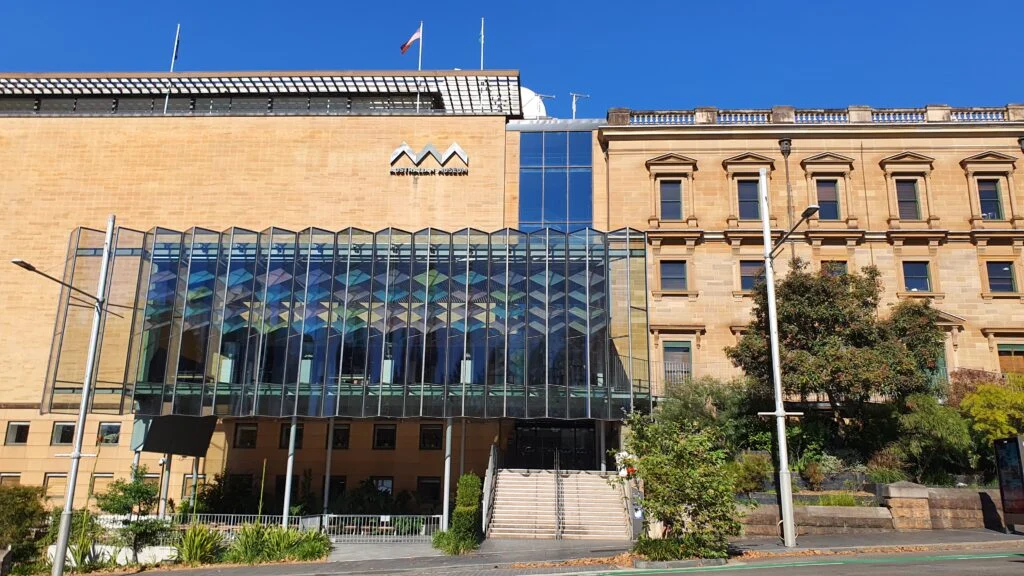
Architecturally, the museum reflects both its age and its adaptation. It combines older institutional elements with later redesign, which means the visit unfolds through a mixture of heritage presence and more contemporary gallery presentation. This layered quality suits the museum’s history. It feels like a long-standing institution still evolving rather than a static monument.
Its location near Hyde Park is another major strength. The museum sits in central Sydney, where it functions as part of the city’s cultural fabric rather than as an isolated destination. This makes the institution easier to integrate into a broader visit and reinforces its civic character.
Spatially, the museum generally supports movement well. Large public museums with broad subject ranges can easily become confusing, but the Australian Museum remains readable enough that visitors can construct their own route without losing coherence.
Visitor Experience
The visitor experience is energetic, family-friendly, and intellectually open. There is enough immediate appeal to engage children and casual visitors, but enough depth to satisfy those with more serious interests in science or museum practice. This is one of the museum’s greatest achievements. It does not confuse accessibility with simplification.
Because general admission is free, the institution feels genuinely public. That affects atmosphere. The museum attracts a broad audience, and the tone is active rather than hushed. Yet the galleries still support meaningful engagement because the displays offer context rather than merely visual impact.
Visitors who enjoy natural history museums will find the institution especially rewarding, but the museum also works well for travelers who want a substantial cultural stop in Sydney that extends beyond art or urban history. It is a museum that broadens the city’s cultural range.
Historical Context
The Australian Museum’s historical importance begins with its founding in 1827 as the nation’s first museum. That alone places it at the center of Australia’s museum history. Over time, however, its significance has expanded. It has become part of the country’s scientific infrastructure as well as one of its major public educational institutions.
This history is not neutral. Like many older museums, the Australian Museum belongs to a longer story of collecting, classification, colonial institutions, and changing ethical standards. Its contemporary relevance depends partly on how it continues to reinterpret those histories while remaining committed to research and public education. That ongoing adjustment is one reason the museum still matters.
Practical Information
The museum is open daily from 10:00 to 17:00 and closed on Christmas Day. General entry to permanent exhibitions is free, which makes it one of Sydney’s most accessible major cultural institutions. Located at 1 William Street, it is easy to reach and easy to combine with other central destinations.
Because the museum offers several different kinds of experience, visitors should decide whether they want a broad overview or a more focused exploration. Either approach works, but a little planning helps. Even a half-day visit can be substantial, especially if you move beyond the most immediately popular galleries.
Final Verdict
The Australian Museum is one of the strongest museum visits in Sydney because it combines research depth, public accessibility, and a wide subject range without losing institutional clarity. It succeeds as a natural history museum, a cultural museum, and a civic educational space. That combination gives it unusual importance.
For travelers interested in science, environmental history, museums of knowledge, or the broader cultural life of Sydney, it is an essential stop. It is a museum with both authority and openness, and that is a difficult balance to achieve well.
Plan your visit
Plan the Australian Museum as a substantial museum stop rather than a brief indoor diversion. Free admission makes it easy to enter casually, but the institution rewards more deliberate attention. It works particularly well as part of a central Sydney day, and visitors who enjoy science or natural history should allow enough time to move beyond the most obvious crowd-pulling galleries and explore the museum’s broader cultural scope.