Angkor National Museum Review
Siem Reap, Cambodia. Siem Reap’s Angkor National Museum situates itself as an educational gateway to the monumental Angkor archaeological site nearby, Cambodia’s highlight for visitors and scholars alike. Unlike the sprawling temple ruins that dominate much of…
Siem Reap, Cambodia. Siem Reap’s Angkor National Museum situates itself as an educational gateway to the monumental Angkor archaeological site nearby, Cambodia’s highlight for visitors and scholars alike. Unlike the sprawling temple ruins that dominate much of…
Best forMuseum lovers, culture travelers, first-time visitors
Review focusCollections, visitor experience, and practical planning
The Museum in Context
Siem Reap’s Angkor National Museum situates itself as an educational gateway to the monumental Angkor archaeological site nearby, Cambodia’s highlight for visitors and scholars alike. Unlike the sprawling temple ruins that dominate much of the local cultural landscape, the museum offers a more contained, curated, and narrative-focused environment. Its foundation in the early 21st century aimed to consolidate Khmer heritage into a modern institution that complements the physical remains by tracing their historical and religious significance through artifacts and multimedia elements. This museum exists in a space where art, archaeology, and national identity meet, framed by the history of Cambodia’s ups and downs, with Angkor symbolizing a peak of civilization that still influences the country’s cultural self-understanding.
This defined scope—as a repository and interpreter of Angkorian civilization—distinguishes it from Cambodia’s broader national museums or the visiting experiences of the temple complexes themselves. Rather than compete with the non-traditional ‘museum experience’ offered by the open-air temples, it offers a systematic, chronological, and thematic context that the sprawling site cannot easily provide. Its urban position, a short drive from the tourist epicenter of Siem Reap, situates it both practically and symbolically as the place to connect the dots in ways the ruins, even accompanied by a guide, cannot fully achieve.
Collections Worth Understanding
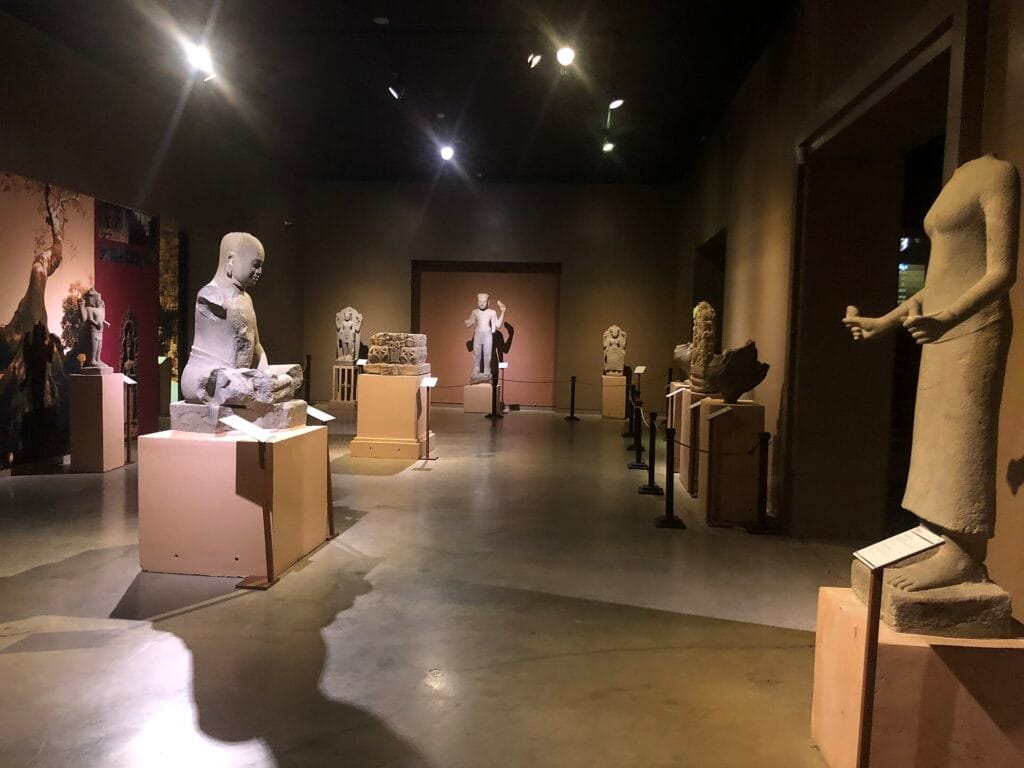
The heart of the museum lies in its collection of artifacts excavated or linked to Angkor and its surrounding region. These span an impressive range, from stone sculpture fragments and bas-reliefs to ceramics and ritual objects. Particular weight is given to the Hindu and Buddhist iconography that pervades Angkor Wat and other temples, including statues of deities like Vishnu and Shiva, along with inscriptions in Khmer and Sanskrit that offer vital textual anchors for the site’s narrative.
A noticeable strength is the chronological sweep of objects—from pre-Angkorian times through the Khmer Empire’s zenith in the 12th century to its decline and the eventual shift in religious focus from Hinduism to Theravāda Buddhism. This helps contextualize Angkor not as a frozen monument but as a living cultural entity shaped by political, religious, and social forces over centuries. The museum’s ethnographic artifacts also connect to contemporary Khmer tradition, underlining how the ancient legacy continues to influence modern culture.
Some of the fine ceramics and jewelry on display come from outside the immediate Angkor complex, revealing the regional trade ties and artistic exchanges that enriched Khmer civilization. For specialists, the collection’s depth in epigraphy, with many inscriptions examined and translated within the displays, provides a solid foundation to understand the political narratives behind temple constructions.
Presentation and Storytelling
The presentation favors a multimedia approach, employing large-scale maps, 3D digital reconstructions of temple sites, and interactive touchscreens that allow visitors to explore the chronology, iconography, and religious symbolism in relative depth. This technological framing strengthens the museum’s educational aims, offering clarity on complex historical timelines and architectural layers that can be overwhelming at the physical sites.
The layout generally progresses through thematic zones—covering cosmology and religion, administration and urban planning, art and daily life—which supports a structured understanding. Labels and interpretive panels tend to be concise but packed with information, aimed at a serious visitor rather than the casual one. The explanations dive into specifics about each artifact’s provenance and cultural function, avoiding simplistic tourism clichés.
However, the use of technology can sometimes be a double-edged sword. Some interactive displays rely on screens that may require a basic familiarity with digital interfaces, potentially slowing down exploration for less tech-savvy audiences. The sheer density of information packed into some sections risks overwhelming visitors who prefer a lighter narrative or a more visually driven experience. The museum’s focus on textual inscriptions and religious symbolism, while academically rich, may feel dense for visitors without prior knowledge of Hindu-Buddhist iconography.
The Experience on the Ground
While direct visitor experience details are limited, the museum’s physical environment is reported as clean, well-maintained, and thoughtfully designed to support both group and independent learning. It builds on a relatively modern architectural shell, contrasting with the ancient stone of the temples. The intentional use of light and space helps isolate exhibits without distracting from the educational content.
The siting close to Siem Reap means it serves as a convenient intellectual primer or follow-up for the area’s temple tourism. Its quiet, indoor environment offers a break from heat and crowds, making it an appealing stop for those wanting background before or after exploring Angkor itself. Visitors interested in archaeology or regional history will find the museum a credible and comprehensive counterpart to the often sprawling and weather-exposed ruins.
Where the Museum Excels
The museum’s strong suit is its pedagogical clarity within a focused thematic frame. By zeroing in on the religious and political underpinnings of Angkor’s monuments, it appeals to visitors seeking a rigorous introduction rather than a surface-level overview. Its epigraphic collection and the emphasis on translations add a textually grounded dimension rarely found in similar institutions.
Another asset lies in the interactive digital reconstructions, which bring the ancient city to virtual life. These reconstructions demonstrate architectural styles and urban layouts that vanished from sight and were only understood through excavation and scholarship. They act as crucial tools for bridging the gap between the ruins’ fragmented state and their original grandeur.
The museum also contributes to national identity and preservation efforts by consolidating Angkor’s story under an authorized and systematic institutional voice, counterbalancing a tourism sector that can sometimes favor spectacle over substance. This intentional narrative discipline supports a more nuanced understanding of Khmer culture and history.
What to Know Before Visiting
It is sensible to check the official website for up-to-date information about admission fees, opening hours, accessibility features, and the availability of guided tours or audio guides, as these practical details can vary. The museum’s focus may be challenging for visitors expecting a more conventional art museum or those unfamiliar with Angkorian history and Southeast Asian religious traditions.
Expect a learning curve in navigating dense inscriptional content and iconography. While the museum does not require specialist knowledge, casual visitors may find the material demanding without accompanying explanations or prior reading. The museum’s modern architecture and use of technology mean it is less atmospheric than the ruins themselves, offering an intellectual rather than aesthetic or spiritual experience.
Visitors aiming to understand Cambodia’s heritage beyond its tourism face value will find this museum a valuable resource. Some knowledge of Buddhist and Hindu iconographic basics will add to appreciation, though the museum tries to clarify key points.
Our View
Functioning as a scholarly introduction to Angkor’s past, this museum distinguishes itself by its focus on religious iconography, inscriptions, and historical context. It serves a specific purpose: to equip visitors with intellectual frameworks to better grasp the meaning behind Cambodia’s most famous cultural landmarks. This is not a space for casual browsing or a decorative display of artifacts; the Angkor National Museum demands attention to detail and some willingness to engage with complex material.
Its extensive use of digital media and textual evidence make it an invaluable resource for those seriously interested in Angkor’s history and archaeology. That rigor can turn away visitors looking for lighter or more sensational experiences, but for those who engage with it, the museum clarifies and deepens the understanding of Angkor beyond its aesthetic grandeur.
The museum’s modern setting and thematic coherence form a solid counterbalance to the sprawling ruins, which can overwhelm without a guiding narrative. By making inscriptions and iconography accessible, it brings key elements of Angkorian civilization into focus. This framing deeply benefits anyone wanting to see beyond the surface of one of Southeast Asia’s most iconic archaeological sites.
Angkor National Museum stands as a specialized institution, well-suited for serious learners of Khmer history, archaeology, and religion. Its thoughtful curation and educational ambitions, while not without challenges in presentation style, offer a well-documented and scholarly doorway into Angkor’s enduring legacy.