Angkor National Museum
Siem Reap, Cambodia. The Angkor National Museum in Siem Reap focuses on the history and art of the Khmer civilization, offering context often missing from visits to the nearby Angkor temple complex. It is primarily an archaeological…
Best forMuseum lovers, culture travelers, first-time visitors
Setting / nearbySiem Reap, Cambodia
Overview
The Angkor National Museum in Siem Reap focuses on the history and art of the Khmer civilization, offering context often missing from visits to the nearby Angkor temple complex. It is primarily an archaeological and cultural museum. Instead of displaying large original monuments or fragments in situ, the museum uses a combination of replicas, multimedia, and original smaller artifacts to tell the story of Angkor and Khmer history. It presents the civilization’s development from early settlements through to the 15th century, a period when Angkor was a political and religious center in Southeast Asia. The museum aims to explain the iconography, architecture, and religion behind the temples, rather than simply showing isolated objects. This approach tries to clarify the cultural framework behind the ruins seen throughout Siem Reap.
Collection Highlights
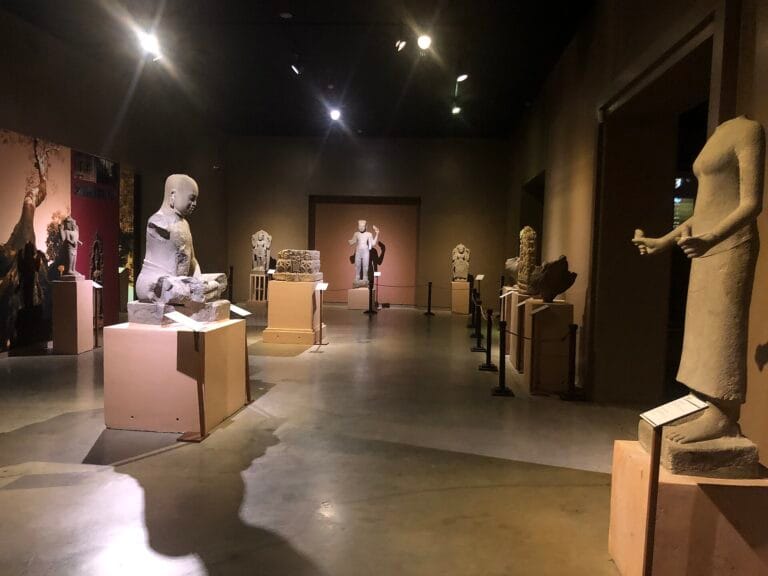
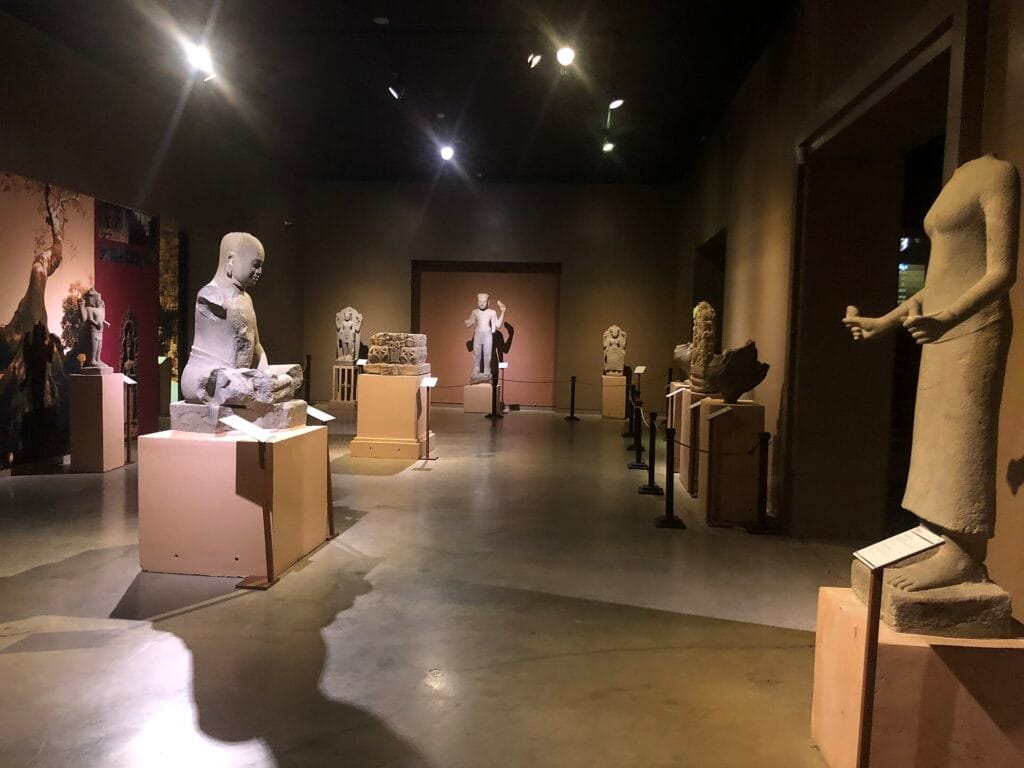
The museum’s strength lies in its concentration of Khmer statues, especially sandstone sculptures that illustrate Hindu and Buddhist mythology as interpreted in Cambodia. These include reproductions alongside original pieces excavated from Angkor and surrounding areas. These statues provide insight into how gods and narratives were represented in Khmer art, often through sensuous poses and intricate detailing typical of the Angkor period, roughly spanning the 9th to 15th centuries.
Other exhibits include bas-reliefs reproducing scenes from famous temples like Angkor Wat, Bayon, and Ta Prohm. These panels help visitors decipher the stories carved into stone, including depictions of the Ramayana and Mahabharata epics as well as local myths and historical events. The museum also illustrates the temple construction process through models and diagrams, explaining how Khmer builders achieved architectural feats without modern tools.
Smaller artifacts on display include ceramics, inscriptions, seals, and tools that shed light on daily life, administration, and trade in Angkorian society. Some language and script exhibits help visitors appreciate the evolution of Khmer writing and its link to the Sanskrit and Pali used in religious texts.
While the museum does not house the gigantic stone blocks or temple ruins themselves, its collection fills in many gaps for people who want to understand what they will see outside the museum in the Angkor Archaeological Park. This context can deepen appreciation of the temples and their symbolic meanings.
Building and Setting
The museum occupies a purpose-built, modern building designed in a style that evokes classical Khmer architecture without reconstructing it literally. It is situated near Siem Reap’s town center, making it accessible for visitors who intend to explore Angkor’s ruins nearby. The building’s layout guides visitors through chronological and thematic galleries, combining audiovisual displays with the object collections.
The structure offers ample space for detailed exhibits and multimedia presentations, including touchscreens and video projections that explain complex iconography and historical timelines. While the building itself lacks the weathered stone and moss-covered quality of the Angkor temples, its clean design helps focus attention on the displays without distraction.
Practical Information
Visitors aiming to explore the museum should check the official Angkor National Museum website for the latest information on opening hours, ticket prices, and any special exhibitions or educational programs. Admission and visitor services may vary seasonally or due to local conditions. The museum is in Siem Reap, which serves as the main gateway to the Angkor site, so it fits easily into itineraries combining museum visits with temple tours.
Since the museum emphasizes explanation and interpretation, visitors might find value in allocating time specifically for reading labels and engaging with multimedia. Planning a visit when the museum is less busy can also improve the experience, though details about peak times are not clearly stated online.
Why Visit
The Angkor National Museum is best suited to those who want a structured historical and artistic introduction to the Khmer civilization before or after visiting the Angkor temples themselves. It organizes complex religious and cultural information systematically, helping visitors distinguish details that otherwise might be overlooked amid the grandeur of the ruins.
For anyone interested in archaeology, art history, or Southeast Asian religions, the museum presents an unusually coherent narrative through both tangible objects and interactive explanations. It avoids the pitfall of being just a display of fragmented stone; instead, it tries to build a story around the remains visible in the nearby park.
However, visitors expecting to see actual temple remains or large-scale original sculptures may be disappointed, as the museum focuses more on interpretation and smaller artifacts. Those visits are best combined with a trip to the actual archaeological sites.
The museum can make a significant difference in understanding the historical context and iconography of the Khmer empire, turning what might otherwise be a series of impressive but enigmatic stone ruins into a clearer cultural experience. This concentrated approach is a particular advantage for first-time visitors or anyone seeking background before wide exploration.
In summary, the Angkor National Museum serves as an informative companion to the physical world of Angkor’s temples, adding layers of historical and artistic clarity that can enhance appreciation of one of Southeast Asia’s most famous archaeological areas. Readers interested should consult up-to-date practical details before making travel plans.