The Museum of New Zealand Te Papa Tongarewa
About: An excellent introduction to Aotearoa. Mix cultural galleries with the natural history sections for variety.What to see: Start with the signature.
Best forArchitecture, royal history, heritage
Setting / nearbyOceania
Overview
The Museum of New Zealand Te Papa Tongarewa is one of the most important museums in the Southern Hemisphere and one of the strongest introductions to Aotearoa New Zealand that any visitor can experience. Located on Wellington’s waterfront, Te Papa is not simply a national museum in the traditional sense. It is a museum of culture, identity, land, memory, science, and public life, all brought together in a way that feels distinctly New Zealand. What makes it especially rewarding is that it does not divide the country into neat separate categories such as “art,” “history,” and “nature” and then leave them disconnected. Instead, it often shows how these things belong together. Māori culture, Pacific heritage, colonial history, environmental knowledge, biodiversity, migration, and contemporary identity are all part of the same wider story.
This broad and integrated approach is one of the museum’s greatest strengths. Many national museums can feel formal, hierarchical, or overly committed to one official narrative. Te Papa is different. It is serious, but it is also public, open, and dynamic. It works as a place of learning for first-time visitors, a place of cultural recognition for New Zealanders, and a place of encounter between different histories and ways of understanding the country. That gives the museum a stronger civic and cultural role than many institutions that simply display collections. It feels alive, not only preserved.
For visitors arriving in New Zealand, Te Papa is often the single best museum to visit early in a trip because it provides such a broad framework for understanding the country. Aotearoa can be experienced through landscape, food, cities, and travel routes, but Te Papa helps explain what ties those experiences together. It gives depth to the place. It makes visible the relationships between land and people, between Indigenous and settler histories, between natural forces and national identity. That is why the museum works so well as an introduction. It is not just informative. It is orienting.
Another major strength is that the museum balances different tones effectively. Some parts are contemplative and culturally weighty, especially where Māori taonga and questions of identity, memory, and belonging are central. Other sections are more interactive, family-friendly, or scientifically focused. This could easily feel scattered in a weaker museum, but Te Papa generally holds these different energies together well. The result is a museum that feels broad without being shapeless and accessible without becoming superficial.
Collection Highlights
One of the defining strengths of Te Papa is its Māori and Pacific collections. These are not side departments or secondary additions to a broader national story. They are central to the institution’s identity and among the most important reasons to visit. Carved meeting-house elements, taonga, textiles, ancestral objects, and contemporary cultural interpretation all help create an experience in which Māori history and knowledge are not treated as distant subjects of observation, but as living and foundational parts of Aotearoa. This gives the museum unusual moral and cultural depth. It is not simply presenting Indigenous material as heritage. It is acknowledging Māori as central to the nation’s story.
The Pacific material is also extremely important, especially because it places New Zealand within a wider oceanic world rather than treating it as an isolated national case. This broadens the visit in a crucial way. Te Papa is strongest when it reminds visitors that Aotearoa belongs not only to a local national history but also to larger Pacific histories of navigation, migration, exchange, and cultural continuity. These galleries deepen the museum’s identity and help prevent it from becoming too narrowly state-centered.
Natural history is another major strength. Te Papa is one of those rare museums where cultural galleries and natural history galleries reinforce one another rather than feeling like separate institutions under one roof. The sections on New Zealand’s geology, biodiversity, marine life, and evolutionary isolation are especially valuable because they explain how unusual the country’s environment really is. This is essential to understanding New Zealand as a whole. The natural world here is not background scenery. It has shaped settlement, economy, ecological concern, and national imagination. The museum’s treatment of the environment helps visitors understand that connection.
The famous colossal squid display is one of the museum’s best-known public draws, and it shows how Te Papa can use a single object to capture public imagination while still contributing to a larger story about marine science and the southern oceans. It is the kind of display that attracts attention immediately, but it works because it is not empty spectacle. It fits into the museum’s wider concern with the life and environment of Aotearoa and the Pacific.
The museum’s history and social identity sections are also important, especially when they address colonization, migration, war, and changing national identity. These galleries help the museum feel like more than a cultural showcase. They make it a place where New Zealand’s difficult and evolving history can be encountered directly. Te Papa is strongest when it allows visitors to feel that national identity is not a fixed slogan but a continuing conversation shaped by memory, conflict, partnership, and change.
Building and Setting
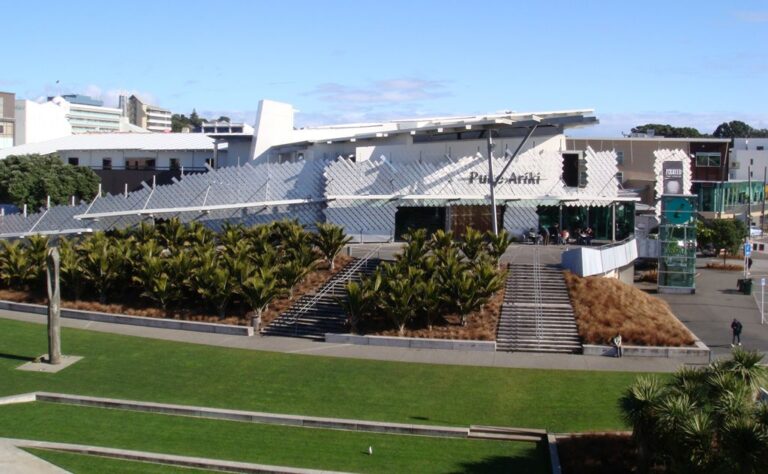
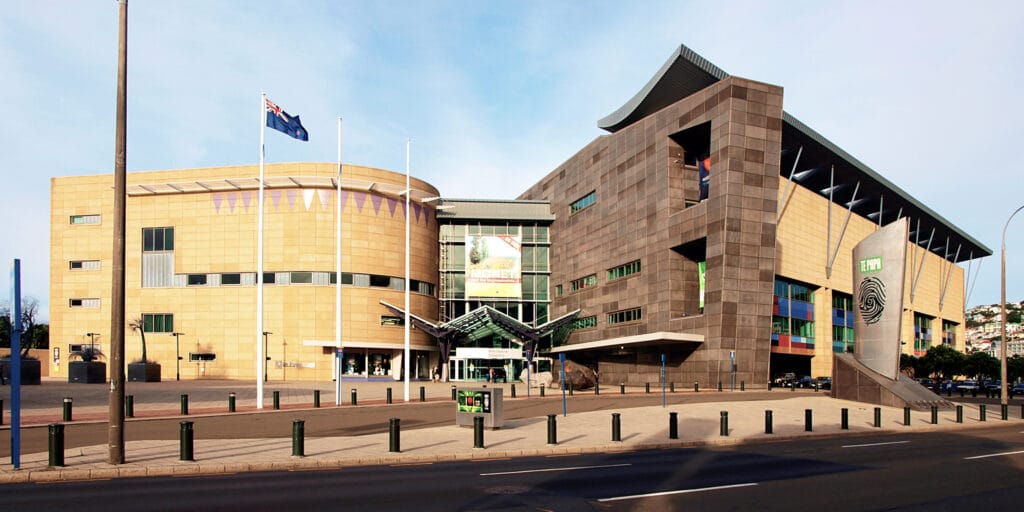
Te Papa’s building is not the kind of museum architecture that depends on old-world grandeur or palace-like ceremony. Instead, it feels modern, public, and practical in a way that suits the institution’s identity. This is important. The museum does not present itself as a distant temple of culture. It presents itself as a civic space built for wide public use, dialogue, and learning. That approach matches the museum’s internal character well.
Its waterfront location in Wellington is one of its great advantages. The museum feels connected to the city and to the broader atmosphere of the harbor rather than sealed off from them. This helps reinforce its identity as a national museum shaped by movement, ocean, environment, and public life. Te Papa would still be a strong museum elsewhere, but the waterfront setting adds something important. It reminds visitors that Aotearoa is an island nation whose history and imagination have always been tied to sea, coast, and movement.
Inside, the building generally works through openness, flexibility, and broad circulation rather than highly ceremonial sequences. This allows the museum to handle its varied subject matter well. Visitors can move between cultural, historical, and natural history spaces without feeling trapped in one rigid route. In a museum with such a wide remit, that flexibility is valuable. It makes the institution feel exploratory rather than authoritarian.
Practical Information
Te Papa works best when visited with variety in mind. A good approach is to mix cultural galleries with natural history sections rather than doing all of one type first and the other later. This keeps the visit fresh and helps the museum’s larger integrated identity become clearer. The institution is broad enough that trying to move through it in a single uninterrupted line can become tiring.
A useful strategy is to begin with the Māori and identity-related sections, since these provide much of the museum’s cultural foundation, and then move into natural history or environmental galleries for contrast. After that, the Pacific and modern historical sections can deepen the experience further. This kind of alternation suits the museum particularly well.
Because the museum is broad and family-friendly, it is easy to underestimate how much time it deserves. Even visitors who are not planning a full day should allow enough time to move beyond the obvious headline exhibits. Some of the museum’s real strength lies in the quieter galleries where context builds gradually rather than dramatically.
Why Visit
Te Papa is best for culture and natural history lovers, first-time visitors to New Zealand, families, and anyone who wants a serious but accessible introduction to Aotearoa. Its greatest strength is the way it brings together different dimensions of national life without flattening them into one narrow official story. Māori culture, Pacific identity, environment, migration, social history, and scientific understanding all appear as part of one larger whole.
What makes the museum worth prioritising is that it offers more than information. It offers orientation. It helps visitors understand New Zealand as a place shaped by Indigenous history, oceanic connections, environmental distinctiveness, and ongoing cultural negotiation. That is a rare achievement for any national museum.
For many visitors, Te Papa becomes one of the most memorable experiences in Wellington because it feels so complete. It is not the most traditional museum, but that is exactly why it works so well. It is open, thoughtful, wide-ranging, and deeply tied to the identity of the country it represents. As an introduction to Aotearoa, it is hard to beat.