POLIN Museum of the History of Polish Jews
POLIN Museum of the History of Polish Jews in Warsaw, Poland, is one of the most significant history museums in Europe because it addresses a.

Best forMemory, history, reflective visits
Setting / nearbyEurope
Overview
POLIN Museum of the History of Polish Jews in Warsaw, Poland, is one of the most significant history museums in Europe because it addresses a long and complex cultural history through a modern narrative structure rather than through a single national or memorial frame. Located on the site of the former Warsaw Ghetto area, the museum presents a thousand years of Jewish life in Polish lands. Its importance lies not only in the gravity of the subject, but in the breadth of its ambition. Instead of limiting Jewish history in Poland to destruction during the Second World War, the museum restores continuity, community, intellectual life, religion, migration, politics, and cultural exchange to the center of the story.
The institution combines architectural symbolism, a major permanent exhibition, and a location of exceptional historical weight. For many visitors, it serves as both a historical museum and a place of reflection. The result is a museum experience that is intellectually demanding, emotionally serious, and unusually coherent in its overall design.
History
The museum was created to present the long history of Jewish presence in Poland and to anchor that history in Warsaw, a city shaped by both Jewish cultural achievement and the devastation of the Holocaust. Its location directly opposite the Monument to the Ghetto Heroes gives the museum immediate historical force. From the beginning, the institution was conceived not as a narrow memorial museum, but as a broader cultural and historical center capable of restoring depth to public understanding.
That decision is central to its importance. Jewish history in Poland cannot be understood only through its final catastrophe. By developing a museum that begins centuries earlier and traces social, religious, artistic, and political life across changing periods, the institution provides context often missing from more compressed accounts. It therefore contributes not only to memory, but to historical reconstruction on a civic scale.
Collection Highlights
POLIN is defined less by a conventional object-centered collection than by the strength of its permanent historical exhibition. The galleries move across periods of settlement, communal development, religious life, intellectual culture, partition, modern politics, interwar creativity, wartime destruction, and postwar memory. Reconstruction, multimedia interpretation, documents, photographs, models, and scenographic environments are all used to support the historical narrative.
One of the museum’s best-known features is the reconstructed wooden synagogue vault and bimah, which gives visual and spatial depth to the section on the early modern period. Elsewhere, the museum excels at showing how Jewish life in Poland was embedded in trade, education, language, print culture, family life, and political debate. This range prevents the story from collapsing into abstraction and allows visitors to understand both continuity and rupture.
Building and Location
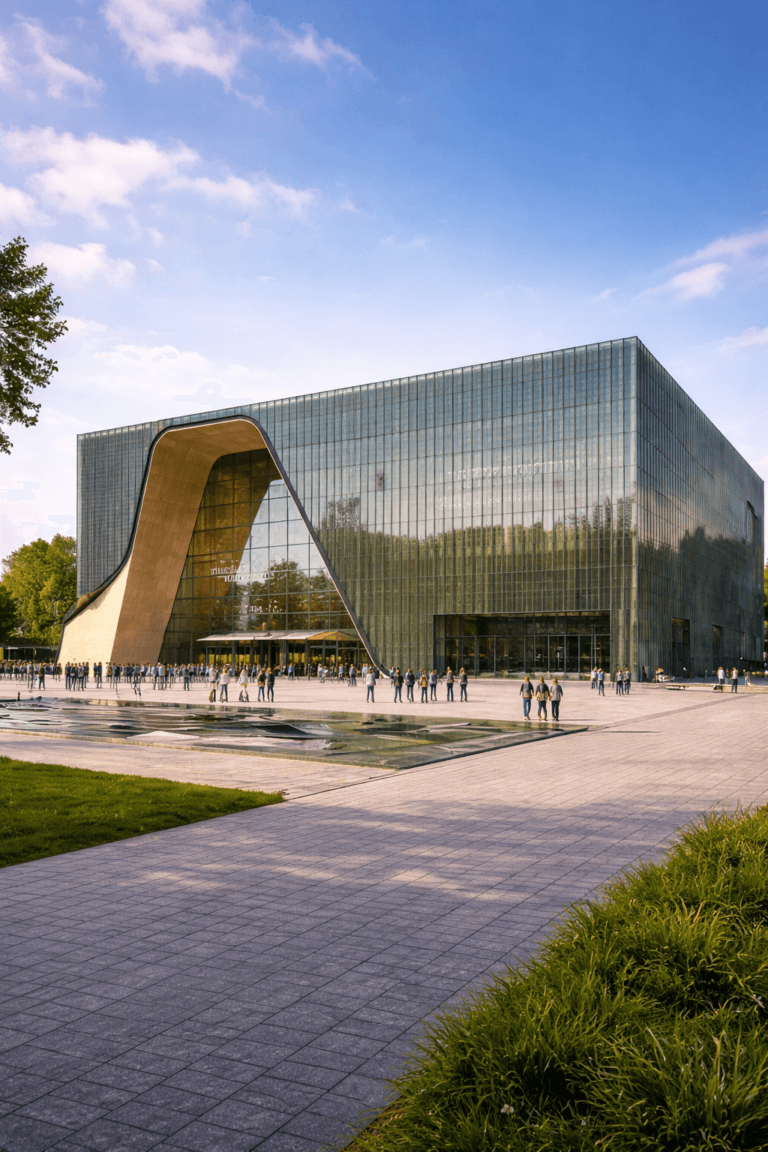
The museum building in Warsaw has a strong architectural identity. Its exterior has a monumental clarity, while the interior entrance hall creates a dramatic spatial gesture that many visitors remember immediately. The building’s modern design suits the institution because it communicates public seriousness without imitating historical architecture. It feels like a contemporary civic museum built to house difficult and expansive history.
The location is equally important. Standing in an area indelibly associated with the destruction of Jewish Warsaw, the museum operates in constant dialogue with the city outside it. This relationship between building and site gives the visit added weight and makes the museum’s broader historical approach even more necessary.
Visitor Experience
The visitor experience at POLIN is substantial and best approached with time and concentration. The museum rewards careful reading and sustained attention because its strength lies in sequence and context rather than in rapid visual spectacle. Visitors move through a series of historical environments and interpretive sections that gradually build a larger understanding of Jewish life in Poland across centuries.
Because the museum balances immersive design with serious interpretation, it remains accessible to general audiences without becoming shallow. It is particularly strong for visitors who want historical depth rather than a brief summary. The emotional register also changes as the galleries progress, giving the visit rhythm and seriousness without flattening every section into the same tone.
Why Visit
POLIN Museum of the History of Polish Jews is worth visiting because it presents one of Europe’s most important cultural histories with unusual depth, dignity, and clarity. It is essential for visitors interested in Jewish history, Polish history, twentieth-century Europe, urban memory, and museum interpretation at a high level. The museum also stands out because it insists on life, culture, and continuity as part of the story, not only catastrophe.
That broader vision gives the institution lasting value. It is not only a museum about loss. It is a museum about presence, creation, and historical scale.
Practical Information
The museum should be planned as a major visit rather than a quick stop. The permanent exhibition is extensive and benefits from a measured pace. Visitors interested in Warsaw’s twentieth-century history will find it especially useful to place POLIN within a wider itinerary that includes related memorial and historical sites in the city. Comfortable footwear is advisable because the galleries cover a substantial chronological and physical route.
Those with a serious interest in history may wish to allow extra time for the permanent exhibition rather than attempting to combine the museum with too many other major institutions on the same day.