National Museum of Scotland
About: Start in the Grand Gallery and then move through the Scottish history collections before exploring the science, design, and world culture.
Best forMasterpieces, architecture, cultural history
Setting / nearbyEurope
Overview
The National Museum of Scotland is one of the most rewarding museums in the United Kingdom and one of the best places to understand Scotland through a mix of history, science, design, archaeology, technology, and national memory. Located in Edinburgh, it is not a museum with a single narrow identity. That is one of its greatest strengths. Instead of reducing Scotland to one story—whether medieval kings, Highland myth, industrial progress, or scientific achievement—the museum shows how all of these strands belong to the country’s larger cultural fabric. It is a museum of breadth, but also a museum of strong character.
What makes the National Museum of Scotland especially compelling is the way it combines national history with a wider curiosity about the world. Some museums of this scale become too scattered, but here the variety usually works because the institution has a strong public purpose. It is trying to explain Scotland, but it is also trying to show how Scotland has related to invention, empire, collecting, global exchange, and modernity. That gives the museum a wider intellectual range than a strictly national-history museum might offer. A visitor can move from prehistoric material to royal history, from scientific instruments to decorative arts, from industrial technology to natural history, and still feel that the museum is building a coherent impression of a country and its place in the world.
The museum is also especially memorable because of its atmosphere. It is one of those institutions where the building, the circulation, and the changing rhythm of the galleries matter almost as much as the objects themselves. Large central spaces, quieter side galleries, and shifts between dramatic and intimate displays help keep the visit alive. This is important in a museum of such breadth. Without that sense of rhythm, the experience could become exhausting. Instead, the National Museum of Scotland often feels generous and exploratory, allowing different kinds of visitors to find their own way through it.
For visitors to Edinburgh, the museum is especially useful because it offers both orientation and depth. The city itself is full of dramatic architecture, political symbolism, and layered history, but the museum gives those things a broader framework. It helps explain how Scotland’s history reaches back into prehistory, how its identity was shaped through monarchy, religion, trade, industry, and empire, and how science and design became central to its modern self-image. That makes it not only a fine museum in its own right, but one of the most helpful places to begin understanding the country.
Collection Highlights
The sections devoted to Scottish history and archaeology are among the museum’s greatest strengths. These galleries help anchor the institution and give the visitor a long chronological view of Scotland that goes well beyond romantic cliché. Prehistoric material, early tools, carved stones, medieval artefacts, and objects from later historical periods make clear that Scotland’s story is deep, regionally varied, and materially rich. These galleries are especially important because they show that national identity is not only built through famous battles or political events. It is also built through settlement, worship, craft, survival, and daily life over many centuries.
The museum’s archaeological holdings are particularly rewarding because they offer evidence of very long continuity in the Scottish landscape. Objects from early settlement, ritual sites, and domestic life help visitors understand the country before the emergence of the familiar later political story. This gives the museum depth and prevents it from feeling too centered on modern nationalism alone. Scotland appears here as a place with ancient roots and changing layers of human presence.
Science, technology, and invention are another defining strength of the museum. This is one of the areas where the National Museum of Scotland becomes more than a conventional national museum. It shows how central scientific thought, engineering, medicine, and industrial innovation have been to Scottish history and international influence. These galleries often feel especially fresh because they connect national identity to curiosity, experiment, and practical achievement. They also broaden the audience, making the museum appealing not only to visitors drawn to history or archaeology, but also to those interested in design, machines, and the making of the modern world.
Decorative arts, design, and objects of craft add another important dimension. These galleries help show that Scotland’s story is not only political or industrial. It is also a story of taste, making, domestic life, and aesthetic ambition. Textiles, furniture, silver, ceramics, and design objects give the museum a richer and more human texture. They remind visitors that historical identity is often expressed through the things people live with, wear, build, and treasure.
The museum is also particularly effective in its treatment of iconic national objects and themes. It knows how to present highlights without allowing them to flatten the institution into a greatest-hits display. This balance is one of its real achievements. Famous objects matter here, but they are usually supported by enough context that they become part of a larger historical field rather than standing alone as patriotic symbols.
Building and Setting
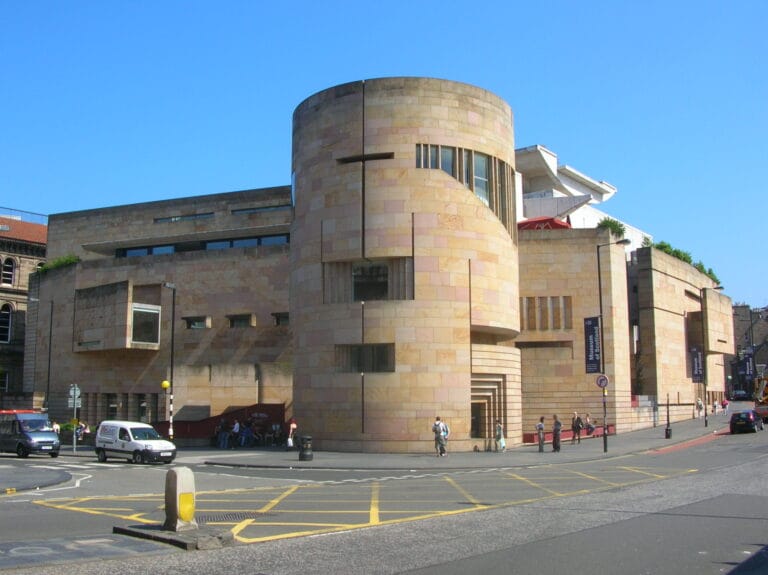
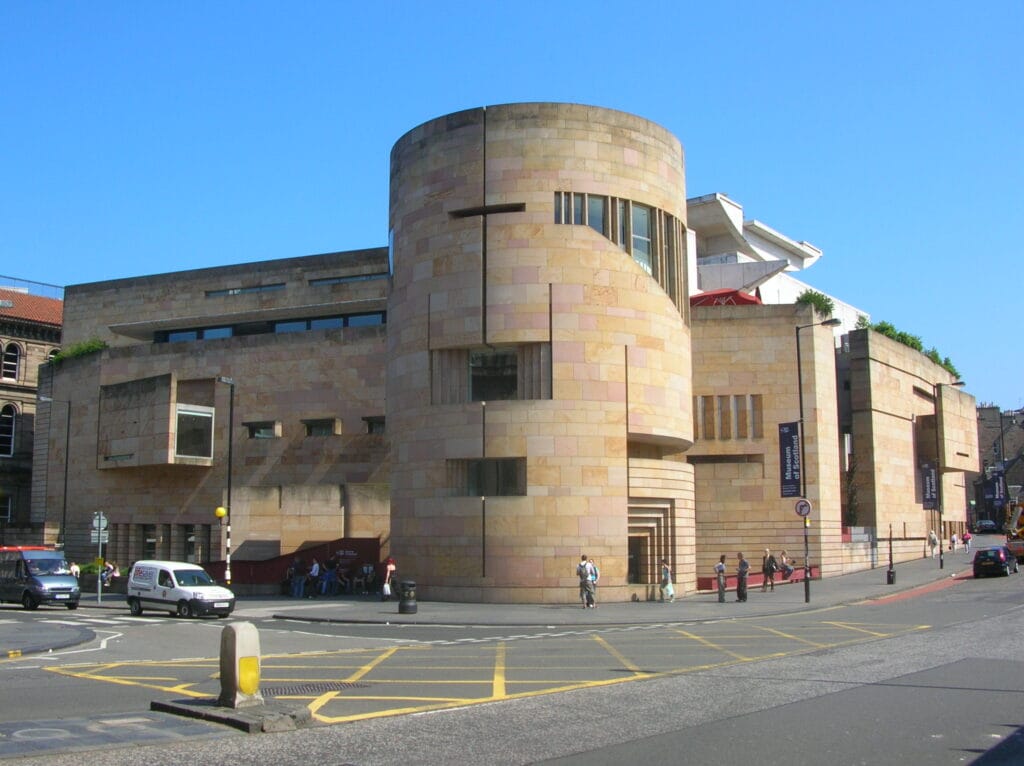
The building is one of the museum’s most memorable qualities. It gives the institution a strong physical identity and helps organize the visitor’s experience of what could otherwise feel like an overwhelming amount of material. The grand central interior spaces are particularly important. They create a sense of openness and orientation that makes the museum feel welcoming rather than crowded, even when many different themes are in play. This is one reason the institution works so well. Its architecture helps visitors breathe between departments.
The older and newer parts of the museum also contribute to its appeal. There is a sense of layered institutional history here, which suits a museum devoted to a country with such a layered identity. The building feels civic and substantial without becoming overly formal or remote. It is a museum meant for public use, and that public character comes through clearly.
Its setting in Edinburgh adds another level of importance. The museum is deeply embedded in a city already saturated with history, scholarship, and national symbolism. That means the visit does not feel detached from its urban context. Instead, it becomes part of the wider experience of Edinburgh as a city of learning, memory, and public culture. The museum helps connect the city’s visible grandeur to longer and broader histories that are less obvious on the street.
Practical Information
The National Museum of Scotland is best approached with some selectivity. It is broad enough that trying to see everything in one pass often weakens the experience. A very good strategy is to combine one major historical route—such as Scottish archaeology and history—with one contrasting area such as science and technology or design. This gives the visit shape while still allowing the museum’s wider identity to come through.
The museum rewards slower looking in the Scottish history sections, where many of the most meaningful objects are not necessarily the largest or most dramatic. At the same time, the larger central spaces and more visually immediate galleries help keep the experience lively. This variation in pace is one of the museum’s strengths and should be used rather than resisted.
Breaks are worthwhile, because the museum’s range can be mentally tiring even when the building feels comfortable. A paced visit is almost always better than a rushed attempt at full coverage.
Why Visit
The National Museum of Scotland is best for visitors who want a serious introduction to Scotland, travelers interested in archaeology and history, and anyone who values museums that bring together national identity, science, design, and cultural memory in one place. Its greatest strength is its breadth combined with coherence. It does not present Scotland as one simple story. It presents it as a layered, inventive, historically deep society shaped by land, belief, making, and knowledge.
What makes it worth prioritising is that it offers both national specificity and wider intellectual range. You can come for Scottish history and leave thinking just as much about science, craft, technology, or the global dimensions of collecting and exchange. That openness is one of the reasons the museum stays with people.
For many visitors, it becomes one of the essential museum experiences in Edinburgh because it feels both substantial and alive. It is not only informative. It is spacious, varied, and genuinely engaging. That makes it one of Scotland’s key cultural institutions and one of the most rewarding museums in the country.