National Museum of Ghana
The National Museum of Ghana in Accra, Ghana, is one of the country’s principal historical institutions and one of the longest-established.
Best forScience, technology, hands-on learning
Setting / nearbyAfrica
Overview
The National Museum of Ghana in Accra is one of the country’s most important cultural institutions and one of the clearest places to begin understanding Ghana through material culture, history, and artistic tradition. As a national museum, it carries a role that is broader than that of a specialist museum. It is not limited to one city, dynasty, or artistic school. Instead, it presents Ghana as a country shaped by many regions, peoples, traditions, and historical experiences. That broad perspective makes it especially valuable for visitors who want more than isolated objects. It offers a framework for understanding how Ghana’s cultural identity has been built across time.
What makes the museum especially compelling is the way it brings together archaeology, ethnography, art, and national history. In many museums, these areas can feel separate, but here they are most effective when seen as part of one larger story. Objects connected to daily life, ritual, craftsmanship, authority, trade, and artistic expression help show that culture is not a narrow museum subject. It is the fabric of lived life. This gives the museum a human quality that makes the visit more meaningful than a simple chronological display would be.
The museum is also important because it offers an introduction to Ghana that is grounded in objects rather than slogans. Visitors often arrive with general ideas about West Africa, but a museum like this makes those ideas more specific and more tangible. Through tools, textiles, carvings, regalia, musical instruments, and archaeological material, Ghana appears not as an abstract nation-state but as a place of deep history, cultural richness, and regional variation. That grounding is one of the museum’s greatest strengths.
For visitors to Accra, the National Museum of Ghana works especially well as a starting point. It provides context that can deepen the rest of a trip, whether one later visits markets, historic coastal sites, art spaces, or communities outside the capital. In that sense, it is not only a museum to see in itself. It is also a museum that makes the wider country more legible.
Collection Highlights
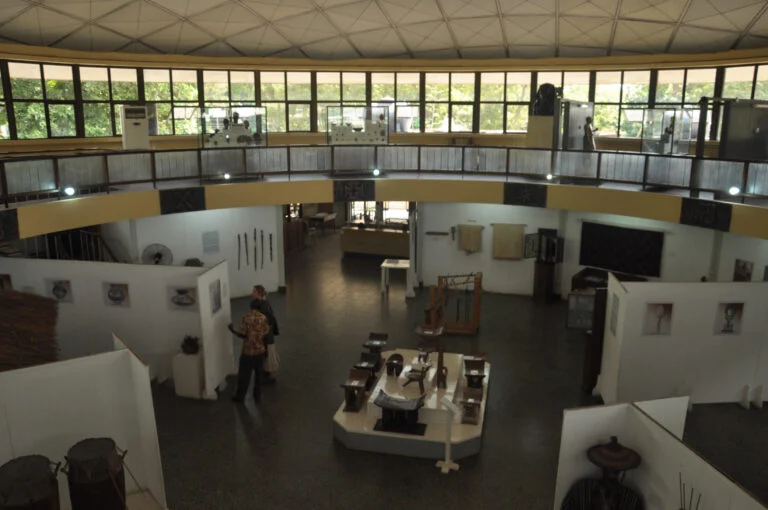
One of the museum’s main strengths is the variety of its collections. A national museum should not feel narrowly focused, and this one is most rewarding when it shows the many ways culture can be expressed through objects. Traditional stools, textiles, masks, jewelry, pottery, woodcarving, and musical instruments often provide some of the most immediate visual interest. These kinds of objects matter not only because they are attractive or skillfully made, but because they reflect systems of belief, authority, social role, and everyday life.
Textiles and regalia are especially important in a Ghanaian context. Objects of dress, woven cloth, adornment, and ceremonial display can reveal much about status, identity, and regional tradition. They also help visitors see how material culture operates in public life, not only in private settings. Museums become stronger when they show that objects once had active roles in society rather than existing only as things to be looked at, and that is one of the most valuable perspectives such collections can provide.
Archaeological material adds another important layer. A national museum gains depth when it shows that the story of the country does not begin in the colonial period or with modern statehood. Earlier settlements, trade networks, technologies, and cultural practices all help create a longer historical frame. Even smaller archaeological objects can be powerful in this respect, because they show continuity, adaptation, and the long development of communities over time.
Ethnographic collections also play a major role. These can be particularly effective when they reveal diversity within Ghana rather than trying to compress the whole country into one simplified cultural image. A strong museum visit allows visitors to understand that Ghana is culturally rich and internally varied, with many traditions coexisting and influencing one another. That complexity is one of the museum’s real strengths.
Building and Setting
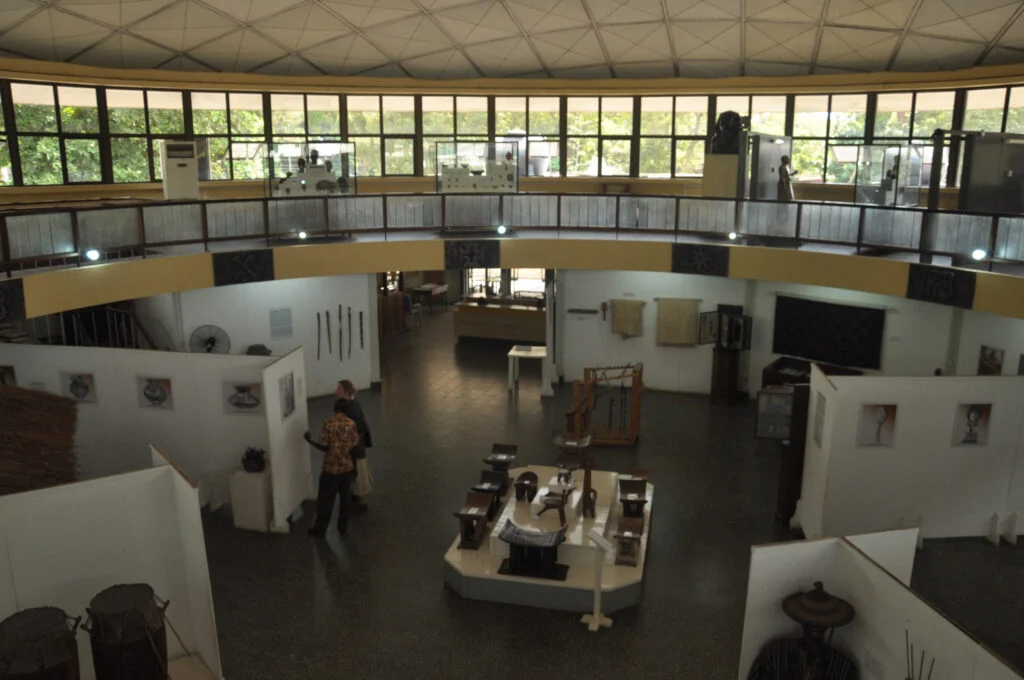
The setting of the National Museum of Ghana contributes to its identity as a public institution. A national museum in a capital city has a civic role as well as a cultural one. It stands not only as a place of preservation, but as a place where the country presents itself to citizens, students, and visitors. That civic function gives the museum a particular importance. It is part of how national culture is made visible in public space.
Architecturally, the museum’s value lies less in spectacle than in purpose. This is not the kind of institution that depends on a dramatic contemporary building to create its effect. Instead, its strength comes from the seriousness of its role and the breadth of its collections. For a museum concerned with historical and cultural grounding, this can be an advantage. The attention stays on the objects and the stories they carry.
Its location in Accra also matters. As the capital, Accra is a place where political, cultural, and social life intersect, and the museum belongs naturally within that environment. For visitors, this means the museum does not feel isolated from the life of the country. It feels like part of the larger setting in which contemporary Ghana continues to define and reinterpret itself.
The atmosphere of the museum is likely to be most rewarding when approached with patience. Museums of history and ethnography often reveal their strengths gradually rather than through one overwhelming visual moment. The National Museum of Ghana is best understood as a place of accumulation, where many objects together create a richer picture of the country than any single display could offer on its own.
Practical Information
The National Museum of Ghana is best visited at a steady pace, with enough time to move through the different sections rather than treating it as a quick stop. Museums with broad cultural collections often become more valuable the longer one spends with them, because the connections between archaeology, art, social life, and tradition begin to emerge gradually.
It is especially useful for visitors early in a trip to Ghana. As an introduction to the country, it provides context that can make later travel more meaningful. But it is also worthwhile later in a journey, when travelers may return with a clearer sense of how local traditions and objects connect to places they have already seen.
This is also the kind of museum that rewards curiosity rather than speed. Smaller details in labels, materials, and object types often matter just as much as the best-known highlights. Visitors interested in history, cultural heritage, African art, or West African societies are likely to find it especially rewarding.
As always, it is sensible to check current official visitor information before going, especially for opening hours and entry arrangements. But in general terms, the museum is best treated as a meaningful cultural visit rather than a brief add-on in Accra.
Why Visit
The National Museum of Ghana is worth visiting because it offers one of the clearest object-based introductions to Ghana’s cultural and historical life. It brings together material that helps visitors understand the country not as a single simple narrative, but as a place shaped by many traditions, regions, and historical layers. That breadth gives the museum lasting value.
It is also worth visiting because it reminds visitors that national history is not only political history. It is also carried in textiles, carvings, tools, regalia, ritual objects, and the material traces of everyday life. Those objects make culture visible in ways that books or general summaries often cannot.
If you want a museum in Accra that provides context, depth, and a strong sense of Ghana’s cultural richness, the National Museum of Ghana is one of the clearest choices. It is a thoughtful and grounding museum visit, and one that can deepen the rest of a journey through the country.