Baltic Maritime Museum
About: The Baltic Maritime Museum in Gdańsk is one of the most rewarding places in northern Europe for understanding how the sea shaped a city, a region.

Best forMaritime history, ships, harbour heritage
Setting / nearbyEurope
Overview
The Baltic Maritime Museum is the kind of institution that speaks not only to maritime specialists but also to general visitors interested in trade, exploration, naval history, and the relationship between people and the sea. Museums of this type are often strongest when they show that maritime history is not a separate subject on the margins of national history, but one of the forces that shaped commerce, migration, shipbuilding, fishing, warfare, and everyday coastal life. That is what gives the Baltic Maritime Museum its value. It opens a window onto the wider world of the Baltic Sea and the communities connected to it.
The Baltic region has long been a place of exchange. Goods, ideas, technologies, and people moved across these waters for centuries, linking ports and coastal towns in ways that influenced politics and culture as much as economics. A museum devoted to that history naturally carries a broad subject. It is not only about ships as technical objects, though those matter. It is also about sailors, merchants, dockworkers, fishermen, naval crews, travelers, and the industries that depended on maritime routes. When a museum handles this well, visitors come away with a stronger understanding of how the sea shaped the development of an entire region.
This makes the Baltic Maritime Museum appealing to several kinds of audiences at once. Families may be drawn by ship models, larger displays, and the visible drama of maritime technology. History-minded visitors often appreciate the way the museum connects local stories to wider European developments. Travelers exploring the Baltic region may also find that a maritime museum provides exactly the kind of context that makes a port city or coastal setting more meaningful. It helps explain why the place looks the way it does and why its history unfolded in particular directions.
A good maritime museum also tends to balance material culture with atmosphere. The subject itself invites imagination: storms, voyages, shipyards, harbors, navigation, and the difficult realities of life at sea. The Baltic Maritime Museum benefits from this built-in narrative richness. Even when the displays are quiet and scholarly, the subject carries movement and tension. That gives the museum a strong presence and makes it more memorable than many institutions with a narrower focus.
Collection Highlights
The collection at a maritime museum is usually most effective when it combines technical, historical, and human perspectives, and the Baltic Maritime Museum fits that pattern well. Ship models are often among the most immediately attractive displays, because they allow visitors to see changes in design, scale, and function across time. A carefully made model can explain a great deal about trade, fishing, naval power, or shipbuilding traditions. In maritime museums, such objects are rarely just decorative. They are tools for understanding how vessels were built, how they moved, and what kind of world they belonged to.
Beyond models, maritime collections often include navigational instruments, maps, uniforms, paintings, photographs, cargo-related objects, ship equipment, and documents connected to trade routes or coastal industries. Together, these displays build a fuller picture of the Baltic maritime world. A compass, sextant, logbook, or chart may appear modest beside a larger vessel display, yet these objects often bring visitors closer to the practical realities of navigation and seafaring. They remind us that maritime history depended not only on powerful ships but also on knowledge, skill, and routine discipline.
Another strength of the museum lies in the way maritime history connects different social levels. A collection may include material linked to naval command or large-scale commercial trade, but it can also reflect everyday work and life at sea. Fishing communities, shipyard labor, port activity, and coastal households all belong to the maritime story. This broadens the museum’s perspective and prevents the subject from becoming too narrowly technical or military. The best maritime museums show that the sea shaped whole societies, not only the lives of captains and merchants.
There is also often a visual richness to maritime collections that helps them reach a broader public. Ships are inherently dramatic objects, and the culture around them produces striking materials: carved details, maritime art, harbor imagery, engineering components, and personal belongings carried on voyages. Even visitors without a deep prior interest in naval history can usually find something engaging in this mix. That is part of the Baltic Maritime Museum’s appeal. It can introduce complex history through objects that are both informative and visually strong.
Building and Setting
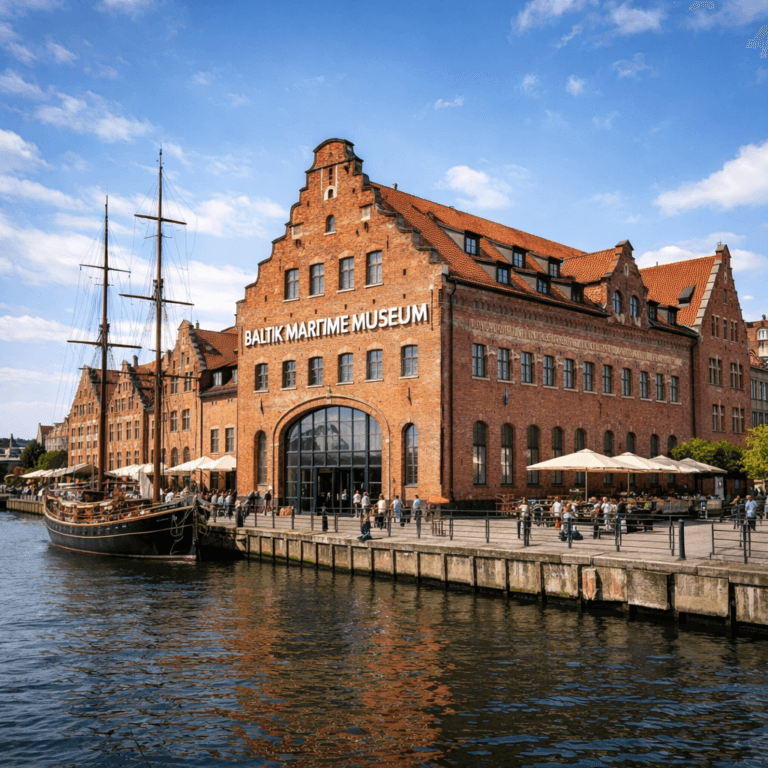
The setting of a maritime museum matters almost as much as the collection itself. Maritime history is closely tied to place, and visitors often experience these museums differently from inland history museums because the subject feels rooted in coastlines, ports, and working waterfronts. The Baltic Maritime Museum benefits from that kind of context. Whether approached as part of a broader visit to a coastal city or as a destination in its own right, it carries the atmosphere of a museum shaped by the sea rather than merely describing it.
This relationship between content and setting helps give the museum a natural sense of coherence. Maritime collections can sometimes seem overly technical if shown in a neutral space without context. In a more fitting environment, however, ships, trade, and navigation feel immediately grounded. The visitor is reminded that the Baltic Sea was not an abstract subject but a lived environment that connected settlements, industries, and states over long periods of time.
Architecturally, maritime museums often work best when they allow room for scale. Even when they do not contain full historic ships, the subject demands display spaces that can accommodate large models, machinery, and objects linked to industrial or naval history. The Baltic Maritime Museum gains from this sense of spatial openness. Maritime history needs room to breathe. Visitors should be able to sense the physical scale of vessels and the ambition of maritime engineering, even when encountering those ideas through models, tools, or documentary material.
The setting also contributes emotionally. Museums of maritime history often carry a mix of industry, adventure, hardship, and regional pride. A well-designed or well-situated museum allows these tones to coexist. It can feel educational without becoming dry, and atmospheric without turning theatrical. That balance is important. The Baltic Maritime Museum is at its strongest when it lets the material speak clearly while still allowing visitors to feel the pull of the subject itself.
Practical Information
The Baltic Maritime Museum is usually best visited with enough time to move through the galleries at a steady pace. Maritime collections tend to reward slower looking because many displays gain meaning from labels, diagrams, and contextual material rather than from visual impact alone. A quick visit may still be enjoyable, especially for those mainly interested in ship models or standout objects, but a fuller visit offers a much better sense of the museum’s historical range.
It is a strong choice for different audiences. Families may appreciate the visual appeal of maritime displays, while adults with an interest in trade history, naval development, regional identity, or transport history are likely to find more depth in the galleries. Travelers who are exploring a Baltic port or coastal destination may also benefit from starting or ending with the museum, since it helps place the surrounding city or landscape in historical context.
As with any museum visit, it is wise to check the official website before going for current opening hours, admission details, temporary exhibitions, and visitor guidance. Practical arrangements can change, and maritime museums sometimes host special exhibitions, ship-related programming, or seasonal events that may affect the visit.
Because maritime history is such a broad subject, it also helps to arrive with realistic expectations. This is not only a museum about beautiful ships. It is also about work, trade, navigation, technology, and the systems that connected Baltic communities over time. Visitors who embrace that wider frame are likely to get more out of the experience.
Why Visit
The Baltic Maritime Museum is worth visiting because it turns a regional subject into something much larger. It shows that the sea was not simply a backdrop to Baltic history but one of its central forces. Through ships, instruments, archival material, and broader cultural interpretation, the museum reveals how maritime life shaped economies, identities, and connections across borders.
It is also the kind of museum that gives substance to place. For travelers in the Baltic region, visiting a maritime museum can deepen the meaning of everything outside it: harbors, old warehouses, shipyards, waterfront districts, and trading histories all become easier to understand. The museum therefore works not only as an attraction on its own terms but also as a key to reading the wider environment.
For museum visitors, its appeal lies in the combination of strong subject matter and broad accessibility. Maritime history has natural drama, but it also offers real historical depth. That combination makes the Baltic Maritime Museum a rewarding stop for anyone interested in how objects, landscapes, and human movement come together in one of Europe’s most important regional histories.
If you want a museum that combines technology, trade, regional identity, and the enduring presence of the sea, the Baltic Maritime Museum is an excellent choice. It is informative, grounded, and full of the kind of historical texture that stays with you after the visit.