The National Museum of Korea
About: Choose one era and follow it. The outdoor spaces and cafés make it comfortable for long visits.What to see: Start with the signature galleries.

Best forMasterpieces, architecture, cultural history
Setting / nearbySeoul, it is not simply a national treasure house
Overview
The National Museum of Korea is one of the most important museums in Asia and the clearest place to understand the long history of Korean art, material culture, and state formation through a collection of exceptional depth. Located in Seoul, it is not simply a national treasure house. It is a museum that presents Korea through continuity: ancient kingdoms, Buddhist art, ceramics, metalwork, painting, calligraphy, scholarship, court culture, and later historical developments all unfold in a way that helps even first-time visitors feel oriented. This is one of the museum’s greatest strengths. Rather than overwhelming visitors with disconnected masterpieces, it gives them a framework for following Korean history across time.
What makes the museum especially rewarding is that Korean art often reveals its force gradually. It does not always depend on monumental scale or immediate visual excess. Much of its power lies in refinement, balance, technical control, and the relationship between material and restraint. The National Museum of Korea is strong because it gives that sensibility enough space to emerge. A celadon vessel, a Buddhist sculpture, a gilt-bronze object, a calligraphic work, or a scholar’s painting may appear quiet at first, but in the museum’s broader context these works begin to show enormous historical and cultural weight.
The museum is also important because it helps visitors understand Korea on its own terms rather than only through comparison with neighboring China or Japan. That is one of its deepest values. Many visitors arrive with only a general impression of East Asian art, but the museum makes clear that Korean traditions have their own rhythm, forms, and historical trajectories. This is especially visible in ceramics, Buddhist art, metalwork, and later literati culture. The museum therefore works as both an introduction and a correction. It not only presents Korean history; it also insists on the distinctiveness of Korean artistic achievement.
Another major strength is that the institution is built for long, serious visits. It is large, calm, and unusually comfortable as a museum environment. Outdoor spaces, generous circulation, and places to pause make it possible to spend substantial time there without feeling trapped. This matters, because the collection is rich enough that rushing almost always weakens the experience. The museum becomes far more rewarding when visitors choose a line through it and allow the works to build meaning gradually.
Collection Highlights
The museum’s greatest strengths include its Buddhist sculpture and religious art. These galleries are among the most important parts of the visit because they reveal how deeply Buddhism shaped Korean visual culture across many centuries. Gilt-bronze Buddhas, contemplative bodhisattvas, stone sculpture, and related ritual objects often carry a stillness and concentration that can be very powerful in person. These works do not usually rely on theatrical display. Their force comes from form, posture, expression, and the long cultural history behind them. For many visitors, these galleries become some of the most memorable precisely because they are so composed.
Korean ceramics are another defining highlight and one of the clearest reasons the museum is internationally important. Celadon in particular is central to the museum’s identity. These works often reward slow looking rather than instant reaction. Their beauty lies in shape, glaze, tone, and precision, and the museum’s displays help visitors understand why Korean ceramics hold such a special place in art history. What may first seem restrained begins to feel extraordinarily controlled and refined. This is one of the museum’s major achievements: it teaches visitors how to see quality in subtle form rather than only in spectacle.
The galleries devoted to ancient kingdoms and early Korean material culture are also essential. These sections provide the historical framework needed to understand later developments. Gold crowns, tomb objects, metalwork, ritual artefacts, and archaeological material help establish that Korean history was shaped by powerful states, regional identities, long-distance exchange, and sophisticated craft traditions from very early periods onward. These rooms are important not only for their beauty, but because they anchor the museum’s larger historical narrative.
Paintings, calligraphy, and later courtly or scholarly materials add another layer. These sections can be especially rewarding for visitors willing to slow down. They show that Korean artistic achievement does not end with sculpture and ceramics. Literati culture, ink traditions, scholarship, and court aesthetics all appear in ways that deepen the museum’s understanding of refinement and intellectual life. The museum becomes stronger when these quieter sections are not skipped in favor of only the most obviously famous objects.
The museum is also effective because it lets different categories illuminate one another. A Buddhist sculpture may change the way you see a painting. A celadon vessel may sharpen your understanding of court taste. An archaeological object may give a later decorative form historical depth. This cumulative quality is one of the museum’s greatest strengths. It is not a collection of isolated wonders, but a deeply structured historical field.
Building and Setting
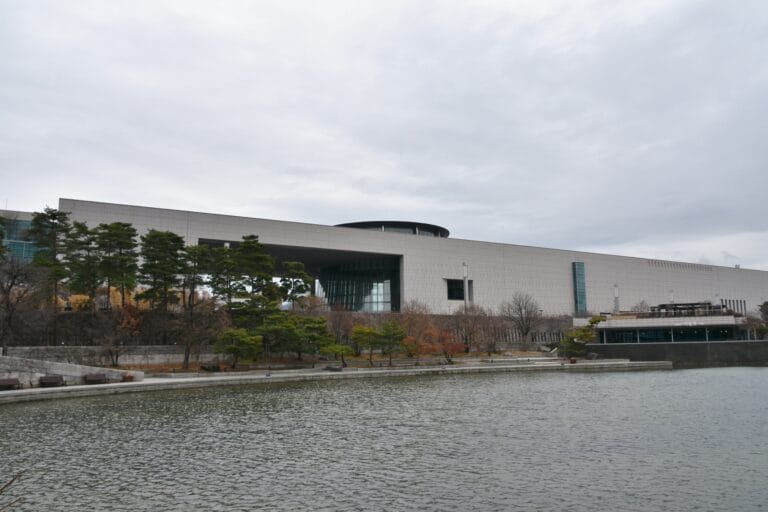
The museum building contributes strongly to the experience. It has the scale and calm expected of a major national institution, but it does not feel oppressive or ceremonially distant. Instead, it offers broad, clear spaces that help the visitor stay oriented across a very large collection. This is important in a museum where the works often reward concentration and context rather than fast visual consumption. The architecture supports that by providing order, quiet, and room to breathe.
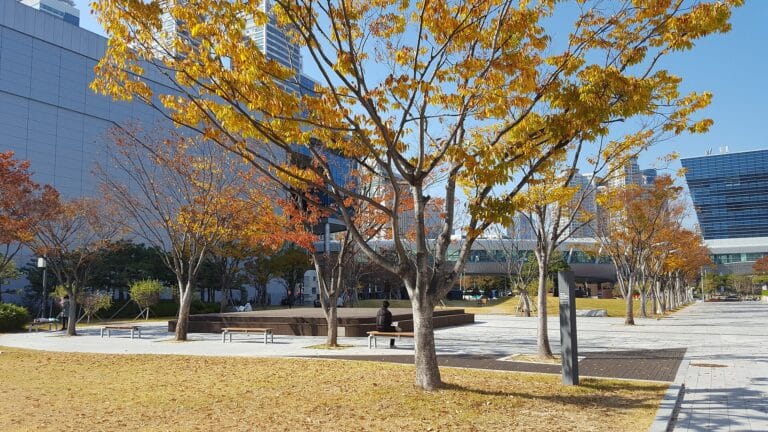
One of the museum’s practical and aesthetic strengths is its relationship to outdoor space. This helps distinguish it from many large museums that become exhausting because visitors are sealed indoors for hours. Here, the possibility of stepping out, pausing, and re-entering the galleries improves the rhythm of the visit. The museum is built for long stays, and those pauses are part of what makes a long visit possible.
Its location in Seoul also matters. As a national museum in a major capital, it carries the weight of representing Korea publicly, but it does so without excessive monumentality. The building feels serious and important, yet still accessible. That balance suits the collection well. It gives the museum national presence without overwhelming the objects inside.
Practical Information
The best practical advice is to choose one era or one line through the museum rather than attempting to see everything in a single rush. The institution is large enough that trying to cover all departments too quickly usually leads to fatigue and weak memory. A far better approach is to begin with one strong anchor—perhaps ancient kingdoms, Buddhist art, or ceramics—and then follow that thread into adjacent sections.
The museum rewards slow looking. This is especially true in galleries of ceramics, Buddhist sculpture, and calligraphy, where quality often lies in subtlety. Visitors used to more immediately dramatic museums may need to adjust their pace. Once they do, the museum becomes much richer.
The outdoor spaces and cafés are genuine advantages. They make the museum more comfortable for long visits and help preserve concentration. This is one of those institutions where breaks improve the experience rather than interrupting it.
Why Visit
The National Museum of Korea is best for history and art lovers, first-time visitors to Seoul, and anyone who wants to understand Korean civilization through one major institution of exceptional depth. Its greatest strength is the way it presents Korean history as a coherent cultural tradition while still allowing for complexity, regional variety, and stylistic change. It teaches through continuity rather than noise.
What makes it worth prioritising is that few museums in Asia present a national artistic tradition with such seriousness, calm, and clarity. The Buddhist sculpture is powerful, the ceramics are world-class, the archaeological material is rich, and the broader historical structure helps all of these things make sense together. The museum does not force itself on the visitor through spectacle. Instead, it rewards patience and attention with steadily deepening understanding.
For many visitors, it becomes one of the essential museum experiences in Seoul because it offers both beauty and orientation. It is not only a museum of treasures, but a museum of how Korea sees its own long cultural history. That makes it one of the strongest national museums in Asia and one of the most rewarding places to spend serious time in the city.