National Museum of Anthropology
About: Start with the Aztec hall, then follow the geography of Mexico. The courtyard architecture is iconic.What to see: Start with the signature.

Best forMasterpieces, architecture, cultural history
Setting / nearbyNorth America
Overview
The National Museum of Anthropology in Mexico City is one of the most important museums in the world and one of the clearest places anywhere to understand the depth, diversity, and historical richness of Mesoamerican and Indigenous cultures. Located in Chapultepec Park, it is not simply a museum of remarkable artefacts. It is a museum of civilizations, landscapes, belief systems, political orders, artistic traditions, and living cultural continuity. What makes it especially powerful is that it does not reduce Mexico’s past to one empire, one narrative, or one symbolic object. Instead, it presents a vast and layered history through archaeology, anthropology, architecture, and regional interpretation.
For many visitors, the museum is immediately overwhelming in the best possible sense. The scale of the institution, the quality of the collection, and the depth of the historical material make clear very quickly that this is not a short-stop museum. It is one of those institutions where even a selective visit can feel major. At the same time, the museum remains unusually legible for such a large place because its structure gives visitors a way into Mexico’s cultural geography. You are not only moving through time; you are moving through regions, traditions, and different ways of understanding what Mexico has been and still is.
One of the greatest strengths of the museum is that it combines archaeological grandeur with anthropological breadth. Many major museums of ancient civilizations focus almost entirely on monumental stone objects, rulers, gods, and ceremonial prestige. The National Museum of Anthropology certainly includes those things, and at a very high level, but it also widens the picture. It helps visitors understand daily life, belief, craft, environment, and the persistence of Indigenous worlds beyond conquest. That broader approach is one of the reasons the museum feels so intellectually serious. It is not only a museum of masterpieces. It is a museum of cultural worlds.
The museum is also deeply important because it remains central to Mexico’s own sense of cultural identity. This is not a museum that feels detached from the society around it. It is a major public institution that continues to shape how national history, Indigenous heritage, and civilizational continuity are understood. For visitors, that gives the museum unusual force. It is not simply a display for outsiders. It is a place of cultural definition, and that seriousness can be felt throughout the visit.
Collection Highlights
The Aztec, or Mexica, hall is one of the museum’s defining highlights and for many visitors the natural place to begin. It contains some of the most internationally recognized objects in the collection and immediately establishes the scale and ambition of the institution. Monumental sculpture, carved stone, ritual objects, and imperial imagery give the room an undeniable power. This is where many visitors encounter the famous Stone of the Sun, and in person it has far more weight and authority than reproduction suggests. Yet the hall is strongest not only because of one iconic object, but because the surrounding material helps place Mexica power, religion, warfare, and ceremony into a broader historical and symbolic framework.
The Maya galleries are another major strength. These rooms bring a different atmosphere and often a different aesthetic and intellectual texture to the museum. Where the Aztec hall can feel monumental and centrally political, the Maya material often opens into a wider world of writing, rulership, architecture, astronomy, and ceremonial life. Sculptures, reliefs, inscriptions, and objects from major Maya sites help the visitor understand how sophisticated and regionally varied this civilization was. These galleries are among the most rewarding for visitors willing to look closely and read carefully.
The Olmec material is also essential. The colossal heads and related objects give the museum some of its earliest and most memorable encounters with the formative periods of Mesoamerican civilization. These works are powerful partly because of their scale and partly because they suggest how deep the region’s cultural history runs. The museum becomes stronger when visitors do not treat the Olmec as merely a prelude to the later civilizations, but as a culture with its own extraordinary force.
The regional galleries are another major reason the museum stands out. This is where the institution becomes more than a sequence of famous civilizations. By moving through the geography of Mexico, visitors begin to understand that the country’s cultural history cannot be flattened into a single central story. Different landscapes, peoples, traditions, and material forms appear with their own integrity. This regional approach is one of the museum’s smartest features because it keeps the institution from feeling too centered on only the best-known imperial cultures.
The upper-level ethnographic and anthropological sections are also important. They remind visitors that Indigenous cultures in Mexico are not only subjects of the ancient past. They continue as living traditions with languages, beliefs, artistic forms, and local identities. This gives the museum moral and intellectual breadth. It does not end history with conquest or reduce living cultures to background context. Instead, it insists on continuity as well as antiquity.
Building and Setting
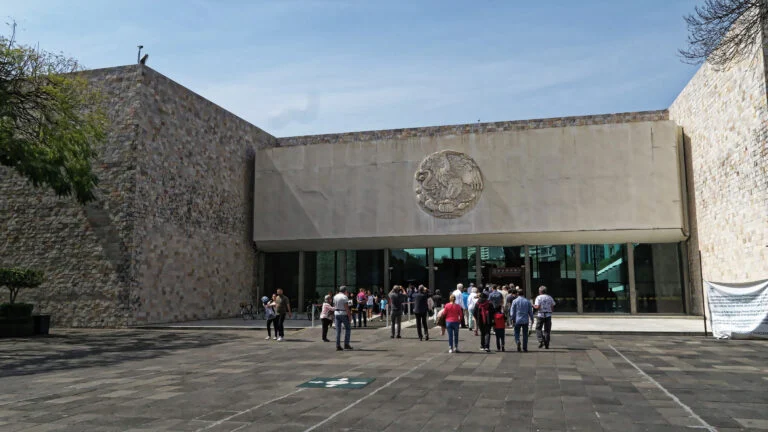
The museum building is one of the great achievements of twentieth-century museum architecture. Its broad courtyard and iconic central canopy create one of the most memorable museum spaces anywhere in the world. The architecture is monumental, but it does not crush the visitor. Instead, it provides a civic and ceremonial setting that suits the scale of the collection. The central courtyard acts as an orientation point, a place of pause, and a reminder that the museum is as much about shared public space as about enclosed galleries.
The building’s organization is one of its greatest practical strengths. For a museum of such size, it is remarkably clear in structure. The courtyard helps visitors re-set between halls, and the sequence of galleries allows the visit to unfold with some coherence even when the subject matter is vast. This is important because without architectural clarity, a museum of this scale could become exhausting very quickly.
Its location in Chapultepec also strengthens the visit. The museum feels connected to the wider cultural and civic life of Mexico City rather than isolated from it. That context matters. The institution is not a remote treasure house. It is part of one of the city’s major public landscapes, and that reinforces its national importance.
Practical Information
A very effective way to visit is to begin with the Aztec hall and then follow the broader geography of Mexico through the archaeological sections. This gives the visit an immediate anchor while also opening out into the wider regional richness of the museum. Trying to “do everything” in a single pass is rarely the best strategy. The museum is too large and too rich for that.
A good visit depends on pacing. The central courtyard is extremely useful as a reset point, and it should be used that way. Short pauses between major halls help the later galleries remain legible. The museum rewards slower attention, and it improves greatly when visitors allow themselves to focus deeply on several sections rather than hurrying through all of them.
If time allows, the upper-level sections on living Indigenous cultures should not be skipped. They are essential to the museum’s larger meaning and help complete the visit in a way that the archaeological halls alone cannot.
Why Visit
The National Museum of Anthropology is best for anthropology lovers, first-time visitors to Mexico City, history enthusiasts, and anyone planning a cultural itinerary around the strongest institutions in the Americas. Its greatest strength is that it combines world-class archaeological material with a broader anthropological understanding of Mexico’s cultural geography and living traditions.
What makes it worth prioritising is that it does not simply display masterpieces of the ancient past. It explains civilizations, regions, belief systems, and continuities in a way that remains accessible while still being intellectually serious. The architecture is iconic, the collection is extraordinary, and the institution’s broader cultural importance gives the visit real depth.
For many visitors, it becomes the essential museum of Mexico City because it offers something very few museums can: scale, beauty, scholarship, and national significance all working together at the highest level. It is not only one of the best museums in Mexico, but one of the great museums of the world.