Kwame Nkrumah Memorial Park and Mausoleum Review
Memorial Museums · Accra, Ghana. Kwame Nkrumah Memorial Park and Mausoleum, situated in Accra, Ghana, is primarily a site of memory dedicated to the life and legacy of Kwame Nkrumah, Ghana’s first president and a leading figure in African…
Memorial Museums · Accra, Ghana. Kwame Nkrumah Memorial Park and Mausoleum, situated in Accra, Ghana, is primarily a site of memory dedicated to the life and legacy of Kwame Nkrumah, Ghana’s first president and a leading figure in African…
Best forMuseum lovers, culture travelers, first-time visitors
Review focusCollections, visitor experience, and practical planning
Context and Identity
Kwame Nkrumah Memorial Park and Mausoleum, situated in Accra, Ghana, is primarily a site of memory dedicated to the life and legacy of Kwame Nkrumah, Ghana’s first president and a leading figure in African decolonization. Unlike comprehensive national museums or art institutions, it concentrates narrowly on a political biography and the symbolism attached to Nkrumah’s personal journey and Ghana’s independence movement. This choice sets its tone and scope. Rather than attempt to cover the broader Ghanaian history or cultural diversity, it focuses on a single figure emblematic of a specific era and ideology. This intense concentration on one man’s public and private trajectory lends the memorial a particular character, where architecture and collection serve political memory and national pride as well as historical record.
Nkrumah’s seminal role in Ghana’s independence from British colonial rule in 1957 and his advocacy for Pan-Africanism form the axis for the park’s narrative focus. At a time when many African countries were still under colonial rule, Nkrumah was a radical voice for self-determination and continental unity. The memorial’s identity is inseparable from this political symbolism and from how post-colonial Ghana has chosen to shape its historical memory around him. It is a monument as much as a museum, designed to enshrine a founding myth. This framing naturally restricts the breadth of the story but sharpens the interpretive lens on Nkrumah’s political philosophy, achievements, and the contradictions of his leadership, especially in light of his overthrow in 1966.
Inside the Collection
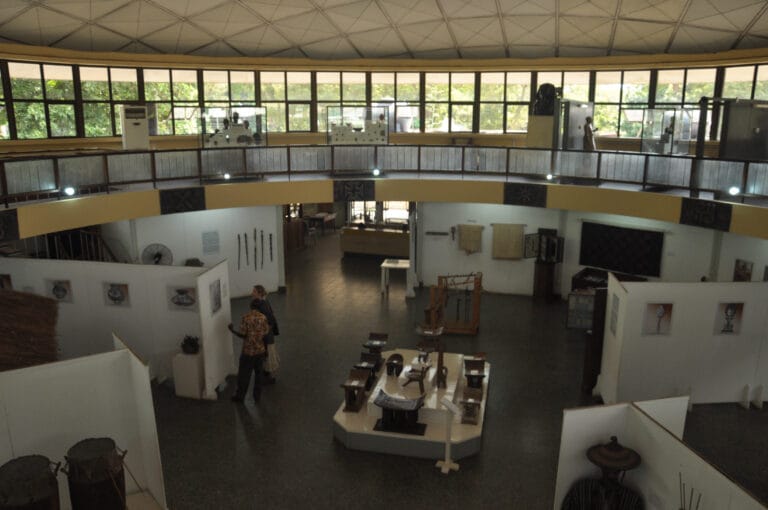
The collection here is not extensive in the conventional museum sense but is tightly curated around personal artefacts, photographs, archival materials, and artworks related to Nkrumah’s life. Items such as his clothing, manuscripts, letters, and official documents offer a tangible connection to Nkrumah’s public and private identities. These are supplemented by displays of medals, awards, and gifts from other heads of state, underscoring his international stature.
This is not a place for encyclopedic historical coverage, nor does it attempt to be. Instead, the material traces key moments of Nkrumah’s political career—the formation of the Convention People’s Party, speeches declaring independence, the construction of modern institutions under his government, and aspects of his exile. There are photographic panels and paintings presenting public events and scenes from daily life during his tenure, which provide contextual colour but remain subordinate to the commemorative focus.
One element that stands out is the use of symbolic objects, such as the urn containing Nkrumah’s remains, located within the mausoleum, which functions as the site’s physical and interpretive linchpin. Around this central feature, the artefacts and images combine to construct a layered historical narrative that is part biography, part political history, but with an explicit tone of reverence appropriate for a national shrine.
Architecture and Display
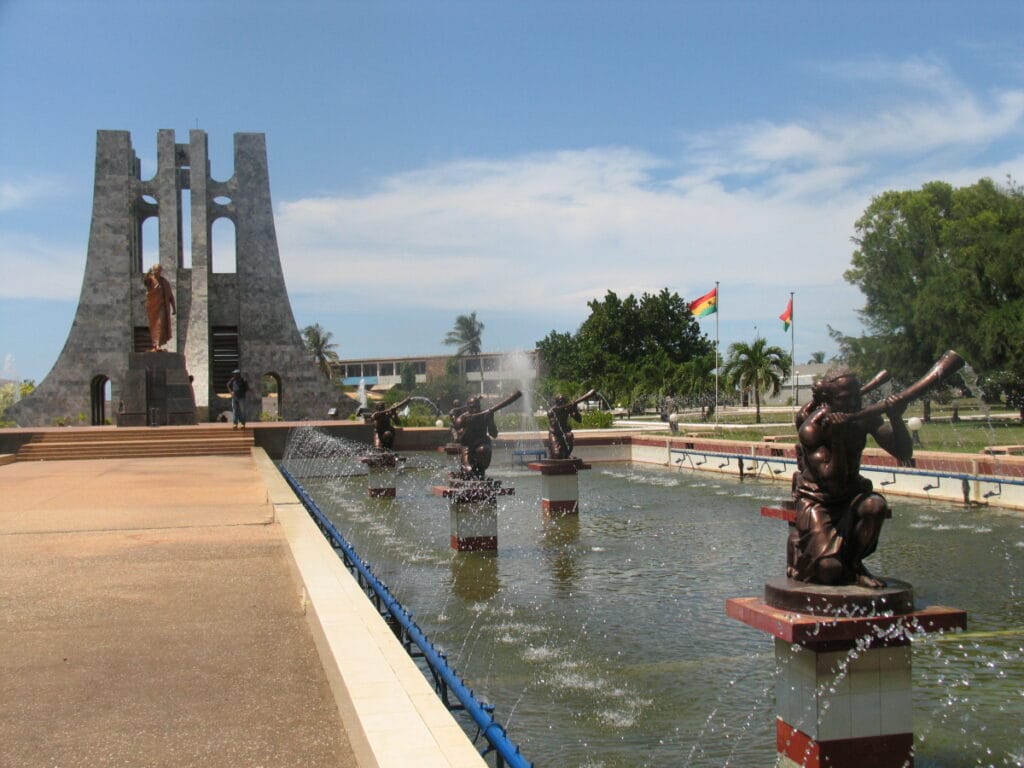
The architecture is integral to the identity and experience of the memorial. The park’s layout combines landscaped gardens with modernist architectural forms, most notably the mausoleum itself, capped with a striking black star—the emblem of Ghana’s independence and the broader Pan-African movement. This geometric symbolism is carried through in the tiled floors and the monument’s clean lines, which together convey a sense of solemnity and dignity.
Designed to evoke both public monument and private tomb, the mausoleum’s use of open space contrasts with the intimacy of the rooms exhibiting Nkrumah’s artefacts. The materials—primarily marble and polished stone—add to the formality and status of the environment. The interplay of light and shadow around the mausoleum also reinforces its symbolic dimension without overt theatricality.
Regarding display technique, the memorial employs straightforward presentation methods: artefacts housed in vitrines, large-format photographs, and explanatory plaques. This merits praise for clarity and preservation, although the interpretive material often sticks to straightforward factual description, with limited critical engagement or contextual nuance. The park offers a quiet dignity appropriate to a mausoleum but less interpretive depth or interactive engagement than might be expected in a broader historical museum.
For Families, Specialists, and First-Time Visitors
This memorial is highly focused, which means it holds particular appeal for visitors interested in African political history, post-colonial studies, and the biography of Nkrumah himself. Specialists studying independence movements or Pan-African ideas will find relevant primary material and symbolic representation concentrated here. The site’s role as a pilgrimage destination adds a cultural and political dimension outside pure museological terms.
Families or casual visitors not previously familiar with Ghana’s mid-twentieth century history might find the content narrowly tailored and moderately challenging without prior knowledge. The signage is mostly in English, the country’s official language, and provides necessary background, but there is limited accommodation for younger visitors or those seeking an interactive or multimedia experience. The solemn atmosphere also means it feels less like an informal cultural outing and more like a formal historical and memorial site.
First-time visitors require some historical context beyond the exhibits. Understanding Nkrumah’s significance demands awareness of colonial history, the independence movement, and Ghana’s post-colonial trajectory. For those who come equipped with this context, the material offers direct insight into Nkrumah’s legacy. For others, the memorial’s narrowly biographical and commemorative form may feel somewhat specialized, lacking broader narrative threads or thematic exploration of Ghanaian or African history more widely.
What Works Best
The memorial’s greatest strength is in encapsulating a complex political history within a compact, symbolically potent space. Its clear focus allows it to present Nkrumah as a tangible historical figure rather than an abstract icon. The careful preservation of personal belongings and official paraphernalia links the mythic and historic dimensions effectively. In settings where national memory can become diffuse or contested, this memorial crystallizes a key chapter in Ghana’s story in concrete terms.
Architecturally, the mausoleum is a successful marriage of monument and museum, with its design reinforcing the political ideals represented inside. The black star motif resonates beyond Ghana, marking an era of African nationalism. The straightforward display techniques avoid gimmickry, underscoring the seriousness of the site’s purpose.
The park’s layout also provides a reflective outdoor space that complements the indoor exhibitions. It allows visitors to engage in a form of cultural commemoration that extends beyond conventional museology. This integration of landscape and architecture supports the memorial’s function as a place of remembrance as much as display.
Practical Considerations
Practical details such as admission fees, opening hours, and visitor services need to be confirmed on the official site, as publicly available data is limited or may change. Visitors should verify this information before planning a trip.
The site’s location in Accra is accessible to those visiting Ghana’s capital, allowing it to fit logically within itineraries focused on Ghanaian history or political heritage. However, it is important to approach the memorial as a focused political and historical site rather than a general museum, which sets expectations about pacing and content.
There is no widely available information on guided tours, audio guides, or interactive exhibits at the site. This may be a limitation for those preferring more structured or multimedia engagement. The park’s solemn atmosphere and primary role as a mausoleum suggest that it is unlikely to provide entertainment or casual recreational facilities, so preparation for a thoughtful, quiet visit is advisable.
Verdict
Kwame Nkrumah Memorial Park and Mausoleum is best understood as a political shrine combined with a modest historical display rather than a broad-based museum. Its strength lies in condensing the biography and symbolism of one of Africa’s most influential mid-twentieth century figures into a coherent architectural and museological form. The collection is selective but meaningful, comprising personal items and visual material that bring Nkrumah’s narrative into focus.
The memorial’s design and setting reinforce its commemorative purpose with a dignified, restrained atmosphere. This focus shapes its appeal—it provides a valuable resource for scholars of African nationalism and for those with existing knowledge of Ghana’s history, though it carries less appeal for visitors seeking comprehensive historical coverage or interactive museum experiences.
This is a place where political memory and national identity are etched into stone and artefact, giving a concentrated historical encounter rather than a broad survey. For this reason, it fulfils a particular role in Ghana’s cultural landscape that other institutions do not. It deserves recognition for preserving the tangible traces of Nkrumah’s legacy, even if it sacrifices breadth and interactivity in the process.