National Museum of Beirut Review
Beirut, Lebanon. The National Museum of Beirut stands as Lebanon’s principal institution for archaeology and history, a symbol of cultural identity amid a landscape shaped by millennia of human activity. Founded in the mid-20th century, the…
Beirut, Lebanon. The National Museum of Beirut stands as Lebanon’s principal institution for archaeology and history, a symbol of cultural identity amid a landscape shaped by millennia of human activity. Founded in the mid-20th century, the…
Best forMuseum lovers, culture travelers, first-time visitors
Review focusCollections, visitor experience, and practical planning
Historical Context
The National Museum of Beirut stands as Lebanon’s principal institution for archaeology and history, a symbol of cultural identity amid a landscape shaped by millennia of human activity. Founded in the mid-20th century, the museum reflects decades of effort to collect, preserve, and display artifacts that narrate the story of Lebanon’s past from prehistoric times through the Ottoman era. Its establishment came at a moment when Lebanon was keen on articulating its rich, varied heritage, culminating in a comprehensive repository of objects excavated from across the country’s diverse archaeological sites.
The museum’s history has been marked by the challenges of the region’s geopolitical context. During the Lebanese civil war, the institution suffered significant damage and loss, with the safety of collections a persistent concern. While restoration campaigns have sought to repair physical damage and secure the artifacts, the museum remains a poignant reminder of both Lebanon’s cultural wealth and the vulnerability of heritage in conflict zones. Its continued operation testifies to the dedication of curators and the broader community to cultural preservation, as well as the importance of the museum as a national cultural anchor.
What You See on Arrival
Approaching the National Museum of Beirut, one encounters a mid-20th century building designed in a restrained modernist style that balances functional exhibition space with a sense of monumentality appropriate for its cultural role. It sits in an urban context that reveals the complexities of Beirut’s recent history, from rapid urban development to areas marked by conflict and reconstruction. The entrance does not overwhelm with grandiosity but instead invites a measured encounter with history, setting a practical tone for the museum’s intention as a place of scholarship and conservation.
Visitors initially encounter a calm, orderly setting with a focus on clarity rather than theatricality. Signage and museum branding are straightforward, with the museum’s identity firmly linked to its function as Lebanon’s archaeological museum. The architectural layout and spatial organization are designed to lead visitors into a chronological journey, with straightforward access to galleries that accommodate a range of objects, from small finds to large sculptures and mosaics.
Highlights and Key Exhibitions
The National Museum of Beirut holds a collection that broadly represents Lebanon’s archaeological timeline, from prehistoric tools to Roman mosaics and medieval artifacts. Among the most significant are the prehistoric assemblages that outline the early human presence in the region. Tools and figurines from the Paleolithic and Neolithic periods provide insight into early human activity, technological development, and settlement patterns on the Levantine coast. These foundational exhibits serve both specialists and general audiences interested in the deep history of human evolution and culture.
Moving forward in time, the collection of Phoenician antiquities holds a central place. Phoenicia, a maritime and mercantile civilization noted for its alphabetic script and wide-reaching trade networks, has left a legacy complex enough to attract regional and global scholarly interest. The museum’s display of Phoenician artifacts includes pottery, jewelry, and religious iconography that reflects the cultural syncretism of ancient Lebanon. These items allow a glimpse into the life of a civilization influential in connecting the Mediterranean world, while also highlighting local styles and practices distinct to the area.
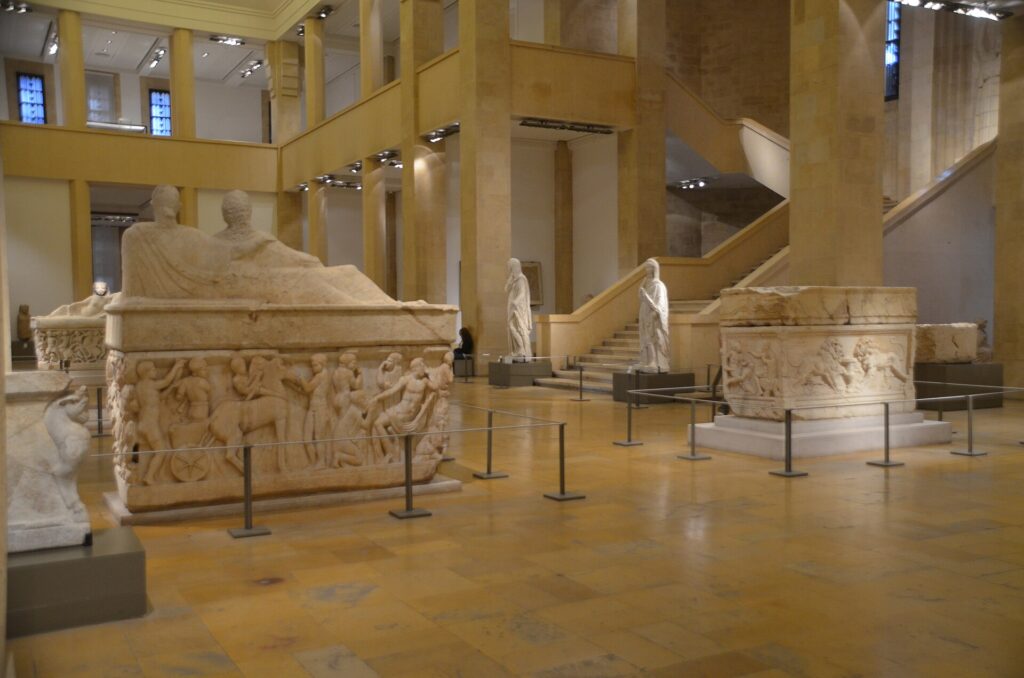
Roman and Byzantine periods are richly represented through a suite of mosaics and architectural fragments. Intricately designed mosaic floors from Roman villas offer both artistic beauty and historical narrative, depicting mythological subjects, everyday scenes, and decorative motifs that illustrate the affluence and cultural integration of Lebanon in the empire. Sculptural works and funerary steles further expand on the social and religious practices of these eras, adding depth to the museum’s contextual telling of the region’s past.
The museum also features artifacts from the Islamic era, including examples of calligraphy, ceramics, and metalwork. These pieces underscore Lebanon’s historical place along important trade and cultural routes during Islamic rule, highlighting technological advances and aesthetic expressions from a complex period often intermixed with local traditions.
Archaeological finds from other eras and cultures, such as the Crusader period and Ottoman rule, are present but occupy a smaller portion of the collection, reflecting a focus that leans more heavily on antiquity. This emphasis serves those particularly interested in ancient Mediterranean cultures and their interplay with Lebanon’s geography, but may leave visitors seeking extensive material on later historical periods wanting in terms of depth and interpretation.
Visitor Experience
The layout of the National Museum of Beirut optimizes a chronological progression, allowing visitors to follow Lebanon’s history in a linear fashion. The space is arranged to minimize congestion, though in times of high attendance, popular sections can feel dense with onlookers. The museum’s interpretive materials, including labels and signboards, are direct and factual, oriented toward clarity and brevity rather than elaborate storytelling or thematic mediation. This style suits visitors with a baseline interest in archaeology and history, as it conveys essential information without overwhelming visual or textual clutter.
Significant strengths lie in the museum’s artifact conservation and display techniques. Many items are securely and tastefully exhibited, with adequate lighting and protective cases that permit detailed viewing. The placement of larger pieces, such as statues or sarcophagi, allows for appreciation of scale and craftsmanship. However, the absence of contemporary multimedia elements or digital engagement tools may represent a limitation for visitors accustomed to interactive or highly interpretive museum experiences elsewhere.
The museum’s clientele likely ranges from scholars, students, and professionals in archaeology and history to local visitors and tourists with a general curiosity about Lebanon’s past. Those with specialized interest in Phoenician culture or Roman mosaics will find particularly rich material, while casual visitors may need patience and interest to engage with some of the more technical or less fully contextualized displays.
Overall, the visitor experience is straightforward and educational, with carefully maintained collections that communicate a sense of cultural stewardship. Its balance of scale and content makes it practical for moderate-length visits without feeling rushed, though those looking for extensive interpretive programming or contemporary exhibition design should adjust expectations accordingly.
Tickets, Access, and Planning
Information on entrance fees, opening hours, guided tours, and other practical visitor services should be verified via the museum’s official channels before planning a visit. Local conditions in Beirut and Lebanon can influence accessibility, and security measures around cultural institutions may also vary over time. Visitors are advised to check for current admission policies, temporary closures or restrictions, as well as availability of tours or educational programs, which can enhance the visit.
Because the National Museum of Beirut lies within the urban fabric of the city, access by public transport or taxi is generally feasible; however, the surrounding area’s traffic and urban conditions should be considered when arranging travel. Amenities such as parking, dining, and shopping facilities are not prominently featured as part of the museum experience and should be explored separately through external sources.
In summary, practical planning should be thorough to accommodate potential changes in operational conditions and to ensure a smooth, well-prepared visit.
Final Verdict
The National Museum of Beirut is an institution central to understanding Lebanon’s archaeological and cultural heritage. It serves a critical function in safeguarding artifacts that span thousands of years and presenting them in a manner that underscores their historical importance. The museum’s strengths lie in its substantial collection from key periods such as the prehistoric, Phoenician, Roman, and Byzantine eras, along with a clear, organized presentation that facilitates chronological understanding.
While the museum may not offer the latest in interactive technologies or the broadest coverage of all historical periods, it remains a vital repository and cultural landmark in Beirut. Visitors interested in archaeology and ancient Mediterranean history will find much to engage with, and the museum’s atmosphere supports focused, contemplative study rather than recreational diversion.
Prospective visitors should approach the National Museum of Beirut with an appreciation for its role as a traditional museum of archaeology—one that places artifact preservation and academic integrity above entertainment trends. It is a place where the layers of Lebanon’s past can be observed and contemplated, providing a foundation for a deeper appreciation of the country’s complex history and cultural diversity. As with any museum in a region marked by political and social volatility, checking current visitor information beforehand is important to ensure a safe and rewarding experience.