Museum of Black Civilisations
The Museum of Black Civilisations in Dakar, Senegal, is one of the most ambitious recent museum projects on the African continent. Created as a.

Best forMasterpieces, architecture, cultural history
Setting / nearbyDakar, it is devoted to the histories, achievements, and artistic traditions of Black civi
Overview
The Museum of Black Civilisations is one of the most ambitious cultural institutions in West Africa and one of the clearest statements of how a museum can be built around historical dignity, cultural breadth, and intellectual reclamation. Located in Dakar, it is devoted to the histories, achievements, and artistic traditions of Black civilizations across Africa and the wider diaspora. That gives it a scope very different from a conventional national museum. It is not focused only on one country, one dynasty, or one period. Instead, it presents Black civilization as a vast and interconnected field of human creativity, knowledge, movement, and memory.
What makes the museum especially compelling is that its subject is both historical and contemporary. It is not simply a place to preserve objects from the past. It is also a place to think about identity, heritage, restitution, representation, and the place of African and diasporic cultures in global history. This gives the museum an unusual kind of seriousness. The visit is not only about looking at artworks or cultural artifacts. It is also about encountering a wider argument: that Black civilizations must be understood on their own scale, with their own intellectual and artistic authority.
The museum is especially valuable because it resists narrow or reductive narratives. Black history is too often fragmented into isolated national stories or reduced to a few familiar themes. Here, the ambition is broader. The museum allows visitors to think across regions, across centuries, and across the Atlantic world. This approach gives the institution both symbolic and educational power. It suggests not just survival, but continuity, influence, and cultural depth.
For visitors to Dakar, the museum offers something especially important. It is not only a major museum in the city. It is also one of the places where Dakar presents itself as a center of African cultural thought. This gives the museum a role that is civic, continental, and international at the same time.
Collection Highlights
One of the museum’s greatest strengths is the breadth implied by its mission. A museum devoted to Black civilizations is strongest when it can move between artistic traditions, historical objects, symbolic materials, and contemporary interpretation without losing coherence. That breadth allows visitors to encounter Black cultural history not as one single style or period, but as a plurality of civilizations, forms, and achievements.
Art is naturally one of the strongest points of entry. Sculpture, textiles, ceremonial objects, masks, regalia, and contemporary works can all help show how visual culture has carried memory, authority, spirituality, and social meaning across time. In a museum like this, such objects matter not only for their beauty, but also for the cultural systems they belong to. They reveal philosophies of power, family, ritual, craft, and community. That makes the displays richer than a simple aesthetic presentation would be.
Another strength lies in the museum’s ability to connect Africa with the wider Black world. This gives the institution a broader intellectual horizon than many museums built only on local or national collections. The relationship between the continent and the diaspora is central here. Objects and themes become ways of thinking about movement, dispersal, continuity, rupture, and cultural renewal. That gives the museum emotional force as well as historical depth.
The museum is also especially important when it addresses knowledge systems and civilization in a fuller sense. A museum of Black civilizations should not suggest that culture is limited to decorative art alone. Its strongest moments often come when it points toward intellectual history, spiritual traditions, political formations, social systems, and artistic innovation as parts of the same broader story. That wider civilizational frame is what gives the institution its real importance.
Building and Setting
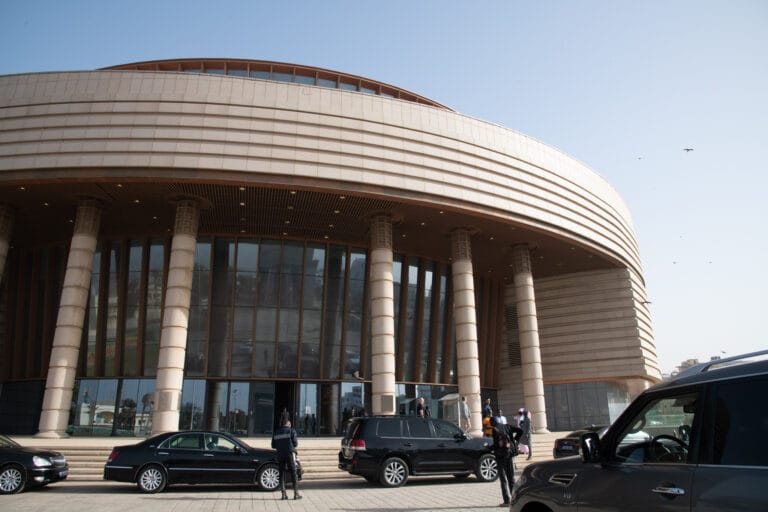
The museum’s building and public setting are part of its power. A museum with this mission needs architectural presence, and the institution benefits from being housed in a structure that feels designed for significance rather than modesty. The museum’s physical scale matters because it reflects the scale of the subject. A museum devoted to Black civilizations should not feel like a minor annex to someone else’s historical framework. It should feel central, public, and confident.
Its location in Dakar is equally meaningful. Dakar has long been one of the major cultural capitals of West Africa, and the museum belongs naturally within that wider landscape of art, scholarship, literature, and public debate. This gives the visit an added layer of importance. The museum is not simply placed in Dakar by accident. It participates in the city’s larger role as a site of African cultural and intellectual life.
Architecturally, the museum is most effective when the building supports the ambition of the institution without overshadowing the collections. Visitors should feel that the subject is being given proper space and dignity. In this case, the public presence of the museum helps underline exactly that point. The building becomes part of the argument the museum is making about visibility, recognition, and cultural importance.
The atmosphere of the museum also matters. Institutions with such a broad mission can become either too abstract or too overloaded. The Museum of Black Civilisations is strongest when it allows visitors to move through its themes with enough space for reflection. A museum like this needs room not only for objects, but for ideas. That sense of intellectual openness is part of what makes the visit distinctive.
Practical Information
The Museum of Black Civilisations is best visited with enough time to absorb both its objects and its larger message. This is not a museum that should be rushed if possible. The value of the visit lies partly in individual displays, but just as much in the broader framework the museum builds around Black history, identity, and artistic achievement. A slower visit allows those connections to emerge more fully.
It is especially rewarding for visitors interested in African history, Black diasporic culture, art, heritage, and museum politics. At the same time, it can also work well for general travelers because its subject is so fundamental and its civic importance is immediately clear. Even visitors without specialist knowledge can feel the scale of the institution’s ambition.
Because the museum is part of a wider cultural landscape in Dakar, it works especially well when treated as a major stop rather than a quick extra. It can help shape the rest of a visit to the city by giving a broader frame for thinking about Senegal, West Africa, and Black cultural history more generally.
Why Visit
The Museum of Black Civilisations is worth visiting because it offers something larger than a standard museum experience. It does not only display objects. It presents a civilizational claim: that Black histories, cultures, and artistic traditions must be seen in their full breadth and depth. That gives the museum unusual intellectual and symbolic power.
It is also worth visiting because it expands the museum idea itself. Many museums in Africa are still approached by outsiders through narrow expectations, but this institution works on a much larger level. It is ambitious, public, and confident in the scale of its subject. That alone makes it important.
If you want a museum in Dakar that combines art, history, identity, and cultural significance on a continental scale, the Museum of Black Civilisations is one of the clearest choices. It is thoughtful, distinctive, and one of the most important museum visits in West Africa.