Tianjin Museum Review
Archaeology Museums · Tianjin, China. Tianjin Museum, located in the northern Chinese city of Tianjin, reflects the region's rich cultural heritage and its historical significance as a major port and commercial hub. The museum was established to showcase the…
Archaeology Museums · Tianjin, China. Tianjin Museum, located in the northern Chinese city of Tianjin, reflects the region's rich cultural heritage and its historical significance as a major port and commercial hub. The museum was established to showcase the…
Best forMuseum lovers, culture travelers, first-time visitors
Review focusCollections, visitor experience, and practical planning
Historical Context
Tianjin Museum, located in the northern Chinese city of Tianjin, reflects the region's rich cultural heritage and its historical significance as a major port and commercial hub. The museum was established to showcase the artistic, historical, and archaeological artifacts collected from the Tianjin area and beyond, offering insight into both local traditions and broader Chinese history. The city’s strategic position has historically connected it with various cultural influences, and this museum situates itself as a repository of that layered past.
Founded in the early 21st century to replace earlier institutions, the museum integrates modern museum design principles with the task of displaying a diverse collection that spans ancient pottery, ceramics, calligraphy, paintings, and historical relics from different dynasties. Its development corresponds with increasing efforts throughout China to promote regional history and culture through museum infrastructure. While Tianjin may not have the same level of international recognition as the cultural centers of Beijing or Shanghai, the museum adds value as a solid regional institution aiming to balance local specificity with elements of national history.
What You See on Arrival
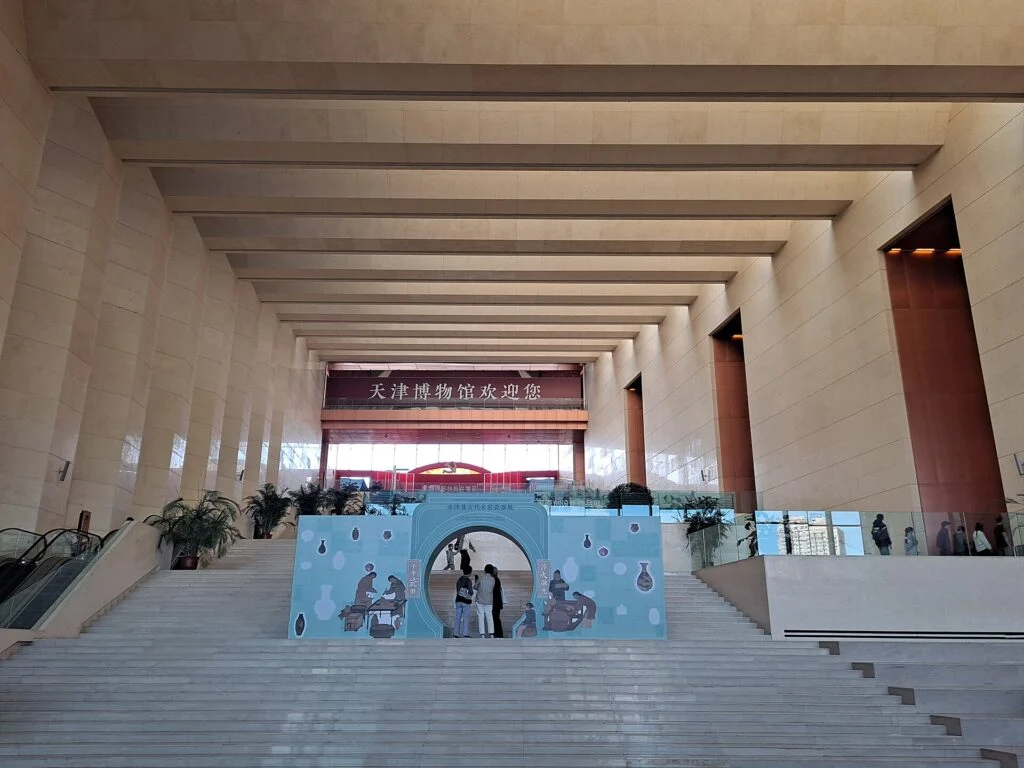
Visitors approaching the Tianjin Museum encounter a structure that signals a modern civic institution while referencing traditional architectural elements. The building’s exterior merges contemporary materials and clean lines with design motifs drawing on Tianjin’s architectural character. The approach leads into a spacious plaza consistent with museum principles of welcoming and orientation, though the scale and openness will likely depend on placement within the urban context.
The museum’s entrance area typically functions as an introductory space with signage and visitor information. This framing prepares guests for a cultural journey focused on Tianjin’s connection to Chinese heritage and art history. Rather than overwhelming visitors with lavish decoration or extensive multimedia installations, the initial spaces emphasize clarity in navigation. The design intent appears to favor straightforward visitor flow and establishes a clear institutional identity rooted in cultural preservation and education.
Highlights and Key Exhibitions
The core strength of Tianjin Museum lies in its comprehensive collection centered on regional archaeology and fine arts. The holdings include significant pieces from the Neolithic period found in the Tianjin basin, such as pottery shards revealing early societal practices. These prehistoric artifacts provide context for understanding the development of human settlement and cultural expression in northern China.
Moving through the historical timeline, the museum emphasizes ceramic art, especially porcelain, reflecting Tianjin’s role as both a commercial nexus and a cultural crossroads. The collection of Qing and Ming dynasty porcelain pieces is particularly substantial, illustrating developments in glazing techniques, artistic motifs, and functional forms. These ceramics not only offer an aesthetic interest but also communicate social and economic histories tied to trade routes and local artisanal communities.
Another cornerstone of the museum is its collection of traditional Chinese paintings and calligraphy. These works span various dynasties, showcasing evolution in brushwork and artistic themes. Visitors with an interest in Chinese art history will note the careful presentation of literati paintings and ink works, which serve to contextualize the cultural milieu in which Tianjin’s elite historically operated.
The museum also dedicates sections to historical artifacts linked to Tianjin’s transformation into a port city during the late Qing dynasty and the Republican era. Exhibits on urban development, trade, and foreign concessions provide insight into the city’s complex socio-political fabric shaped by both Chinese and Western influences. These displays, often composed of maps, photographs, and everyday objects, offer a valuable perspective on the interaction of local and global forces in shaping modern Tianjin.
While the focus remains largely on permanent collections, the museum’s curatorial approach prioritizes chronological and thematic clarity. This helps visitors understand artifacts within broader historical narratives without reliance on temporary shows. However, this emphasis on established collections means that visitors seeking avant-garde or experimental museum presentations may find the offerings comparatively traditional.
Visitor Experience
The Tianjin Museum’s layout encourages a measured pace suited to a broad public, including those with moderate familiarity with Chinese history and art. The clear chronological and thematic organization of galleries helps prevent confusion. Visitors can expect a logical progression from ancient archaeology to art and urban history, facilitating comprehension without becoming overwhelming.
Interpretive materials are generally concise and informative, with descriptions focussing on cultural and historical significance rather than abstract theory. This approach suits a wide range of visitors, from local families and students to international tourists with an interest in Chinese heritage. However, the reliance on textual panels means that non-Chinese speakers might benefit from additional translation or interpretive support, as comprehensive multilingual materials may vary.
The museum’s atmosphere is one of restraint and quiet reflection. Presentation choices emphasize the artifacts themselves rather than elaborate staging. This minimalist style supports focused viewing but might limit engagement for visitors accustomed to more interactive or technology-driven experiences. For audiences with a strong interest in the visual arts or archaeology, the depth of authentic material will be compelling, but casual visitors could find some galleries less immediately engaging.
Crowd conditions and visitor flow are shaped by Tianjin’s position as a regional rather than major national museum. This typically allows for comfortable viewing without substantial congestion. However, facilities and signage may require some advance familiarization, especially for international visitors or those with accessibility needs. The general infrastructure supports standard museum visits, but prospective guests are advised to consult the museum’s official resources for current visitor services details.
Tickets, Access, and Planning
Information regarding ticketing and admission should be verified through the museum’s official website before planning a visit. Tianjin Museum’s policies can change seasonally or according to special programming, and up-to-date details on opening hours, admission fees, tours, available discounts, and visitor amenities are best obtained directly from official sources.
Access to the museum is favorable within Tianjin’s urban context, though specifics on public transport connections or parking are not consistently detailed in public materials. Visitors should ensure they confirm transport options and accessibility arrangements as needed. The museum’s size and layout are suitable for a half-day visit but could stretch longer depending on visitor interest in the collections.
Prospective visitors should be aware that temporary exhibitions are not a central feature of the institution’s current programming. Those prioritizing dynamic, frequently changing content might find fewer reasons for repeat visits in the short term, while others will appreciate the stable, well-maintained permanent displays.
Final Verdict
Tianjin Museum stands as a purposeful cultural institution devoted to preserving and exhibiting the history and art of its city and surrounding regions. Its strengths lie in a solid archaeological collection, noteworthy ceramics, traditional paintings, and exhibits contextualizing Tianjin’s role in modern Chinese urban and economic history. The museum aims to convey a clear, traditional narrative through carefully selected and well-organized objects rather than engaging experimental display methods.
The museum suits visitors with a serious interest in Chinese historical and cultural artifacts, as well as those looking to deepen their understanding of Tianjin’s unique place within China’s broader historical landscape. Families, students, and regional tourists will find value in the accessible presentation style, while international visitors may benefit from additional interpretive support.
Limitations include the relative conservatism of exhibitions and the potential for language barriers to reduce accessibility for some visitors. It is not designed as a high-technology experience nor as a venue with rapid rotation of shows to attract repeat attendance. Planning ahead is wise, given the absence of broadly advertised visitor services and the museum’s regional rather than global profile.
In summary, Tianjin Museum offers a steady, informative encounter with Chinese cultural history through the prism of a key northern city. It remains a worthwhile visit for those appreciating tangible connections to history presented in a straightforward and dignified museum setting.