National Museum of India Review
New Delhi, India. The National Museum of India, situated in New Delhi, stands as a testament to the subcontinent’s layered history and its efforts to preserve and interpret that vast heritage under one roof. Established in 1949…
New Delhi, India. The National Museum of India, situated in New Delhi, stands as a testament to the subcontinent’s layered history and its efforts to preserve and interpret that vast heritage under one roof. Established in 1949…
Best forMuseum lovers, culture travelers, first-time visitors
Review focusCollections, visitor experience, and practical planning
Context and Identity
The National Museum of India, situated in New Delhi, stands as a testament to the subcontinent’s layered history and its efforts to preserve and interpret that vast heritage under one roof. Established in 1949 following independence, soon after the end of British colonial rule, the museum reflects the nation’s desire to curate a narrative that extends from prehistory to the modern era. Unlike a general history museum, it claims a comprehensive sweep through Indian art, archaeology, anthropology, and history that is both geographically and temporally expansive.
What fundamentally distinguishes this museum is its postcolonial mission embedded within the collection. It attempts to present India’s past on its own terms, rather than through the colonial fragmentations once typical in historical institutions. The collection embodies the complex layers of cultural, religious, and artistic development from the Indus Valley civilization to the late 20th century. This framework does not just bundle together objects; instead, it consciously situates them within evolving identities and historical contexts that have shaped India’s national self-awareness. The museum’s character is defined by this broad but deliberate scope, focusing on continuity and change across thousands of years within the same institution.
Inside the Collection
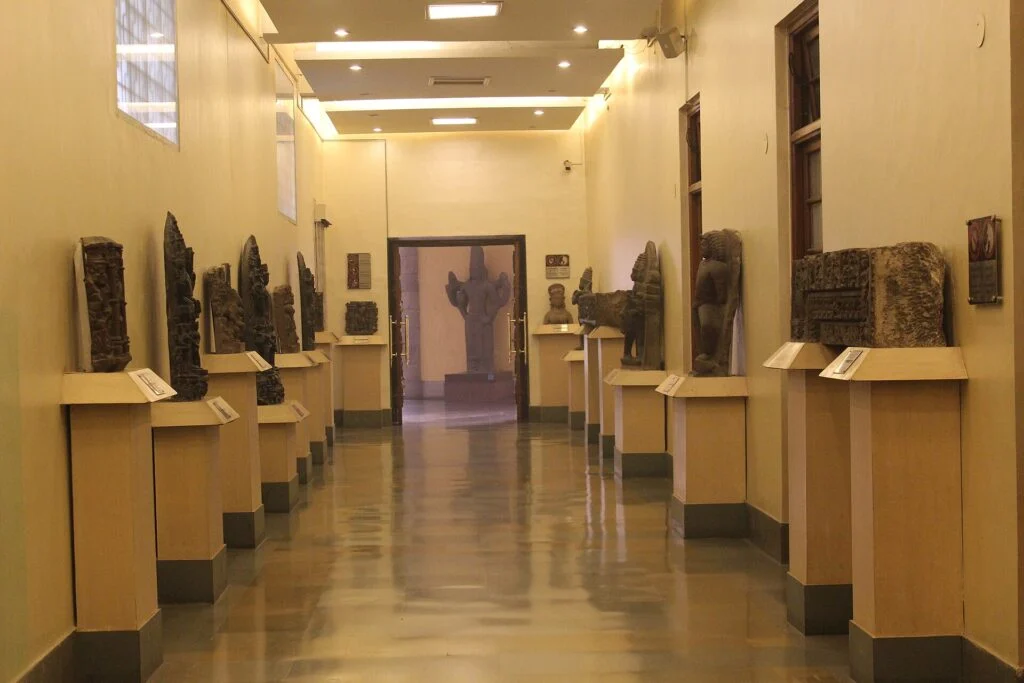
The holdings span an immense range: stone sculptures from Bharhut and Sanchi, the Ajanta cave paintings reproduced and contextualized, exquisite Mughal and Rajput miniatures, textiles from various regions, along with coins, weapons, manuscripts, and decorative arts. Some specific objects gain a certain singularity, such as the massive Yaksha statue from Mathura, which dates back to the 3rd century BCE and represents one of the oldest monumental human forms in Indian art, or the spectacular collection of Gandhara sculptures that reveal Greco-Buddhist syncretism. These anchors within the collection provide focal points for understanding broader cultural narratives.
Artifacts from tribal and folk traditions juxtapose with royal and religious art, reflecting regional diversity and the social stratification that shaped India. Items related to classical Sanskrit literature and religious artefacts related to Hinduism, Buddhism, Jainism, and Islam demonstrate the country’s spiritual plurality. The museum’s archaeological materials, including Harappan seals and tools, testify to one of the world’s earliest urban civilisations, providing depth and context for the subsequent historical layers above them.
While the scope is broad, the museum’s collection strategy opts for key representative exemplars rather than an exhaustive assemblage. This creates a nuanced but sometimes uneven experience. Not all regions or periods have equal depth; for instance, the medieval Deccan or the history of colonial interactions receive less prominence compared to ancient and medieval north Indian artefacts or the Mughal era. This suggests a certain traditional hierarchy in Indian art-historical focus, which may not align precisely with current scholarly priorities but resonates with the museum’s founding ethos.
Architecture and Display
Occupying a large, stately colonial-era building designed in the late 1930s as the Imperial Museum, the structure is a product of British architectural influences blending neoclassical and Indian revivalist elements. Its grand scale and formal symmetry provide an imposing setting more suited to a government archive than a contemporary gallery designed for narrative flow and visitor engagement. The layout follows a chronological and thematic sequence, but the galleries feel compartmentalized, emphasizing discrete collections over dynamic storytelling.
Display methods prioritize traditional vitrines and wall labels, with limited use of multimedia or interactive technology to enliven the historical narratives or accommodate different learning styles. While this approach can suit the museum’s scholarly mission, it risks disengaging visitors without prior interest or knowledge. The lighting and walkthrough patterns sometimes make it challenging for visitors to make connections across periods or themes; there is little cross-referential interpretation.
This architecture preserves a certain dignity appropriate to national heritage yet does not embrace modern museological trends of narrative immersion or outreach. The scale and density of the exhibits can be overwhelming, demanding sustained focus to gain a real sense of the collection’s significance. The museum’s arrangement suits specialized research or those with pre-existing interest rather than casual discovery or family visits.
For Families, Specialists, and First-Time Visitors
This institution clearly prioritizes specialists and students of Indian art and archaeology. The extensive collections offer a rich resource for academic research, and the museum’s documentation and archives support deeper study. However, the way material is presented is less accessible for families or casual visitors unacquainted with the underlying history and cultural references. The absence of interactive displays or clear thematic trails tailored for different visitor groups may limit engagement among younger audiences or those seeking a more guided experience.
First-time visitors with a general interest will find value in the overarching chronological flow but may face difficulties in interpreting intricate details without additional guidance like tour commentary or educational programs. The museum’s vastness and focus on individual objects require visitors to invest time and effort to appreciate the full picture, making it less suitable for a brief or superficial visit.
Families with children may particularly struggle unless accompanied by a guided explanation that can link key artworks to accessible stories and contexts. While academic users gain from the breadth and preservation of the collection, the museum’s presentation does not make these riches immediately approachable to a broad public.
What Works Best
The museum excels where its collection furnishes clear touchstones to major Indian historical epochs. For example, the art and archaeological galleries that cover the Maurya, Gupta, and Mughal periods provide a solid visual and material foundation to these formative eras. The range of Buddhist sculpture, from terracotta figurines to monumental stone carvings, offers both breadth and depth that underpin ongoing scholarly debates about religious transformation and art history.
The curatorial focus on major artistic traditions like Mughal miniature painting or South Indian bronzes unpacks sophisticated narratives that go beyond decorative appeal, showing historical and religious dimensions. These segments demonstrate the museum’s capacity to serve as a repository and presentation ground for India’s classical heritage that remains central to its cultural identity.
Similarly, its ethnographic materials, although sparser, give important insights into the continuity between rural and tribal lifestyles and classical cultural artefacts. In these strengths, the museum makes tangible the continuities and disruptions in Indian history through selected masterpieces and well-documented provenance.
Practical Considerations
Visitors should check the National Museum official website for up-to-date information on opening hours, ticketing, and available guided tours, as these can change and impact the visitor’s experience significantly. Given its location in New Delhi, access is generally straightforward, though parking and transport conditions may vary depending on the city’s traffic.
Facilities within the building seem geared primarily toward preservation and research, rather than visitor convenience or entertainment. Amenities such as cafés, rest areas, and shops are not prominently noted in available resources. This institutional focus reflects the museum’s slower evolution towards prioritizing visitor-centered services.
Language of labels and interpretation is expected to be English and Hindi, reflecting the national context, but the extent of multilingual signage or materials for international visitors is not specified. This factor might influence accessibility for non-local audiences.
Verdict
The National Museum of India serves as a serious, measured repository for Indian civilization’s multiple layers, focusing on cultural continuity and key artistic traditions. Its strength is in the depth and authenticity of selected objects that anchor major historical narratives, especially from archaeological and classical periods. The museum’s architecture and presentation echo a mid-20th-century ethos of scholarly preservation rather than a contemporary, visitor-engagement model.
It will not satisfy those expecting a dynamic, interactive experience or a comprehensive survey that balances every region and period equally. Instead, it achieves its aims by preserving and staging a core narrative about India’s past that resonates with the nation’s self-understanding. Those approaching the museum with patience, purpose, and some prior knowledge will find irreplaceable material and trustworthy scholarship in its collection. For others, the museum’s restrained presentation and scale may seem daunting or less accessible.
This is not a museum shaped by popular display trends but a foundational institution holding and interpreting some of India’s most significant cultural treasures, with all the strengths and limits such a role entails.