Museum aan de Stroom Review
Intro Museum aan de Stroom in Antwerp, Belgium, is one of the more ambitious city museums in Europe because it treats urban history as something.
Intro Museum aan de Stroom in Antwerp, Belgium, is one of the more ambitious city museums in Europe because it treats urban history as something.
Best forMaritime history, ships, harbour heritage
Review focusCollection, setting, visitor experience
Intro
Museum aan de Stroom in Antwerp, Belgium, is one of the more ambitious city museums in Europe because it treats urban history as something inseparable from global circulation. Many city museums focus primarily on local identity, civic milestones, and community memory. MAS includes those elements, but its real achievement lies in showing how Antwerp became itself through trade, migration, collecting, empire, maritime exchange, and contact with worlds beyond the city. That larger frame gives the museum real intellectual scope.
At the same time, MAS is undeniably a civic landmark. Its architecture, harbor location, and skyline presence make it part of Antwerp’s self-image. This means the museum works on two levels: as a place of historical interpretation and as a contemporary symbol of the city’s cultural confidence.
How the Site Works
MAS works through themes rather than a narrow linear chronology. This is a sensible decision for a port city whose history cannot be fully understood as a simple sequence of local events. Trade, goods, travel, migration, and world encounter all overlap in ways that cut across neat period divisions, and the museum’s structure allows that complexity to remain visible.
The institution also works because it uses its building and public circulation well. Visitors do not simply move from case to case. They experience the museum as a route through a landmark, and that spatial logic supports the idea that Antwerp’s history is one of movement, height, visibility, and exchange.
Because of this, MAS is particularly effective for first-time visitors to Antwerp. It provides orientation without collapsing into tourist simplification. The city becomes understandable as a place shaped by larger forces, which is exactly what a strong urban museum should achieve.
Exhibitions and Collection
The museum’s exhibitions and collections are strongest when they connect local material to wider historical systems. This is where MAS differentiates itself from more conventional city museums. It does not treat Antwerp as an isolated civic unit. Instead, the city appears as a port, a marketplace, a collecting center, and a meeting point of goods and people.
The thematic galleries, visible storage, and wider collection presentation help communicate the museum’s breadth. This broadness could easily become diffuse in a weaker institution, but MAS often avoids that problem by returning consistently to the question of what kind of city Antwerp has been and how that identity was produced.
The museum is also strong in showing that urban history is never just architectural or political. It is material. Objects, commodities, maritime links, and cultural exchange all play active roles in the interpretation. This makes the museum feel more grounded and less abstract than some high-concept civic institutions.
Not every section will resonate equally with every visitor, but the overall curatorial strategy is convincing. MAS succeeds because its exhibitions keep returning to the idea of Antwerp as a city formed by outward and inward motion.
Architecture / Space
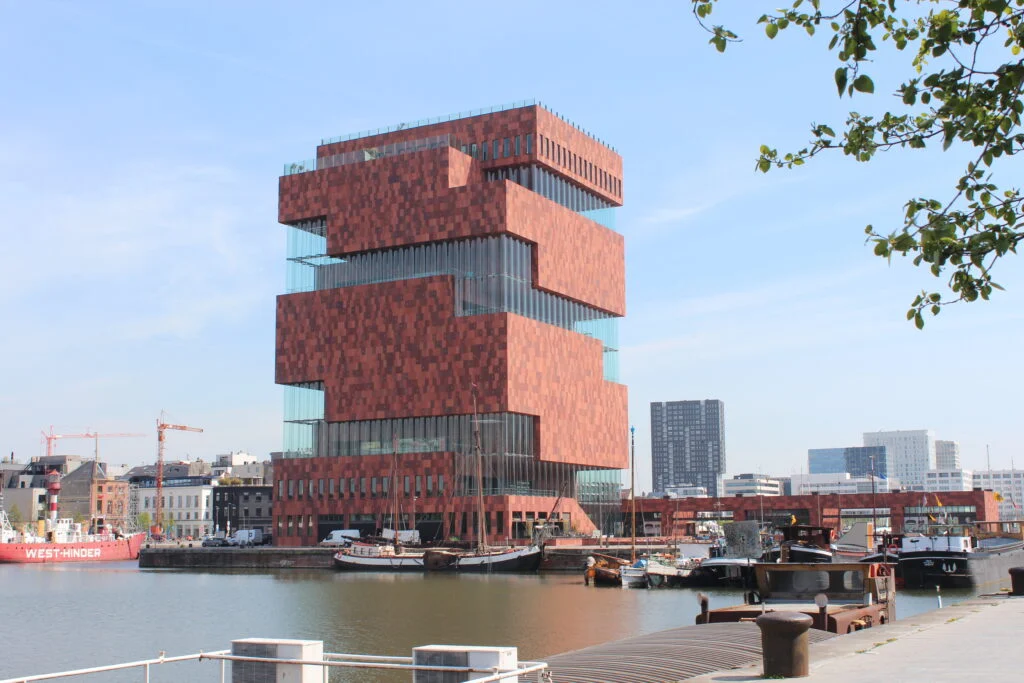
The MAS building is one of the museum’s greatest assets. It is not simply a container but an active part of the visitor experience and of the museum’s civic role. The architecture gives Antwerp a highly recognizable cultural landmark, and the museum makes good use of that visibility.
Inside, the building supports vertical movement and changing vantage points, which reinforces the museum’s themes of perspective, port life, and urban scale. The museum feels spacious and public, which suits an institution trying to speak not only to specialists but to the city and its visitors more broadly.
Its harbor location is equally important. A museum dealing so centrally with trade, circulation, and urban exchange gains enormous interpretive force from being set in a district shaped by those histories. The building and the site together make the museum more persuasive.
Visitor Experience
The visitor experience at MAS is generally rewarding because the museum offers more than one type of engagement. Some visitors will respond first to the architecture and the views. Others will focus on the galleries and thematic content. The institution accommodates both without allowing either to overwhelm the other entirely.
It is an especially good museum for travelers who want more than a quick local summary. MAS gives Antwerp historical depth and helps explain why the city matters beyond its immediate urban boundaries. At the same time, the museum remains approachable. It does not require prior expert knowledge, which broadens its appeal considerably.
Because the museum is sizeable and the themes are broad, a rushed visit can flatten the experience. It works best when visitors accept that it is a substantial civic museum rather than simply a landmark to look at from the outside.
Historical Context
MAS matters because Antwerp matters historically as one of Europe’s major port cities and as a site of long-distance exchange. Its development was tied to maritime trade, finance, collecting, migration, and wider political and imperial structures. Any museum that seeks to explain Antwerp honestly therefore has to go beyond local anecdote.
MAS does exactly this. It belongs to a newer generation of city museums that understand urban history as globally entangled. That makes it historically intelligent in a way some older municipal museums are not. Instead of treating the city as self-contained, it treats it as relational.
Practical Information
The museum is currently open Tuesday to Sunday from 10:00 to 17:00, with Monday closed and last entry at 16:00. Standard admission is listed at 10 euros when there is no temporary exhibition and 12 euros when there is one, with reduced admission at 6 or 8 euros and free entry for visitors under 18.
Visitors should allow enough time for both the exhibitions and the building itself. A short visit is possible, but a fuller experience requires more than a rapid pass through the main galleries. This is a museum best treated as a major stop in Antwerp.
Final Verdict
Museum aan de Stroom is one of the strongest urban museums in Europe because it understands the city as a product of connection. It combines architecture, civic ambition, and historical interpretation more effectively than many institutions of similar scale.
For visitors to Antwerp, it is essential. For museum travelers more generally, it stands as a persuasive example of how a city museum can be both locally grounded and globally aware.
Plan your visit
Plan MAS as a central museum visit in Antwerp rather than a quick harbor stop. Give enough time to follow the galleries properly and to understand how the museum uses its architecture and setting as part of the interpretation. It works especially well early in a stay, because it gives historical context that can deepen the rest of the city visit.