Heureka Finnish Science Centre Review
Science Museums · Vantaa, Finland. Heureka Finnish Science Centre, located just outside central Helsinki in Vantaa, represents Finland’s long-standing commitment to scientific education and public engagement. Established in 1989, Heureka carries forward the legacy of science cen…
Science Museums · Vantaa, Finland. Heureka Finnish Science Centre, located just outside central Helsinki in Vantaa, represents Finland’s long-standing commitment to scientific education and public engagement. Established in 1989, Heureka carries forward the legacy of science cen…
Best forScience fans, families, hands-on learning
Review focusScience exhibits, innovation, and visitor planning
Historical Context
Heureka Finnish Science Centre, located just outside central Helsinki in Vantaa, represents Finland’s long-standing commitment to scientific education and public engagement. Established in 1989, Heureka carries forward the legacy of science centers that emerged in the late 20th century as interactive spaces aimed at sparking curiosity across all age groups. Unlike traditional museums primarily focused on preservation and display, Heureka was designed as an active learning environment to make science accessible and relatable, particularly to younger audiences and families.
Its founding reflected broader educational trends in Finland, where hands-on, inquiry-based pedagogy has played a substantial role. Over the decades, Heureka has evolved with a clear mission to break down complex scientific concepts into approachable experiences. This approach has shaped the development of its permanent exhibitions and influenced its programming choices. The center’s architecture and layout also reflect its pedagogical ambitions, incorporating open spaces conducive to movement and interaction rather than quiet contemplation.
Given Finland’s high ranking in global education indices and its emphasis on innovation, Heureka’s position as a national science hub is significant. It provides visitors with a practical point of contact with scientific knowledge outside formal schooling. While Heureka shares similarities with international counterparts, its particular cultural and educational context distinguishes it, focusing on relevant scientific themes within Finnish society and harnessing technology to create dynamic learning opportunities.
What You See on Arrival
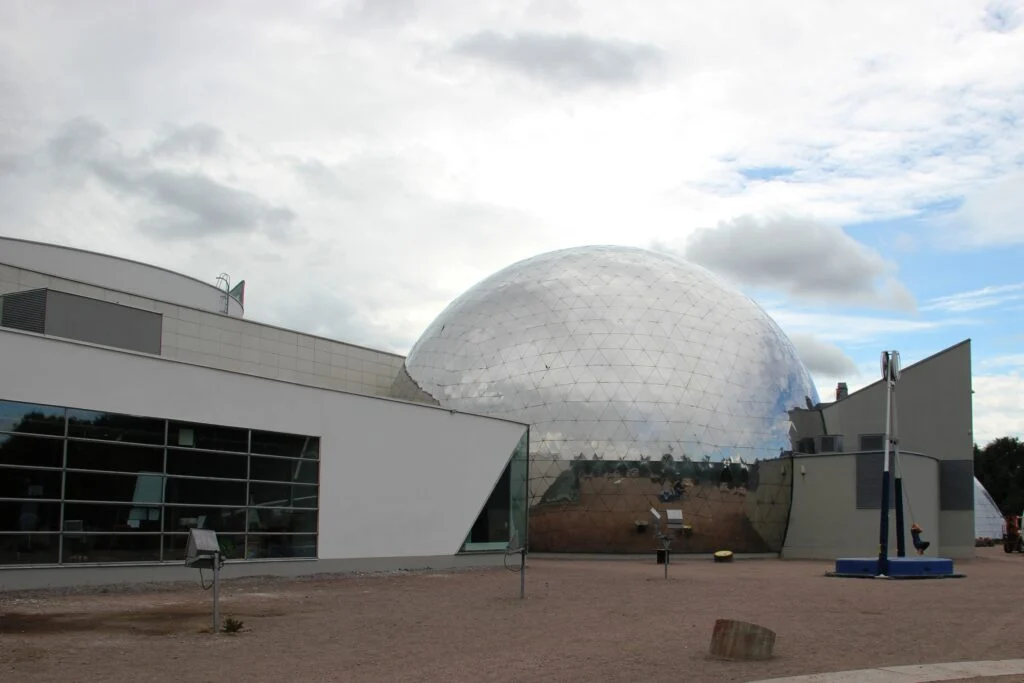
From the outset, Heureka presents itself not simply as a museum but as an interactive science center. The external design and signage signal a contemporary, accessible environment geared toward engagement. Approaching Heureka, visitors encounter a modern building complex surrounded by green spaces that hint at a connection between science, nature, and technology. The facade and entrance area avoid the traditional museum austerity, instead featuring clean lines and transparent elements that invite curiosity.
The lobby typically functions as both an orientation point and a transitional space, preparing visitors for the hands-on experiences ahead. Information desks and clear signage provide practical details without overwhelming, supporting a visitor’s self-directed exploration. The spatial layout visible on arrival gives the impression of fluidity and openness, underlining the center’s identity as a place for active participation rather than passive observation.
Visually and atmospherically, there is a balance between stimulating displays and areas encouraging reflection or discussion. This offers an initial framing of Heureka as a place where science is not distant or abstract but a field to be touched, questioned, and tested. For first-time visitors, the entrance zone sets expectations of a diverse and multi-sensory engagement rather than a static exhibition.
Highlights and Key Exhibitions
Heureka’s core appeal lies in its extensive array of permanent exhibitions designed around interactive displays and experiments. The center organizes its content thematically, allowing visitors to explore scientific phenomena through direct manipulation and observation. Although specific exhibit details can vary over time, several key thematic areas underscore Heureka’s approach to science education.
One central section addresses the physical sciences, inviting visitors to investigate principles of mechanics, electricity, magnetism, and sound. Exhibits here often feature simple experiments designed to demonstrate fundamental concepts such as levers, pulleys, light refraction, or electrical circuits. This hands-on approach encourages a trial-and-error method that supports learning through doing rather than reading.
Another major focus is the human body and biology, which presents human physiology and health sciences in an approachable manner. Displays related to senses, the brain, nutrition, and genetics typically form part of this section. Interactive elements might include testing individual capabilities (such as reflex speed or color perception) or tracing the journey of food through digestion. Such exhibits tend to integrate current scientific knowledge with everyday relevance, grounding abstract concepts in visitors’ own experiences.
Heureka also dedicates space to earth and environmental sciences, reflecting global and local concerns. This area often includes exhibits on weather, climate, energy use, and ecosystems. The center reinforces an understanding of how natural phenomena work and their implications for human society. The design encourages reflection on sustainability and environmental responsibility, though within an accessible framework free of alarmist tones.
The science center’s planetarium offers a complementary experience, focusing on astronomy and space science. The planetarium’s programming includes shows that explore stars, planets, and cosmic phenomena, providing a different sensory dimension compared with the tactile exhibits on the main floors.
Throughout, digital technologies play an important role, facilitating interactive quizzes, simulations, and visualizations that help illustrate complex ideas. The exhibits balance simplicity with scientific accuracy, aiming to maintain visitors’ interest without oversimplifying key content.
Visitor Experience
Heureka is designed primarily for families, school groups, and visitors who benefit from active participation rather than passive viewing. Its interactive nature means that pacing is generally self-directed; visitors can engage as deeply or briefly as preferred. This flexibility suits a variety of ages and learning styles but means that adults seeking more traditional museum experiences with extended reading or quiet observation might find the environment less conducive.
The open layout contributes to a lively atmosphere, but it may also mean there is background noise and movement that affect those sensitive to sensory overload. The hands-on approach demands some physical mobility and manual dexterity, which may impose limits for visitors with certain disabilities. Check with the center’s official resources for accessibility specifics.
Interpretation relies heavily on succinct text panels, direct experimentation, and staff facilitation rather than extensive curatorial narratives. This model supports discovery by trial and error but might leave those interested in deeper historical or scientific contexts wanting. The educational message concentrates on foundational concepts and curiosity stimulation rather than exhaustive coverage.
Some visitors may find certain exhibits repetitive or lacking in complexity, particularly adults or science enthusiasts who are already familiar with basic principles. However, the variety and breadth of topics help maintain engagement across multiple short visits. The planetarium adds a useful contrast in mood and format but requires separate ticketing or scheduling considerations.
Visitor flow can vary, with peaks during school holidays and weekends. Planning visits during quieter periods may enhance comfort and exploration time. Many visitors appreciate the balance between open interactive zones and more secluded spaces designed for reflection or group learning activities.
Tickets, Access, and Planning
Ticketing and visitor policies at Heureka are subject to change, so it is advisable for potential visitors to consult the official website to confirm current information. The science center typically charges admission for access to its permanent exhibitions and the planetarium, with varying prices depending on age or group status.
Accessibility considerations are important for planning; potential visitors should review details regarding physical access, services for visitors with disabilities, and any assistance options available on site. Similarly, information about guided tours, workshops, or other educational programs, if offered, is best verified directly through official channels.
The location in Vantaa means that although not in the heart of Helsinki, it is reachable by public transport and car. Visitors planning a trip should also confirm opening hours, as these can be seasonal or affected by special events.
The center’s design and concept support visitors spending a minimum of two to three hours for a thorough engagement, but shorter visits are possible if pressed for time. Those visiting with families or school groups are likely to find the time needed to fully explore exhibits and attend planetarium shows extends beyond a quick stop.
Final Verdict
Heureka Finnish Science Centre occupies a distinctive role in Finland’s cultural and educational landscape by emphasizing interactive learning rather than conventional display. Its location in Vantaa, not far from Helsinki, makes it accessible for both residents and visitors interested in science beyond traditional museums.
The center’s greatest strengths lie in its commitment to hands-on, inquiry-based experiences across a broad range of scientific fields. Its permanent exhibitions provide approachable ways to engage with principles of physics, biology, environmental science, and astronomy, tailored especially to younger visitors and families. The inclusion of a planetarium broadens the scope, offering a more passive sensory experience that complements tactile learning.
However, Heureka’s focus on interaction and foundational concepts may limit its appeal for those seeking in-depth scientific information or historical context. It is less a museum of artifacts and historical narratives, and more a place to experiment, question, and discover. Visitors with mobility challenges or sensitivity to busy environments should investigate accessibility and crowd conditions in advance.
Overall, Heureka serves its educational mission with clarity and energy, making science approachable in an informal context. But potential visitors would do well to frame their expectations accordingly. Those curious about the basics of science and open to active learning will find value here, while more expert audiences or those seeking quiet reflection may consider it one part of a wider itinerary in Finnish museums.
For updated details on opening hours, admission, accessibility, and visitor services, consulting the official Heureka Finnish Science Centre website is recommended before planning a visit.