Exploratorium Review
Architecture Museums · San Francisco, United States. Opened in 1969, the Exploratorium in San Francisco stands as a distinctive institution dedicated to science, art, and human perception. Conceived by physicist Frank Oppenheimer, it emerged during a period of renewed interest in…
Architecture Museums · San Francisco, United States. Opened in 1969, the Exploratorium in San Francisco stands as a distinctive institution dedicated to science, art, and human perception. Conceived by physicist Frank Oppenheimer, it emerged during a period of renewed interest in…
Best forMuseum lovers, culture travelers, first-time visitors
Review focusCollections, visitor experience, and practical planning
Historical Context
Opened in 1969, the Exploratorium in San Francisco stands as a distinctive institution dedicated to science, art, and human perception. Conceived by physicist Frank Oppenheimer, it emerged during a period of renewed interest in informal science education within the United States. Its founding principle was to encourage visitors not merely to observe but to engage directly through hands-on exhibits that invite experimentation and inquiry. Over time, the museum has grown and evolved, relocating to its current location on Pier 15 in 2013, a shift that allowed for expanded facilities and a broader waterfront ambiance.
The Exploratorium operates as a hybrid space—it functions as both a public museum and an active research center investigating science communication and education. The emphasis is not on displaying comprehensive encyclopedic collections but on fostering curiosity and tactile learning. This approach places it somewhat apart from traditional natural history or art museums, situating it firmly in the category of interactive science centers. Establishing itself as a pioneer in this field, the Exploratorium has influenced other institutions globally to incorporate interactive and experimental methods into their programming.
What You See on Arrival
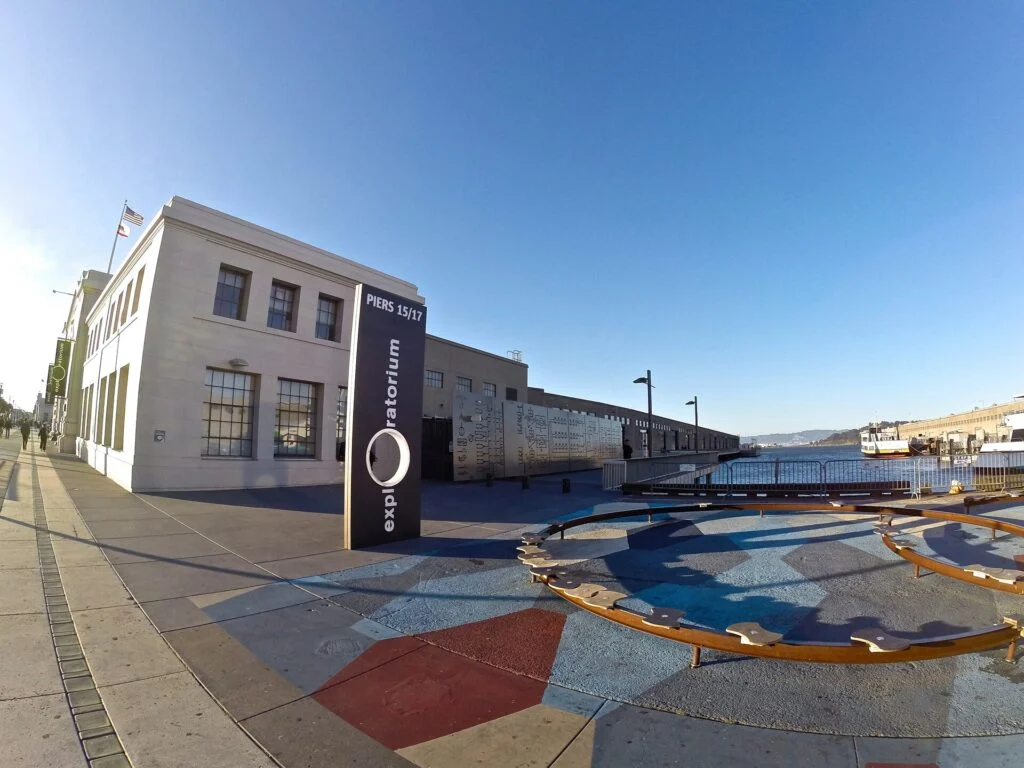
Upon approaching the Exploratorium at its waterfront location, visitors are met with a building that immediately signals openness and accessibility. Large glass panels and an airy design invite daylight deep into the interior, underlining a transparent ethos consistent with the museum’s hands-on philosophy. The Pier 15 setting situates the museum in direct contact with the Bay, allowing for a blend of indoor exhibits and outdoor experiences tied to the environment and science of the local region.
The entrance area functions as a transition space, where visitors can orient themselves amid the abundance of exhibits. It’s an environment designed to reduce the distance between visitor and subject matter. Rather than formal galleries lined with placards, guests encounter stations and displays meant to be touched, manipulated, and tested. The institutional voice here balances playful engagement with educational intent, aiming to demystify science rather than intimidate with jargon or complexity.
While the museum’s identity is rooted in being an experimental laboratory for discovery, the spatial layout supports a degree of self-directed exploration. Visitors are encouraged to follow their own curiosities, moving freely between areas without a fixed route or narrative imposed. For first-time visitors, this may present a more open-ended experience than typical museums, but it aligns with the institution’s goal of discovery-driven participation.
Highlights and Key Exhibitions
The core strength of the Exploratorium lies in its vast array of interactive exhibits, which span multiple domains of science, art, and human perception. Rather than housing permanent collections in the traditional sense, it presents thematic areas that collectively provide a comprehensive engagement with scientific inquiry.
One of the notable sectors is the “Living Systems” area, where visitors encounter exhibits focused on biology, perception, and human physiology. This section often includes demonstrations of how the eye and brain work together to interpret sensory inputs, interactive displays about sound and hearing, and experiments related to light and vision. The opportunity to manipulate variables and experience immediate feedback encourages a deeper understanding of complex biological processes through direct involvement.
Another prominent thematic zone is “Physical Science,” which covers principles of physics, mechanics, and material science. Exhibits here typically invite participants to experiment with forces, motion, and energy. Classic examples include pendulums illustrating harmonic motion, centrifugal force exhibits, and devices showing wave phenomena. The hands-on nature is crucial as it bridges abstract scientific concepts with tangible, observable effects. This is especially important for visitors who may find physics challenging in more conventional settings.
The Exploratorium’s approach to art and perception blurs traditional disciplinary boundaries. There are installations and objects that probe the nature of color, shape, and spatial relationships, often prompting visitors to reconsider assumptions about how they see and interpret the world. These exhibits highlight the museum’s commitment to exploring the intersection of scientific method and aesthetic experience. It is not a science museum exclusively concerned with facts but an environment where sensory experience itself is a subject of study.
Outdoor exhibits on the Pier take advantage of the museum’s waterside location. These exhibits often relate to environmental science, including investigations into tides, buoyancy, and marine life. The proximity to the Bay creates a unique opportunity for site-specific science engagement, grounding the museum’s content in the immediate context of San Francisco’s ecology and geography.
In addition to the physical exhibits, the Exploratorium integrates technology in ways that adapt with ongoing research in education and engagement. While the museum does not generally emphasize permanent digital installations as standalone features, it incorporates interactive software, real-time data displays, and experimental interfaces that complement physical experimentation.
Visitor Experience
The visitor experience at the Exploratorium is shaped primarily by its participatory and exploratory character. There is no fixed path or prescribed narrative; guests are invited to wander freely, interact at will, and spend as much time as desired at each station. For those inclined to self-directed learning and inquiry, this approach offers a rich and rewarding environment. It supports repeated experimentation, encourages questions, and often facilitates informal social interactions as visitors test hypotheses or puzzles together.
This open-ended format has both advantages and drawbacks. The advantage is the freedom it offers: visitors young and old can engage at their own pace and according to their own interests. The tactile, sensory nature of many exhibits makes the museum well-suited for families and children, particularly those drawn to hands-on learning and informal science experiences. Many exhibits function intuitively, which lowers barriers to engagement for a wide audience.
On the other hand, visitors seeking a more traditional museum experience with a clear chronological or thematic storyline, comprehensive labels, or guided interpretation might find the Exploratorium’s style less structured. Some exhibits rely on openness and experimentation rather than detailed explanation, which can leave certain scientific principles implicit unless supplemented by additional context, either from staff or preparatory materials.
Interpretive materials at the museum tend to be concise and focused on inviting exploration rather than delivering exhaustive content. This fits with the Exploratorium’s foundational goal to foster curiosity and personal discovery. For visitors with prior scientific knowledge or a strong interest in the underlying mechanics, the exhibits offer ample depth to sustain engagement, but for novices, some trial and error is to be expected.
Overall, the experience encourages active participation. This can generate learning through doing but requires visitors willing to engage physically and mentally. Because of this, the museum suits families, students, educators, and curious adults. It may be less appealing to visitors looking primarily for a passive viewing experience or those expecting traditional display cases and explanatory panels resembling conventional museums.
Tickets, Access, and Planning
Details concerning tickets, operating hours, special discounts, or specific visitor services should be verified directly via the official Exploratorium website before planning a visit. This is important as such practical information can change seasonally or in response to public health guidelines.
The Exploratorium’s location on Pier 15 means it is accessible to the public transit networks that serve San Francisco’s waterfront. However, parking near the Pier can be limited, and visitors relying on personal vehicles should plan accordingly. The site’s urban waterfront setting encourages walking or transit connections rather than driving.
Given the open-ended nature of the museum, the time needed for a visit can vary widely. Some may spend just an hour or two interacting with select exhibits, while others may find themselves immersed for half a day or more. Visitors are advised to allocate time flexibly, especially if exploring with children or groups.
It is also sensible to consider crowd patterns, as the museum can draw significant attendance during weekends, school holidays, and special events. Those seeking a quieter experience may wish to plan visits during weekday mornings or less busy periods.
The Exploratorium makes efforts at accommodating diverse visitor needs, but specifics on accessibility, including provisions for mobility impairments or sensory sensitivities, should be confirmed in advance.
Final Verdict
The Exploratorium offers a distinctively interactive approach to science education, emphasizing discovery through direct engagement rather than passive observation. Its wealth of hands-on exhibits across biology, physics, perception, and environmental science encourages visitors to experiment, test hypotheses, and see scientific principles in action. This experiential model makes it a valuable institution for families, educators, and anyone interested in learning through doing.
The museum’s strength lies in its openness, the variety of exhibits, and the way it invites curiosity in visitors of all ages. By situating itself at the waterfront, the Exploratorium also takes advantage of its surroundings to deepen the connection between science and place. Such a site-specific dimension distinguishes it from many other science centers.
At the same time, the Exploratorium’s lack of a fixed narrative or traditional exhibit format may not suit every visitor. Those looking for comprehensive explanations, guided tours, or a more conventional museum layout may find the experience less forthcoming. The interactive exhibits often presuppose willingness to experiment and to accept incomplete or evolving explanations.
Practical considerations such as visitor flow, crowding, and site access also require some planning. Confirming current operational details in advance is advisable to avoid surprises.
Ultimately, the Exploratorium remains an influential and innovative institution in science communication. While it is not a conventional museum, it presents an environment where scientific principles become accessible through firsthand experience. For those prepared to engage actively, it offers rich rewards. For more passive visitors, it might present challenges but also opportunities to encounter science anew.