Uffizi Gallery
About: Go early, then take a break on the terrace café. The Botticelli rooms get packed; visit them first or last.What to see: Start with the signature.
Best forMasterpieces, architecture, cultural history
Setting / nearbyEurope
Overview
The Uffizi Gallery in Florence is one of the most important museums in Europe and one of the defining places to understand Italian Renaissance painting in depth. Unlike larger encyclopedic museums that move across many civilisations, media, and periods, the Uffizi has a much more concentrated identity. Its strength lies in the way it presents painting, especially from late medieval Italy through the Renaissance, within a collection that is both historically foundational and visually rich. For many visitors, this is not simply a museum of famous works. It is a museum where the language of Renaissance art becomes legible in a sustained and unusually rewarding way.
What makes the Uffizi especially distinctive is that it does not feel like a general-purpose art institution. It feels specific. Its collection is rooted in Florence, in the Medici, and in the history of painting as it developed in Italy and beyond. That gives the museum more coherence than many equally famous institutions. The visit is not built around one isolated masterpiece or one short “must-see” list, even though the museum certainly contains many works that draw international attention. Instead, it is built around a larger visual story: the emergence of naturalism, the refinement of devotional imagery, the rise of portraiture, mythological painting, and the transformation of artistic ambition within Renaissance Europe.
For that reason, the Uffizi works particularly well for visitors who are willing to let the museum unfold gradually. It can be crowded, especially in the best-known rooms, and it can easily become tiring if approached as a checklist exercise. But when visited with some patience, it becomes one of the richest museum experiences in Florence. The collection is strong enough that even rooms outside the most famous sequences can feel rewarding, and the museum’s structure encourages comparison across generations of artists rather than only admiration of individual icons.
The Uffizi is also inseparable from Florence itself. This is not just because of location, but because the museum embodies so much of the city’s cultural identity. Florence can sometimes feel burdened by the sheer number of its major attractions, but the Uffizi remains one of the places where the city’s reputation is most clearly justified. It helps explain why Florence mattered so much in the history of European art, and why that history still feels visible in the city today.
Collection Highlights
The most famous highlights are naturally the Botticelli rooms, especially works such as *The Birth of Venus* and *Primavera*. These paintings are among the most recognisable images in European art, and for many visitors they form the emotional centre of the museum. Their fame is fully understandable. Botticelli’s paintings have a poetic and decorative force that remains powerful even in crowded rooms. Yet it is also important not to reduce the Uffizi to Botticelli alone. These galleries are central, but they are most rewarding when seen as part of a broader Renaissance story rather than as isolated icons.
The earlier Italian rooms are among the museum’s greatest strengths and often some of its most intellectually satisfying spaces. Here the development of painting becomes visible in a concentrated way. Visitors can move through works by artists such as Giotto and those who followed him and begin to see how Western painting changed in structure, emotion, spatial ambition, and naturalism. These rooms are essential because they make the more famous Renaissance galleries easier to understand. Without them, the Uffizi risks being experienced only as a sequence of celebrated masterpieces rather than as a museum of artistic development.
The High Renaissance rooms are another major attraction. Works connected to artists such as Leonardo, Michelangelo, and Raphael bring another level of concentration and prestige to the museum. These galleries often attract heavy attention, but they justify it. The Uffizi allows visitors to see how artistic confidence, technical control, and compositional complexity evolved within a short and immensely productive historical span. These rooms can be busy, but they are still among the most rewarding parts of the collection.
Portraits and devotional paintings across the museum also deserve slower looking. Many visitors move quickly between the most famous names, but the Uffizi becomes richer when one pays attention to the continuity of style, the changes in religious imagery, and the evolution of how individuals and sacred subjects were represented. This is one of the reasons the museum can support repeat visits so well. It is not exhausted by one or two headline works.
The collection’s later Venetian and other regional contributions also broaden the experience. They help prevent the museum from becoming too narrowly Florentine in feel, even though Florence remains central to its identity. These sections remind visitors that Renaissance painting was not one unified language but a field of related traditions and competing strengths. That wider view helps give the Uffizi depth beyond its most famous rooms.
Building and Setting
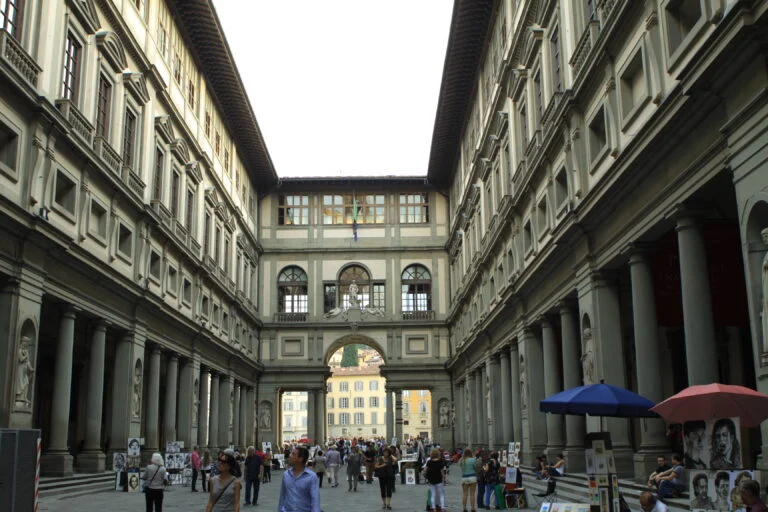
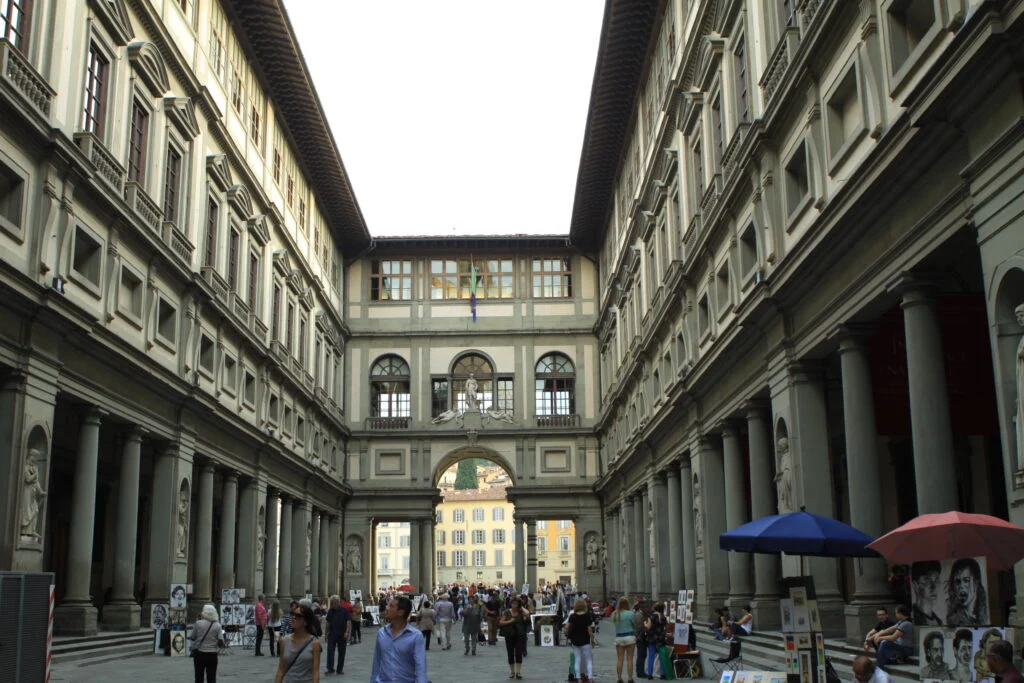
The Uffizi’s building is an essential part of the experience. It is not simply a container for paintings, but one of the great historic museum settings in Europe. Originally connected to Florentine administration and Medici power, the building carries the authority of Renaissance Florence in its architecture and position. This gives the visit a particular sense of continuity. The museum does not feel like a later neutral institution into which old paintings were placed. It feels historically rooted, as though the city’s artistic and political past still shapes the framework through which the collection is encountered.
The long corridors, window views, and sequence of rooms are part of the museum’s character. The circulation can feel busy, and at peak times the museum can seem heavily trafficked, but the architecture still provides moments of orientation and relief. Views over Florence and the Arno remind visitors that the museum is deeply tied to the city outside. These glimpses outward matter more than one might expect. They keep the visit grounded in place and reinforce the sense that the collection belongs to Florence rather than being abstracted from it.
The terrace café is also more than a convenience. In a museum as visually dense as the Uffizi, the ability to step out, pause, and re-set attention is genuinely valuable. This makes the visit more manageable and often more enjoyable, especially for those who find long sequences of painting demanding. The museum’s setting therefore contributes not only symbolically but practically to the quality of the experience.
Practical Information
The Uffizi is best visited with some planning. Going early is often wise, especially because the Botticelli rooms and the other best-known galleries can become packed. One practical strategy is to see the most famous rooms either very early or later in the visit, depending on traffic and energy levels. The museum rewards selective focus. Trying to absorb every room equally can quickly become exhausting, especially in crowded conditions.
A good visit often begins with the main chronological flow rather than jumping only to the most famous works. This helps establish the collection’s larger story and makes the later highlights feel more meaningful. At the same time, it is perfectly sensible to identify a few major priorities in advance. The Uffizi is not a museum where total completeness is a realistic or especially satisfying goal for most visitors.
Breaks are important. The terrace café or even short pauses between the more intense galleries can make a real difference. This is a place to absorb, not to rush. The museum becomes far more rewarding when visitors allow themselves time to look rather than forcing a pace that turns masterpieces into visual noise.
Why Visit
The Uffizi Gallery is best for Renaissance art lovers, first-time visitors to Florence, and anyone planning a city itinerary around culture at the highest level. It is especially worthwhile for visitors who want not only to see famous paintings, but to understand how Renaissance painting developed and why Florence mattered so much to that story. The museum’s greatest strength is the way it combines internationally famous works with a larger narrative of artistic evolution.
What makes the Uffizi worth prioritising is not simply that it contains masterpieces, though it certainly does. It is that those masterpieces sit within a collection strong enough to make the museum feel coherent, serious, and historically alive from beginning to end. The crowds can be heavy and the visit can be demanding, but for anyone willing to approach it with patience, the Uffizi remains one of the most rewarding museum experiences in Florence and one of the great painting museums of Europe.