National Museum of Qatar
National Museum of Qatar is one of the Middle East’s most significant modern museums—built not only to display objects, but to set a cultural tone for.
Best forMaritime history, ships, harbour heritage
Setting / nearbyMiddle East
Overview
The National Museum of Qatar is one of the most distinctive museums in the Middle East and one of the clearest examples of how a national museum can combine architecture, storytelling, environment, and historical identity into a single experience. Located in Doha, the museum is not simply a building filled with artefacts. It is a carefully staged narrative about land, memory, trade, Bedouin life, pearling, state formation, and the rapid transformation of Qatar in the modern era. That broad narrative structure is one of its greatest strengths. Rather than presenting the country through disconnected objects alone, the museum gives visitors a sense of movement from geology and environment through human settlement and into contemporary nationhood.
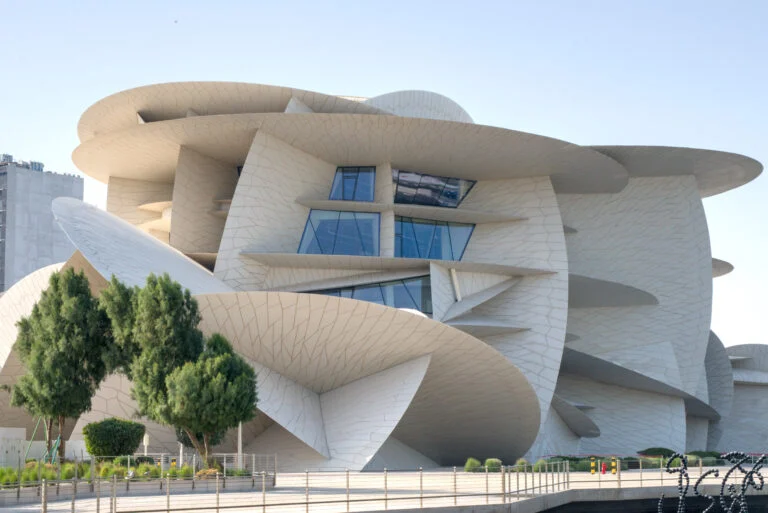
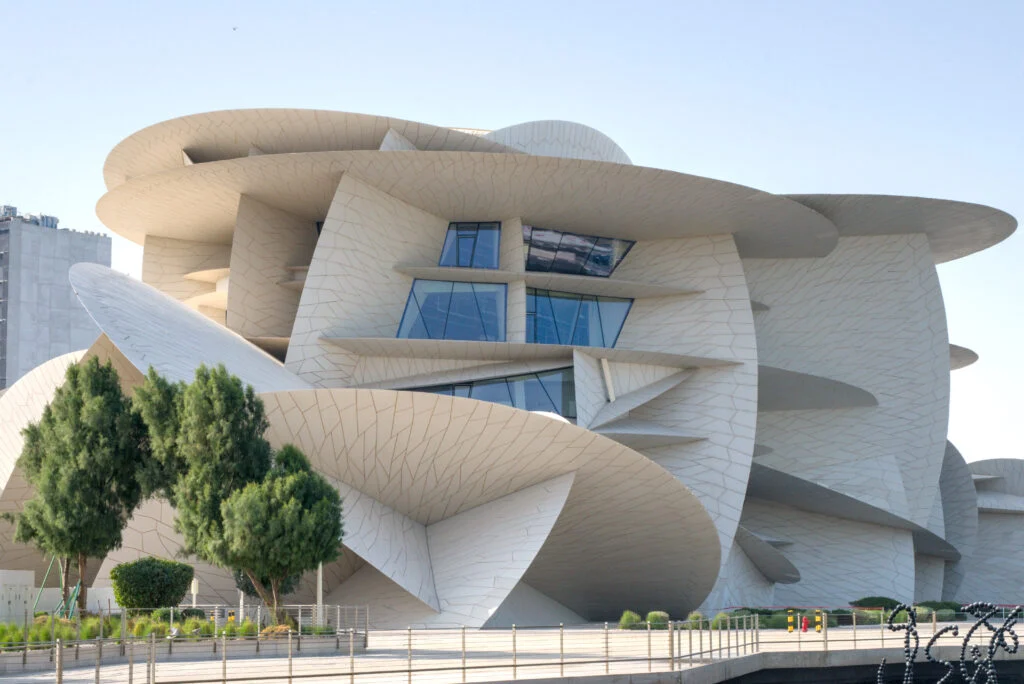
What makes the museum especially memorable is that the building itself is inseparable from the experience. Its dramatic form, inspired by the desert rose crystal, makes an immediate impression and signals that this is meant to be more than a conventional museum visit. Yet the architecture is not only spectacle. It supports the museum’s larger subject by rooting the institution in desert geology and by suggesting that the land itself is part of the national story. This is one of the museum’s major achievements. It creates a strong visual identity while still serving the content inside.
The museum is also especially rewarding because it treats Qatar not as a sudden modern success story appearing from nowhere, but as a place shaped by older environmental realities, maritime life, tribal movement, trade routes, and the difficult conditions of survival before oil and gas wealth transformed the state. This gives the museum more depth than many rapidly built national institutions. It acknowledges that the present grew out of older forms of life and labor. That sense of continuity matters, because it prevents the story of Qatar from becoming only one of recent development.
Another of the museum’s strengths is its emotional rhythm. The galleries move through large immersive spaces, objects, documentary material, and audiovisual storytelling in ways that often feel cinematic without becoming empty. This makes the museum accessible to first-time visitors while still allowing for serious reflection. The result is a museum that works both as an introduction to Qatar for outsiders and as a public narrative of national identity for people already connected to the country.
Collection Highlights
The museum’s greatest strength lies less in a single universally famous object than in the way it combines artefacts, immersive environments, and narrative sequence. This is important to understand before visiting. The National Museum of Qatar is not at its best when treated as a treasure house of isolated masterpieces. It is strongest when approached as a story told through many different forms of display. That gives it a very different character from older encyclopedic museums.
The sections on natural environment and geological formation are especially effective because they establish a deep foundation for everything that follows. These galleries help visitors understand that Qatar’s history begins with desert, coast, sea, and climate rather than with modern urban life. This is one of the museum’s major strengths. It shows that the country’s environmental conditions shaped settlement, movement, trade, and survival in lasting ways. A visitor begins to understand the land before understanding the society, which gives the later galleries much more force.
The museum’s treatment of Bedouin life and traditional social organization is another highlight. These sections matter because they help make visible forms of mobility, domestic structure, hospitality, and adaptation to harsh conditions that defined life in the region for generations. Objects tied to everyday life, shelter, clothing, tools, and family structure become especially meaningful in this context. The museum is strongest when it allows these things to appear not as romantic folklore, but as parts of a practical and highly developed way of living in a demanding environment.
The pearling sections are among the most memorable parts of the museum and one of the clearest reasons the institution has real historical depth. Pearl diving and maritime trade shaped the economy and social life of the Gulf long before modern hydrocarbons transformed the region. The museum’s treatment of this world gives visitors a sense of danger, labor, skill, and economic dependency that is often missing from simplified stories of Gulf history. These galleries widen the visitor’s understanding of Qatar beyond desert imagery and reveal the importance of the sea, trade, and hardship in forming the country’s past.
The later sections on state formation and modern transformation are also central. These galleries often show how rapidly Qatar changed in the twentieth and twenty-first centuries, but they are most effective when read against the earlier rooms. Because the museum has already established geology, subsistence, pearling, and social life, the transition into modern statehood feels more dramatic and more intelligible. This is one of the institution’s major achievements. Modern Qatar appears not as an isolated miracle, but as a historically layered result of much older conditions and more recent political and economic change.
Building and Setting
The building is one of the museum’s defining features and one of the reasons it has become internationally famous. Inspired by the form of a desert rose, the architecture creates a museum that feels sculptural before one even enters. This matters because the institution is trying to embody the identity of Qatar physically, not only explain it through labels and objects. The building therefore acts as a national symbol as much as a container for exhibitions.
What makes the architecture especially effective is that it avoids feeling separate from the museum’s theme. The layered discs and dramatic external geometry are not random formal experiments. They connect directly to desert geology and to the museum’s larger concern with land, environment, and place. That gives the building a conceptual strength that many visually dramatic museums lack.
The museum’s setting in Doha also adds to its significance. It stands in a city defined by rapid modern development, infrastructure, and global visibility, yet the museum insists on a longer and more grounded narrative of place. This tension is one of the reasons the museum works so well. It sits within a contemporary capital, but it continually asks the visitor to think beyond the skyline and back toward older landscapes, routes, and forms of life.
Inside, the galleries are arranged in a flowing sequence that supports the museum’s narrative style. Large immersive spaces, shifting ceiling heights, controlled light, and transitions between objects and media all help create a sense of movement. This is not a museum best understood by wandering randomly. The architecture and display design work together to guide the visitor through an intended story.
Practical Information
The National Museum of Qatar is best visited in sequence. Unlike some museums where jumping between departments works well, this one is strongest when its narrative is allowed to build from beginning to end. Starting with the natural history and environmental sections, then moving into Bedouin life, pearling, and later state formation, creates a much richer experience than entering only for modern highlights.
A slower pace is especially worthwhile because the museum uses film, sound, objects, and immersive staging together. Rushing through it can make the visit feel like a stream of impressive rooms without much retention. Giving each section time helps the broader structure emerge and makes the final galleries more meaningful.
Breaks are useful here, because the museum is visually and emotionally rich. It is not exhausting in the way some encyclopedic museums are, but its immersive format can still become overwhelming if taken too quickly. A paced visit usually produces a much better memory of the institution as a whole.
Why Visit
The National Museum of Qatar is best for first-time visitors to Doha, travelers interested in Gulf history, and anyone who values museums that combine architecture and national storytelling at a high level. Its greatest strength is that it explains Qatar as more than a modern capital of wealth and development. It shows the country through desert, sea, labor, adaptation, trade, and transformation across time.
What makes it worth prioritising is that few museums in the region combine design ambition with historical narrative so effectively. The building is unforgettable, but it is not only about appearance. It supports a museum that genuinely helps visitors understand how Qatar’s environment, older lifeways, and modern statehood fit together.
For many visitors, it becomes one of the essential cultural experiences in Doha because it offers both immediate visual impact and deeper historical grounding. It is not only a landmark, but a serious public institution that gives shape to the story of the country. That combination makes it one of the most distinctive museums in the Middle East.