National Museum of China
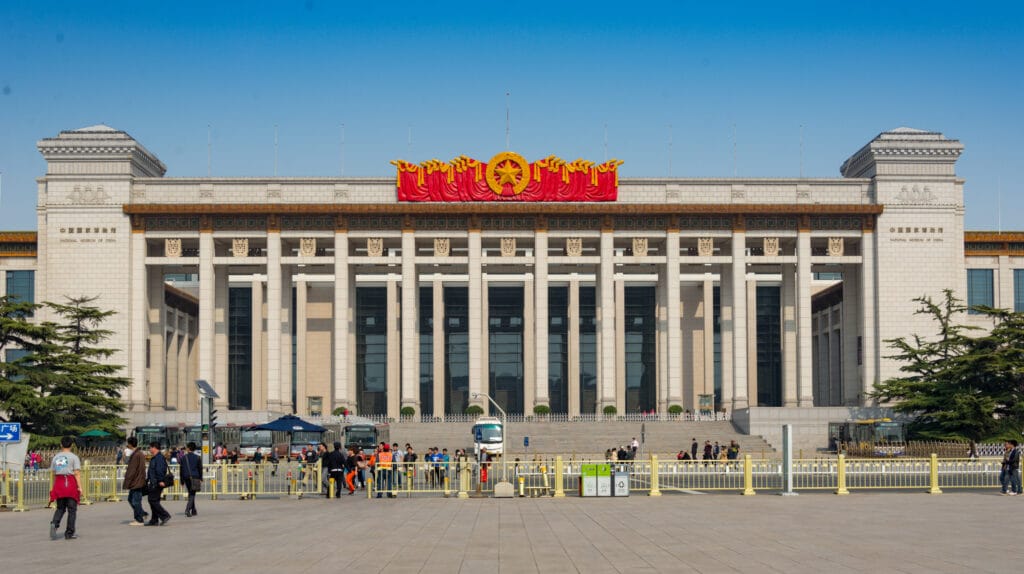
The National Museum of China stands on the eastern side of Tiananmen Square and ranks among the largest museums in the world. Its scale is.
Best forAncient history, archaeology, cultural heritage
Setting / nearbyAsia
Overview
The National Museum of China in Beijing is one of the largest and most important museums in the country, and it works above all as a museum of national history on a monumental scale. Situated on the eastern side of Tiananmen Square, it is not simply a museum in the ordinary civic sense. It is an institution designed to present China’s historical depth, cultural achievement, and national narrative through collections that stretch from antiquity to the modern era. For visitors, that means the museum operates on two levels at once. It is a place to see major objects from Chinese history, but it is also a highly symbolic public institution whose setting, scale, and curatorial direction reflect the role it plays in the presentation of the Chinese state and its past.
What makes the museum distinctive is its breadth. This is not a single-subject museum, nor is it limited to art in the narrow sense. Instead, it combines archaeology, historical artefacts, decorative objects, political history, and national storytelling in one very large institution. The result is a museum that can feel far broader than a standard art museum or even a conventional history museum. Visitors encounter bronzes, ceramics, inscriptions, jade, calligraphy-related material, revolutionary displays, and exhibitions that present modern Chinese history in a more explicitly national framework. Because of that range, the museum appeals to several kinds of visitor at once: those interested in ancient China, those interested in historical state formation, and those who want to see how a major national museum frames the story of the country.
The National Museum of China is also notable for its scale and seriousness. It does not aim to feel intimate or personal. It is built to convey weight, continuity, and public importance. That can make the museum feel more formal than many museums elsewhere, but it also suits the subject matter. China’s long historical span and the symbolic setting of the building call for exactly this sort of institutional presence. For many visitors, the museum’s authority is part of the experience. Even before entering the galleries, one has the sense of approaching a place intended to represent the nation at the highest level.
For that reason, expectations matter. This is not the sort of museum that works best as a casual stop with no plan. It is too large and too varied for that. The visit becomes far more rewarding if approached selectively, with an understanding that the museum’s value lies not in seeing every room, but in choosing a meaningful route through the larger whole. For some visitors, the focus will naturally be the ancient collections. For others, it will be the modern historical exhibitions. Either way, the National Museum of China is one of those institutions where scale is not just a practical issue but part of its identity.
Collection Highlights
Among the museum’s strongest highlights are its archaeological collections, especially those connected to ancient Chinese civilisation. Bronze vessels, ritual objects, jade, ceramics, and early historical artefacts form some of the most compelling sections of the museum and are often the most rewarding for visitors interested in China’s long historical foundations. These galleries give real substance to the idea of civilisational continuity. Rather than presenting only isolated treasures, the museum often creates a broader impression of material culture across dynasties and periods. That accumulation is one of its strengths. Visitors come away with a stronger sense of historical depth than they would from a museum built around only a handful of iconic works.
The bronze collections are especially significant. Ancient Chinese bronzes are among the most important objects in the country’s historical and artistic tradition, and the museum’s holdings allow visitors to appreciate both their ceremonial function and their formal power. These are not merely decorative objects. They are central to understanding authority, ritual, and elite culture in early China. Displayed on this scale, they help make ancient history feel less abstract and more materially grounded.
Ceramics are another major strength. Chinese ceramics are so internationally famous that it can be easy to approach them only as beautiful export objects or refined decorative arts. In the National Museum of China, however, they are part of a much larger historical framework. The galleries allow visitors to understand them not only as aesthetic achievements, but as products of changing technical knowledge, taste, trade, and imperial culture. Even for those who are not specialists, these sections often become more impressive the longer one looks, because the continuity and variation across periods gradually become clearer.
The museum’s historical exhibitions covering modern China are also central to its identity. These galleries may differ in tone from the more archaeological and artistic sections, but they are an essential part of what the museum is. They present the development of modern China through a national lens and help clarify the museum’s broader purpose as an institution of public history. For international visitors, these exhibitions can be valuable not only for the objects on display but for the insight they offer into how history is officially framed and communicated within the setting of a major national museum.
Temporary exhibitions may also add another layer, depending on the time of visit. In a museum of this scale, changing exhibitions can provide focus and variety, especially if they draw attention to a particular theme, dynasty, medium, or historical question. They can also offer a more manageable way into the museum for visitors who do not want to tackle the entire permanent collection in one visit.
Building and Setting
The building itself plays a major role in the experience. Located directly on Tiananmen Square, the National Museum of China occupies one of the most politically and symbolically charged settings in Beijing. That immediately gives the museum a different atmosphere from institutions located in quieter cultural districts or detached museum campuses. The setting shapes expectations before the visit even begins. One is not simply entering a building full of objects. One is entering a major national institution positioned within the ceremonial heart of the capital.
Architecturally, the museum is monumental and formal. Its façade, scale, and spatial organisation are designed to project dignity and state authority rather than intimacy or experimentation. This suits the institution’s role. The National Museum of China is not trying to present itself as a boutique cultural experience or a highly personalised curatorial journey. It is meant to feel significant in public terms, and its architecture reinforces that at every stage.
Inside, the museum tends toward broad, spacious galleries capable of handling both large visitor numbers and substantial exhibitions. The atmosphere is often more ordered and formal than in smaller museums, which again suits the collection. Some visitors may find the scale impressive but emotionally distant, while others will appreciate the sense of seriousness and clarity. In either case, the building succeeds in giving the collections a setting appropriate to their historical and symbolic weight.
The broader setting in central Beijing adds another dimension. Because the museum sits near several of the city’s most important political and cultural landmarks, the visit naturally becomes part of a larger reflection on power, memory, and national representation. This is one of the reasons the museum remains so interesting even for visitors who are already familiar with historical objects of the kinds displayed inside. The institution’s meaning comes not only from what it contains but from where it stands.
Practical Information
The National Museum of China is best approached with a plan. It is too large to absorb comfortably without one, and many visitors will get more out of the museum by focusing on a limited route rather than trying to move through everything. A sensible approach is to begin with the archaeological and early historical collections if your main interest lies in ancient China, or with the modern historical exhibitions if you want the broader national narrative first. Trying to cover both in equal depth in a single visit can quickly become exhausting.
Time matters here. Even a relatively selective visit can take several hours, and the museum is better suited to steady concentration than to hurried browsing. Comfortable pacing is important, as is the recognition that the museum’s scale can become physically and mentally demanding. It is usually better to see fewer sections properly than to rush through too much.
Because of its location and prominence, the museum can also be combined with a broader day in central Beijing, but it should still be treated as a substantial destination in its own right. The institution is large enough and important enough to justify focused attention rather than being reduced to a quick stop between other landmarks.
Why Visit
The National Museum of China is best for visitors who want a serious introduction to Chinese history at national scale, especially those interested in archaeology, dynastic material culture, and the way a modern state museum presents the story of the country. It is also highly worthwhile for travelers who are interested not just in historical objects, but in the relationship between museums, public memory, and national identity.
What makes the museum worth prioritising is the combination of historical depth, institutional scale, and symbolic setting. It is not always the easiest museum to absorb in one visit, and it can feel overwhelming without planning, but those are also signs of its ambition. The National Museum of China is not meant to be small or casual. It is meant to present the weight of a civilisation and the narrative of a nation. For visitors willing to approach it selectively and patiently, it is one of the most important museum experiences in Beijing and one of the clearest expressions of national history in museum form.