National Gallery London
About: Start with your ‘must‑see’ list. The rooms are dense — take breaks, and don’t hesitate to skip sections.What to see: Start with the signature.

Best forMasterpieces, architecture, cultural history
Setting / nearbyEurope
Overview
The National Gallery in London is one of the most important painting museums in Europe and one of the clearest places to encounter the history of Western painting through a collection that is both broad and remarkably concentrated in quality. Located on Trafalgar Square, it is not a general museum of decorative arts, antiquities, or mixed historical material. Its identity is much more focused than that. This is a museum built around painting, and that clarity gives it one of its greatest strengths. Visitors are not being asked to move constantly between different kinds of collections and different curatorial languages. Instead, they are offered a sustained encounter with major European painting across several centuries.
That focus makes the National Gallery especially rewarding for visitors who want to understand artistic development rather than just see isolated masterpieces. The collection moves from the late medieval and early Renaissance periods through the great traditions of Italian, Dutch, Flemish, Spanish, and French painting, and on into later European works. Because the museum is organised chronologically and geographically in a relatively accessible way, it often works well even for visitors who do not consider themselves specialists. It is one of those museums where the structure of the collection itself helps the visitor learn naturally. The rooms make it possible to trace shifts in light, technique, subject, and composition in a way that is harder to grasp in more fragmented institutions.
At the same time, the National Gallery is not only educational in a formal sense. It is also highly rewarding as a place of visual pleasure. The museum contains many of the best-known paintings in Britain and an extraordinary density of works by artists such as Van Eyck, Leonardo, Titian, Velázquez, Rembrandt, Turner, Monet, and Van Gogh. Yet unlike museums dominated by one or two overwhelmingly famous objects, the National Gallery often encourages steadier looking. Its masterpieces are spread through a collection strong enough that the visit does not collapse into one room or one queue. That gives the museum a more balanced rhythm than some larger institutions where the most famous works distort everything around them.
What makes the National Gallery especially valuable is that it succeeds at being both canonical and approachable. It is unquestionably one of Europe’s major painting museums, but it rarely feels as forbidding as that reputation might suggest. The museum can work for a first-time visitor who simply wants to see great paintings, and it can also reward someone returning with very specific interests. That combination of seriousness and accessibility is not easy to achieve, and it is one of the reasons the National Gallery remains such a strong museum visit in London.
Collection Highlights
The strongest highlights of the National Gallery are not confined to one artist, one wing, or one period. Instead, the museum’s strength lies in the consistency of its collection across multiple schools of European painting. The early Italian rooms are an excellent starting point for many visitors because they establish the long arc of the collection and show how painting developed from more formal devotional structures toward greater naturalism, spatial depth, and emotional complexity. These rooms may be quieter than the later, more famous galleries, but they are essential to the museum’s larger value.
The Renaissance and high Renaissance sections are among the museum’s most important areas. Here, visitors encounter a concentration of works that make clear why the National Gallery is one of the central painting museums in Europe. The transition from early devotional imagery to more complex and confident forms of representation becomes visible in a way that feels organic rather than forced. These galleries often provide some of the clearest moments of artistic continuity in the museum.
The Dutch and Flemish collections are another major strength. Paintings from these traditions often reward especially close looking because their impact depends not only on scale or fame but on surface, detail, and control. In these rooms, visitors can appreciate how much variety exists within the broader history of European painting. The atmosphere shifts from the grander narrative and religious ambitions of some Italian works to other forms of intimacy, domesticity, portraiture, and light. These sections are important because they prevent the museum from becoming too tied to one dominant idea of painting.
The Spanish and French works add another dimension, and the later rooms leading toward the nineteenth century are often among the most popular. Here, the museum becomes increasingly familiar even to visitors without much background in art history, because the names and styles are more widely recognised. Yet these galleries still work best when seen as part of the whole rather than as isolated highlights. One of the museum’s greatest virtues is that it makes later familiar masterpieces feel connected to a longer tradition rather than detached from it.
Among the most memorable rooms are those where visitors can compare different approaches to portraiture, religion, landscape, and modernity across periods and national schools. The museum is full of specific famous works, but its deepest strength lies in comparison. It encourages the eye to move from one solution to another, from one tradition to another, and from one historical moment to another. That is what makes the collection feel alive rather than merely prestigious.
Building and Setting
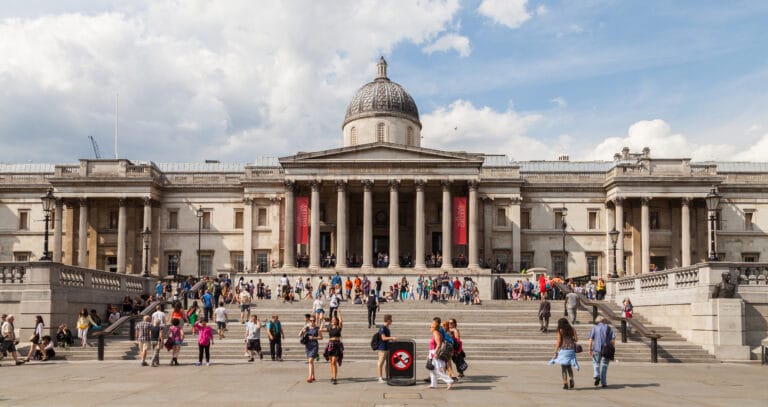
The National Gallery’s setting on Trafalgar Square is central to its identity. It occupies one of London’s best-known public spaces and benefits from that civic prominence. The museum does not feel tucked away or specialist in the manner of a smaller institution. It feels public in the fullest sense, and that suits its role as one of the country’s major art museums. The approach across Trafalgar Square reinforces the sense of arrival, and the museum’s façade contributes to its authority without turning the experience into something overbearing.
Architecturally, the building is stately and recognisable, but the real strength lies in how the interior supports the collection. The galleries generally give painting the priority it needs. Some rooms are more intimate, others more ceremonial, but the museum rarely allows architecture to overshadow the works. Instead, the building helps structure the visitor’s progression through centuries of European painting. This is one reason the museum is so manageable compared with some larger institutions. It feels composed around a clear purpose.
The position in central London also adds practical and symbolic value. The museum is easy to combine with other major sites, but it also stands well on its own. Its location makes it feel deeply part of the city’s public life rather than isolated in a specialist district. That matters because the National Gallery is not only a repository of masterpieces. It is a civic institution, and its setting reinforces that public identity.
Practical Information
The National Gallery is best visited selectively, even though it is more manageable than some of the world’s largest museums. The collection is rich enough that trying to move through every room too quickly can still become tiring. A good approach is to decide in advance whether the visit will be broad or focused. Some visitors may want a general chronological route through the collection, while others may prefer to concentrate on one school or period.
A very effective strategy is to begin with the sections most important to you and then allow time for slower wandering afterwards. The museum works well for short visits because even a limited route can still include extraordinary material, but it also rewards those who linger and compare works closely. Taking breaks is sensible, especially because painting museums demand concentration of a different kind than object-based museums. The eye can tire even when the body does not.
One of the great advantages of the National Gallery is that it can serve many kinds of visitor. A first-time museum-goer can still have a very satisfying experience by focusing on a handful of rooms, while a more experienced visitor can use the galleries for detailed and more analytical looking. This flexibility is one of the museum’s great strengths.
Why Visit
The National Gallery is best for visitors who want to experience one of Europe’s great painting collections in a setting that is serious, public, and surprisingly approachable. It is ideal for first-time visitors to London who want one major art museum experience, but it is equally valuable for those already familiar with European painting who want to look carefully at a collection of exceptional consistency.
What makes the museum worth prioritising is its clarity of purpose. This is a museum of painting, and it embraces that identity fully. The collection is broad without being shapeless, canonical without being dull, and educational without feeling heavy-handed. For many visitors, it offers one of the best opportunities anywhere in Europe to understand the development of Western painting in a way that remains enjoyable from beginning to end.
The National Gallery’s lasting strength is that it does not need to rely on spectacle. Its authority comes from the quality of the works and the intelligence of the collection as a whole. For anyone interested in painting, it remains one of the most rewarding museum visits in London and one of the strongest painting museums in Europe.