Museum of the Future Review
Tickets & Tours
Compare ticket options and guided tours from trusted booking partners.
We may earn a commission if you book through these links.
Some museums impress you the moment you arrive. Others earn it slowly, room by room, as the curatorial choices start to make sense. Museum of the Future sits confidently in the first category—but its best work happens in the quieter details: the pacing, the light, the way the building and the collection support one another rather than competing for attention.
Arrival and first impression
The first minutes at Museum of the Future are designed to shift your mindset. Whether you’re stepping in from heat, traffic, or a busy schedule, the entrance sequence calms the tempo. Architecture is used as a tool—guiding movement, softening noise, and creating a sense that you’re entering a space built for attention.
Galleries and storytelling
The museum’s core strength is how it tells stories. Objects aren’t simply displayed; they’re arranged to build context. You can move through the galleries without feeling lost, and interpretation tends to respect both first-time visitors and people who want depth. When labels are short, the visual logic does the work. When themes are complex, the museum usually provides enough framing to avoid confusion.
Atmosphere and design
Museum of the Future uses atmosphere as part of the experience. Light, ceiling height, and corridor width shift subtly from zone to zone. The effect is that each section feels distinct, which helps attention last longer. This is especially valuable for visitors doing a full museum day, where fatigue is often the hidden enemy.
Visitor experience
Practical experience is strong. Staff presence is professional, signage is clear, and the museum feels built around real visitor behavior—where people stop, where they look for toilets, where they need seating, where they want a pause. Amenities don’t dominate the museum, but they’re placed well enough to keep the day comfortable.
Strengths
• Strong sense of pacing and spatial flow
• Clear interpretation without feeling “tour guide” simple
• Presentation that feels modern and confident
• A visitor experience designed for comfort in the United Arab Emirates context
Weaknesses
The main limitation is that some galleries can feel slightly “controlled” in tone—polished to the point where spontaneity is reduced. In certain sections, visitors who want deeper scholarly layering may wish for a bit more interpretive depth or more daring object-to-object contrast. These are not deal-breakers, but they are opportunities.
Architecture and Design
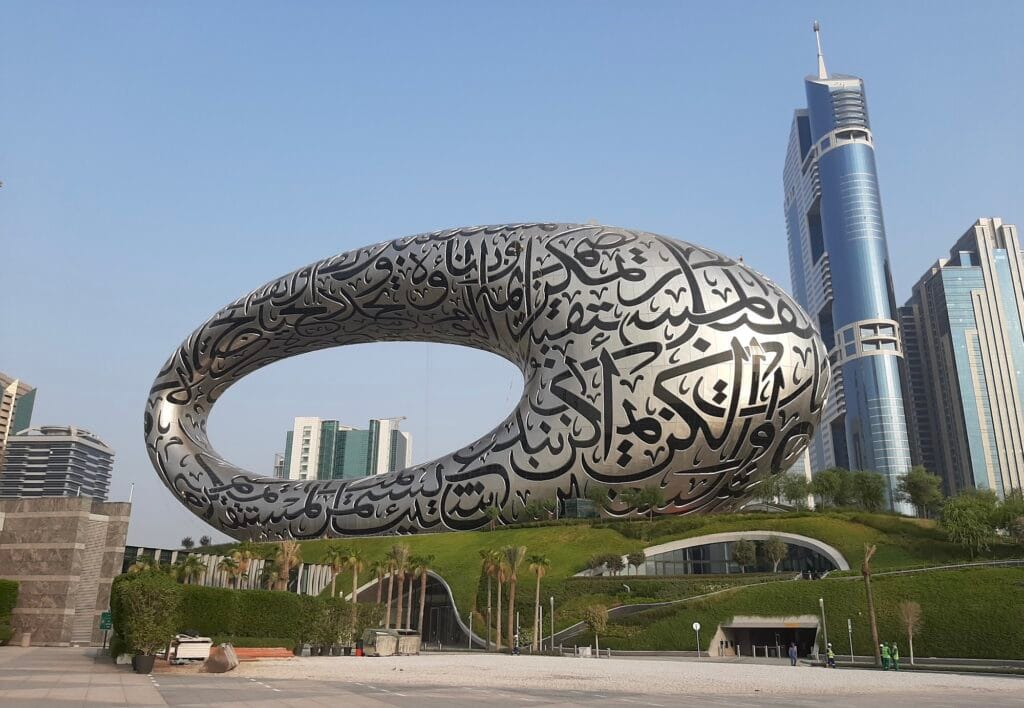
The architecture of the Museum of the Future is one of its most distinctive features and has become an icon of modern Dubai. The building was designed by Killa Design and is shaped like a torus, often described as a ring with an empty center. This unusual form represents humanity, the earth, and the unknown future, symbolizing the idea that the future is still unwritten.
The exterior is covered with stainless-steel panels containing Arabic calligraphy with quotes about innovation and progress. These lines, written by Sheikh Mohammed bin Rashid Al Maktoum, express the idea that the future belongs to those who imagine and build it. The facade consists of more than one thousand uniquely shaped panels created using advanced digital engineering.
The structure itself is considered one of the most complex buildings ever constructed, using modern parametric design tools and advanced steel frameworks. The museum stands on a landscaped hill that represents the past, while the building represents the present, and the open void in the middle represents the future that has yet to be discovered.
Inside, the architecture continues the futuristic concept, with curved spaces, immersive rooms, and lighting designed to create the feeling of entering another world. The design is not only aesthetic but also part of the storytelling experience that defines the museum.
Visitor Experience
Visiting the Museum of the Future is designed as a journey rather than a traditional museum tour. Instead of walking through static galleries, visitors move through themed floors that present possible versions of the world in the coming decades. The experience often begins at the top levels and continues downward, guiding guests through different ideas about science, space, nature, and human development.
One of the main themes focuses on the year 2071, where visitors explore concepts such as space travel, artificial intelligence, environmental restoration, and new forms of human technology. Interactive displays, digital simulations, and immersive sound and light installations are used to create a sense of realism.
Another part of the museum explores how technology can help solve global challenges, including climate change, health, and energy. These exhibitions combine scientific ideas with artistic presentation, making them accessible to both adults and younger visitors.
Unlike many traditional museums, the Museum of the Future encourages participation. Guests are invited to interact with the installations, reflect on possible futures, and consider how innovation may shape everyday life. This approach makes the visit feel more like an experience than a simple exhibition.
Final verdict
Museum of the Future is the kind of museum that helps define a city’s cultural identity. It feels intentional, well-run, and internationally credible, while still grounded in the realities of Dubai. If you’re building a Middle East museum itinerary, this is not an optional stop—it’s one of the anchors.