Museum of the Future
Museum of the Future is one of the Middle East’s most significant modern museums—built not only to display objects, but to set a cultural tone for the.
Best forMasterpieces, architecture, cultural history
Setting / nearbyMiddle East
Overview
Museum of the Future is one of Dubai’s most recognizable cultural landmarks and one of the most unusual museum experiences in the region because it is not built around ancient collections, traditional archaeology, or a conventional sequence of historic objects. Instead, it is designed as an immersive museum of ideas. That is its defining strength. The institution asks visitors to think about technology, environment, space, health, artificial intelligence, and the possible shape of human life in the decades ahead. Rather than explaining the past through artefacts, it explores how the future might be imagined, designed, and debated.
What makes the museum especially distinctive is that it treats the future as a subject of storytelling rather than as a technical forecast. This matters because many institutions dealing with innovation can feel too corporate, too abstract, or too close to trade-show culture. Museum of the Future works differently. It uses immersive design, sound, projection, installation, and speculative narrative to create a museum experience that feels more like moving through a set of future scenarios than through a conventional exhibition hall. This is one of its greatest strengths. Visitors are not simply reading about new technologies. They are entering staged environments meant to provoke wonder, reflection, and curiosity.
The museum is also especially important because it fits so clearly into Dubai’s larger public identity. Dubai is a city that often presents itself through ambition, infrastructure, and future-oriented development. Museum of the Future turns that civic self-image into a cultural institution. It is not just about what technologies exist now. It is about how a city imagines itself, how it wants to speak about tomorrow, and how architecture and exhibition design can turn aspiration into public experience. In that sense, the museum is as much a statement about contemporary Dubai as it is about the future itself.
At the same time, the museum works best when visitors understand that it is not a traditional museum of collections. Its power lies in atmosphere, concept, and immersion. This can make it highly memorable, especially for first-time visitors, families, and people who enjoy museums that are experiential rather than object-heavy. It may not satisfy someone looking for a dense scholarly collection of artefacts, but that is not its purpose. Its purpose is to make visitors feel that the future is something shaped by choices, imagination, ethics, and design rather than something that simply arrives on its own.
Collection Highlights
Museum of the Future is strongest when understood as a sequence of immersive environments rather than a museum of single masterpiece objects. This is one of the first things visitors should know. The experience is not centered on one universally famous artefact or one historical treasure. Instead, the “highlights” are often whole rooms, concepts, and staged encounters. This is what gives the museum its distinct character.
One of the museum’s major strengths is its treatment of space and near-future scientific imagination. These sections often invite visitors to think beyond Earth and to consider how exploration, ecology, and long-term survival might be connected. Rather than presenting space simply as heroic spectacle, the museum often uses it as a way to discuss fragility, responsibility, and the scale of human ambition. These areas are especially memorable because they combine visual drama with broader questions about the future of civilization.
Environmental and ecological themes are another important highlight. The museum becomes more substantial when it moves beyond technological optimism and asks how human societies might live differently in response to climate stress, biodiversity loss, and resource limits. These displays are effective because they broaden the meaning of “future.” The future is not shown only through machines and digital systems. It is also shown through questions of balance, repair, adaptation, and planetary care. This gives the museum more seriousness than a purely gadget-driven institution would have.
Health, wellness, and human-centered future scenarios also play a major role. These sections are often especially accessible because they connect futuristic thinking to the body, the mind, and everyday life. The museum becomes most persuasive when it suggests that the future is not only about bigger infrastructure or faster machines, but also about how people live, feel, and relate to one another. These areas can be among the most engaging because they make abstract innovation feel personal.
Artificial intelligence, robotics, and digital systems are naturally part of the museum’s appeal as well. These sections often attract immediate attention because they align with what many visitors expect from a future-themed institution. Yet the museum is strongest when these elements are embedded in larger questions rather than treated as spectacle alone. The most effective displays are not simply saying “look at this new machine.” They are asking what kinds of futures these systems might create, what trade-offs they involve, and what sort of world people may want to inhabit.
Another important highlight is the way the museum addresses children and families. This is not an incidental feature. The institution is built to be approachable, and some of its most successful moments come from giving younger visitors a future-oriented environment that feels participatory rather than passive. That broadens the museum’s audience and helps explain why it is often memorable even for visitors who do not normally enjoy more conventional museums.
Building and Setting
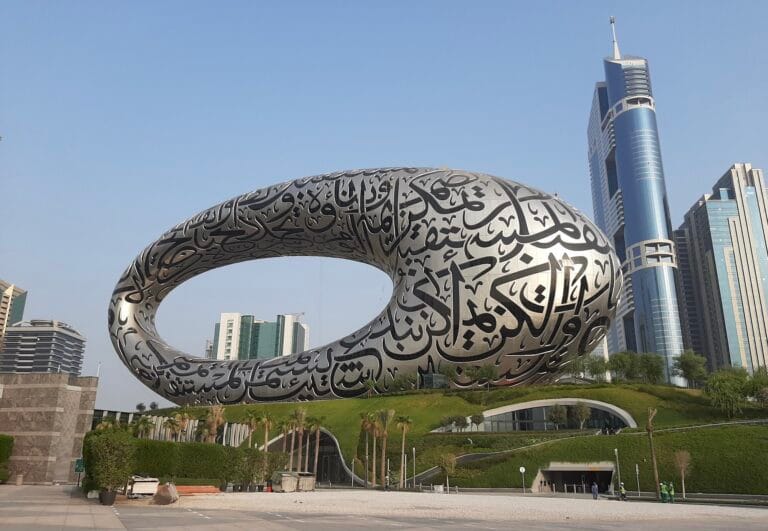
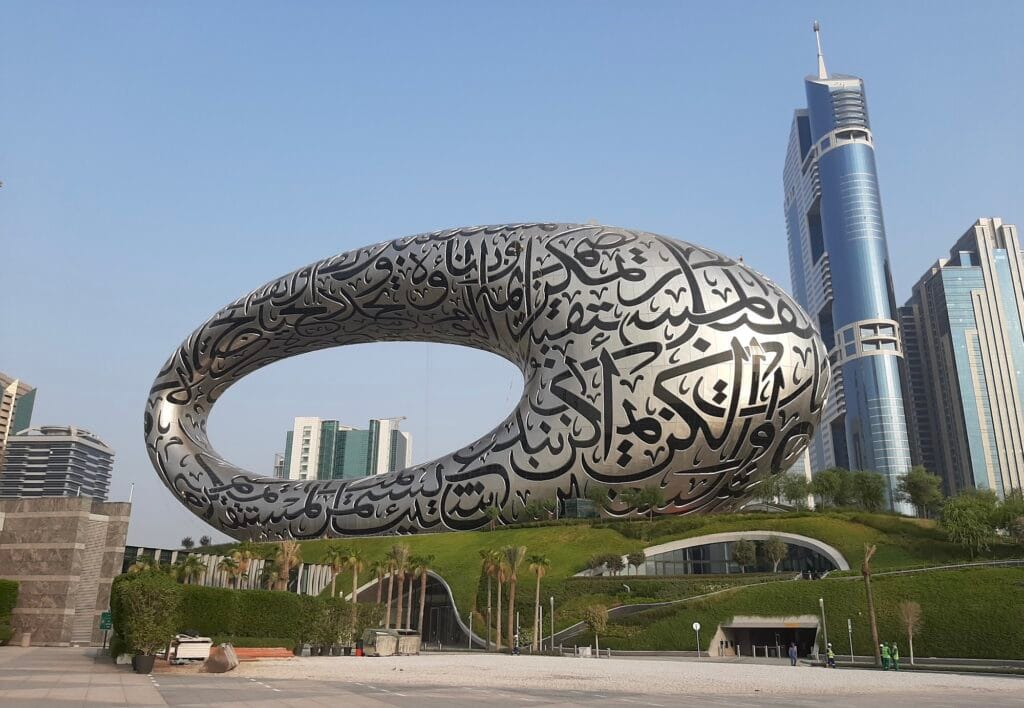
The building is one of the museum’s defining achievements and one of the reasons it has become globally famous. Its torus-like form, combined with the calligraphic exterior, makes it one of the most recognizable pieces of contemporary architecture in Dubai. This is not architecture acting only as a shell. It is part of the museum’s message. The structure announces from the outside that this is a place concerned with imagination, innovation, and symbolic ambition.
What makes the architecture especially effective is that it feels both futuristic and public. The building does not resemble a traditional museum palace, nor does it look like a standard office tower or exhibition hall. It stands apart from the city around it while still clearly belonging to Dubai’s visual culture of bold forms and engineered confidence. This gives the museum strong urban presence. Even before entering, visitors understand that the institution is meant to be experienced as an icon.
Inside, the architecture supports the immersive nature of the museum. Curved circulation, dramatic lighting, controlled transitions, and spatial reveal all contribute to the sense that the visitor is moving through a designed narrative rather than a series of neutral rooms. This is important because the museum depends heavily on atmosphere. The building helps create that atmosphere from start to finish.
Its location in Dubai also matters greatly. The museum feels inseparable from the city’s identity as a place associated with rapid development, global visibility, and future-oriented branding. This connection gives the institution additional force. It is not a generic future museum placed anywhere. It is a Dubai museum, and that context is central to its meaning.
Practical Information
Museum of the Future is best visited as a full experience rather than rushed through as a checklist stop. Because the institution depends on immersion and transitions between spaces, moving too quickly weakens much of what makes it special. A slower pace allows the narrative structure to emerge and gives the installations time to resonate.
It is especially useful to approach the museum with the expectation that this is a museum of ideas and environments, not a museum of historic collections. Visitors who accept that on arrival usually have a much stronger experience. Those looking only for traditional artefacts may misread what the institution is trying to do.
The museum works especially well for first-time visitors to Dubai, families, and travelers who want one visually memorable cultural stop. It also pairs well with the wider city because it gives context to Dubai’s future-facing public image. Even a relatively short visit can be rewarding, but it is better when the visitor gives the space enough time to unfold.
Why Visit
Museum of the Future is best for visitors interested in technology, design, architecture, immersive exhibitions, and the ways cities imagine tomorrow. Its greatest strength is that it turns abstract ideas about the future into something spatial, emotional, and publicly accessible. It does not merely describe innovation. It stages it as experience.
What makes it worth prioritising is that very few museums combine iconic architecture with this level of immersive narrative ambition. The building is unforgettable, but the museum is more than its exterior. It offers a way to think about what kinds of futures people may build, desire, fear, or hope for. That gives the institution more depth than a purely photogenic attraction.
For many visitors, Museum of the Future becomes one of the most memorable cultural experiences in Dubai because it captures something essential about the city itself: ambition, spectacle, experimentation, and a desire to shape the story of what comes next. That combination makes it one of the most distinctive museum visits in the region.