The Louvre
About: Start with Denon Wing early, then loop to Sully for ancient galleries. The Richelieu wing is calmer mid‑afternoon. Build breaks into your route —.

Best forMasterpieces, royal history, iconic architecture
Setting / nearbyEurope
Overview
The Louvre is one of the largest and most famous museums in the world, but its real importance lies in more than scale or reputation alone. In Paris, it stands as both a national institution and a global museum, holding collections that range across centuries, regions, and artistic traditions. For many visitors, it is the museum they most associate with European art and historical grandeur, yet that description only captures part of what makes it so compelling. The Louvre is not a single-theme museum and not even a museum that can be neatly summarized by a shortlist of masterpieces. It is, instead, a vast museum of art, history, empire, collecting, and architecture, where different periods and civilizations are presented within one of the most recognisable cultural settings in Europe.
What makes the Louvre distinctive is the breadth of its holdings. It is a museum where ancient sculpture, royal decorative arts, Renaissance painting, monumental history painting, and Near Eastern antiquities can all form part of the same visit. That range is one of its great strengths, but it is also what makes the museum challenging. Unlike a more tightly focused museum, the Louvre does not naturally offer one simple story. Visitors need to approach it with some selectivity. If they do, the museum becomes much more rewarding. Rather than trying to see everything, it works best when treated as a place of concentrated highlights within a much larger historical landscape.
The Louvre is also unusual because it combines the experience of a major art museum with the atmosphere of a former royal palace. This gives the institution a sense of ceremonial scale that few museums can match. Even before entering the galleries, visitors encounter a place shaped by monarchy, state power, and the later transformation of royal spaces into a public museum. That layered history matters. It changes how the collections are perceived. The Louvre does not feel like a neutral container for art. It feels like a historic structure that has accumulated meaning over time.
For many first-time visitors, the museum can seem overwhelming. The crowds, scale, and fame of individual works can create the impression that the Louvre is something to survive rather than enjoy. Yet it is at its best when approached patiently and strategically. It is not necessary to conquer the museum to appreciate it. A visit can be successful even if it focuses only on a few major sections, because the Louvre’s depth allows a smaller route to still feel substantial. In that sense, the museum rewards discipline. Choosing a limited path through it is often a better experience than trying to see too much.
Collection Highlights
The Louvre contains an extraordinary range of major works, but some sections are more rewarding than others depending on the visitor’s interests. Among the most famous highlights are the Mona Lisa, the Venus de Milo, and the Winged Victory of Samothrace. These works draw enormous attention, and for many visitors they form part of the essential Louvre experience. Each has a different kind of presence. The Mona Lisa is important less because of scale or visual force than because of its singular fame and historical weight. The Venus de Milo remains one of the museum’s defining examples of classical sculpture, while the Winged Victory is one of the most dramatically displayed objects in the entire building, with an energy that often exceeds expectations in person.
Yet the Louvre is strongest when visitors move beyond only the best-known names. The large Italian and French painting collections offer far more than the handful of works most often reproduced in guidebooks. The museum’s French painting galleries, in particular, contain works that can feel more spaciously appreciated than the most crowded iconic rooms. Likewise, the museum’s holdings in ancient Egyptian and Near Eastern antiquities provide some of the most intellectually rewarding areas in the building. These sections often feel more immersive and less compressed by celebrity-driven traffic than the famous painting galleries.
The monumental rooms of French decorative arts and the former royal apartments are another major strength. These spaces are not simply displays of furniture and ornament. They contribute directly to the sense of the Louvre as a palace museum. Chandeliers, gilded interiors, ceremonial rooms, and elaborate decorative schemes help connect the collections to the political and cultural history of France. For many visitors, these rooms provide a welcome shift in pace after painting and sculpture. They also remind the viewer that the museum itself is part of what is being encountered.
The Denon Wing often attracts the most attention because it includes many of the museum’s best-known works, but this also makes it the most crowded. The Sully and Richelieu wings can provide a more balanced experience, particularly for visitors who want to spend time looking carefully instead of moving through a constant stream of people. This is one reason why the Louvre rewards planning. The museum’s strongest objects are not all in one place, and some of the most satisfying moments come in less congested sections that reveal the museum’s depth rather than its fame alone.
Building and Setting
The Louvre’s setting is central to the experience. The museum occupies a historic palace complex in the heart of Paris, and its architecture gives the visit a scale and ceremonial character that is almost impossible to separate from the collections. This is not a museum where the building fades quietly into the background. The courtyards, façades, staircases, ceiling heights, and sequence of grand rooms all shape how the art is encountered. The museum therefore works not only as a collection of objects but also as an architectural and historical environment in its own right.
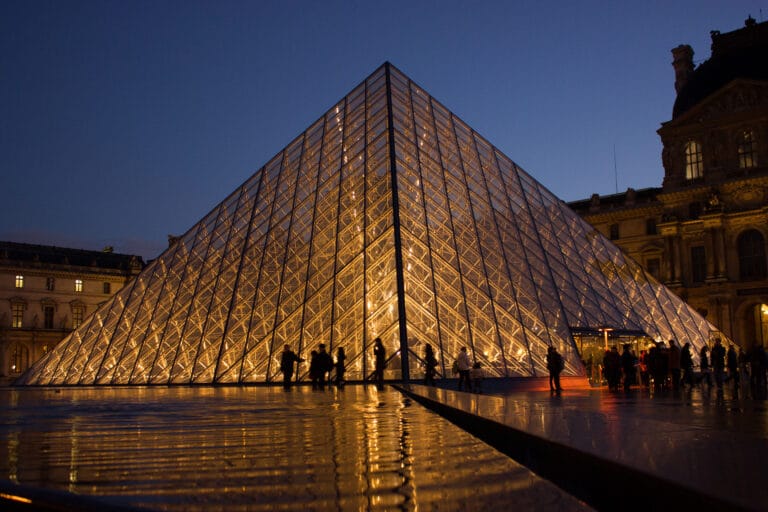
One of the most recognisable modern additions is the glass pyramid in the Cour Napoléon. Its role is practical as well as symbolic, functioning as a major entrance and orientation point, but it also creates a strong contrast between old and new. For some visitors the pyramid is now inseparable from the Louvre’s identity, while for others the palace architecture remains more memorable. In practice, both are important. The museum’s setting becomes part of the experience before one even begins looking at the galleries.
Inside, the Louvre alternates between spaces that feel grand and ceremonial and others that are more functional or gallery-like. This can make the museum feel uneven in the best sense: there is always a shift in atmosphere, scale, or emphasis. Some rooms encourage close study of objects, while others are impressive because of their architectural drama. The result is a museum that rarely feels static, even when one has already spent a long time inside.
Its location in Paris further strengthens its appeal. The museum sits within one of the city’s most historically resonant areas and can be approached as part of a broader walk through central Paris. This helps the Louvre feel embedded in the city rather than isolated from it. A visit to the museum often carries the atmosphere of Paris itself into the experience, especially when seen in relation to the Tuileries, the Seine, and the surrounding monumental urban landscape.
Practical Information
The most important practical advice for the Louvre is to plan selectively. Trying to see everything in one visit is almost always a mistake. The museum is too large, too crowded, and too rich in material for that approach to be satisfying. Instead, it is better to identify a few departments or a limited route in advance. Visitors interested mainly in major highlights may choose a concentrated path through the most famous works, while others may focus on one or two sections, such as Italian painting, Egyptian antiquities, or decorative arts.
Timing matters as well. Arriving early can make a significant difference, especially in the most famous galleries. Even then, certain rooms become busy quickly, so it can be helpful to head first to the areas that matter most. Once the essential rooms have been seen, the rest of the visit often becomes calmer and more enjoyable.
The museum is also physically demanding. A Louvre visit involves a great deal of walking, changing levels, and navigating large crowds. Comfortable pacing is important. It is usually better to have a shorter, focused visit that remains enjoyable than to stay too long and lose concentration. Visitors should also allow time simply to orient themselves, because part of the challenge of the museum is not the individual objects but the sheer scale of the institution.
Why Visit
The Louvre is best for visitors who want to experience one of the great museum institutions of the world and who are willing to approach it with patience rather than urgency. It is particularly rewarding for those interested in the breadth of art history, the relationship between art and state power, and the experience of a museum that is also a palace. Even for travelers who are not deeply specialized in art, the Louvre offers a kind of cultural scale that is difficult to match elsewhere.
Its greatest strength is that it combines masterpieces, historical depth, and architectural grandeur in one setting. It can be crowded, demanding, and impossible to exhaust, but those qualities are part of what define it. The Louvre is not a museum to finish. It is a museum to enter selectively and remember in fragments: a staircase, a sculpture, a ceiling, a crowded room, a quieter gallery, a sudden masterpiece. For visitors willing to accept that rhythm, it remains one of the most important and most rewarding museum visits in Paris.