National Football Museum
Football Museums · Manchester, United Kingdom. The National Football Museum in Manchester focuses entirely on the story of football as a sport, a social activity, and a cultural phenomenon. It collects and displays a wide range of materials that narrate…
Best forFootball fans, cultural travelers, families, and sports-history visitors
Setting / nearbyManchester, United Kingdom
Overview
The National Football Museum in Manchester focuses entirely on the story of football as a sport, a social activity, and a cultural phenomenon. It collects and displays a wide range of materials that narrate the development of football from its origins through to the present day. The museum is devoted to aspects such as the evolution of the rules, the achievements of clubs and national teams, and how football has shaped communities and identities in the United Kingdom and beyond. Rather than being part of a stadium tour, this institution concentrates on the historical and archival side of the game, bringing together objects and stories that illustrate football’s many dimensions.
Collection Highlights
The museum’s collection centers on the tangible heritage of football: jerseys, trophies, photographs, programs, badges, and other memorabilia linked to clubs, players, managers, and supporters. Among these are kits worn by famous footballers and replicas or originals of trophies won at domestic and international levels. The museum also holds items documenting pivotal moments in football history—such as objects connected to World Cup tournaments and historic league victories. Besides material relating to players and teams, the collection explores supporter culture through artifacts reflecting fan traditions, chants, and matchday rituals.
The archives contain documents and images that trace changes in the sport’s rules and organizational structures. For example, early rulebooks and referee equipment offer insight into how football’s regulations have evolved. The museum also preserves historic club badges and official merchandise, revealing the visual and commercial growth of football clubs. Records about managers and tactics form another layer of the collection, linking on-pitch innovation with broader trends in the game.
Some exhibits cover regional football histories and the role of local clubs in their communities, demonstrating football’s reach beyond the elite level. Stratford-upon-Avon and other towns’ football traditions may be represented, highlighting grassroots connections. The various materials invite visitors to understand football not just as a game but as a social practice shaped by decades of change, rivalry, achievement, and fandom.
Building and Setting
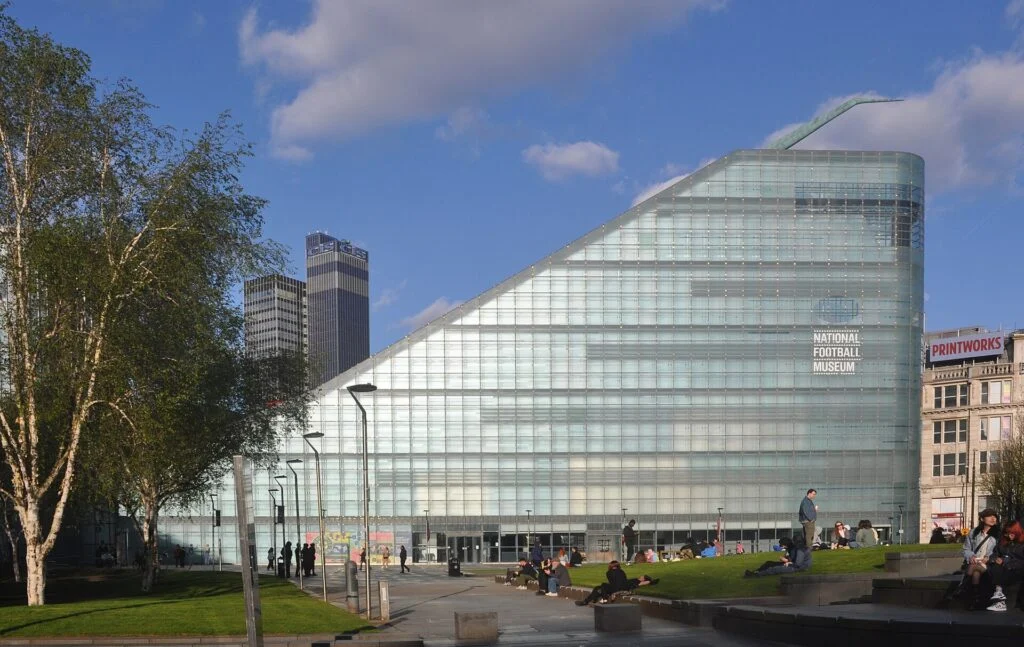
Located within Manchester city centre, the National Football Museum occupies a modern building designed to suit exhibition, archive, and visitor services. Its environment places it conveniently near other cultural sites, although it is distinct from the stadiums where football is played. The museum’s architecture supports the display of fragile historical objects and provides controlled lighting and climate conditions necessary for preservation. Public transport and pedestrian access in the vicinity make visiting straightforward for those staying in or traveling through Manchester.
The museum’s setting does not involve a historic stadium structure, unlike some football museums elsewhere, which can influence the visitor experience by separating the object-focused exhibitions from live game-day energy. This separation allows the museum to concentrate fully on the aspects of football history, heritage, and culture lending themselves to display and study within a gallery format.
Practical Information
Before planning a visit, it is advisable to check the National Football Museum’s official website for current details about opening hours, ticket prices, booking requirements, and any visitor services. The museum’s website (nationalfootballmuseum.com) provides comprehensive information about what to expect and any event listings or temporary exhibitions. Information on accessibility and facilities is also available online.
Guidance on tours or audio-visual aids is best sourced from the museum itself as these might vary. Visitors should verify the availability of on-site amenities. Whether arriving by public transport, on foot, or by car, directions and parking details are more effectively obtained from the museum’s official communications.
Why Visit
This museum provides a focused look at football through its material culture and archival records. It is especially suited for those wanting to trace the game’s history through actual objects rather than simply reliving match-day experiences or particular club stories. Its strength lies in presenting football’s development over time in ways that clarify changes in rules, player, and fan culture.
One limitation is that, being a museum rather than a stadium tour venue, it does not integrate live football atmospheres or pitch-level perspectives. Visitors should approach it with an interest in football heritage as an enduring social and sporting phenomenon rather than a focus purely on recent game highlights or current teams.
The museum’s collection puts weight on historic depth, from early forms of the sport to later global competitions, which can enhance understanding for readers and football supporters curious about how the game and its culture have grown and shifted. It offers a comprehensive repository of football memories and documents that relate back to clubs, players, managers, competitions, and the fans whose devotion has shaped the sport’s legacy.
For those keen on exploring football’s broader cultural footprint and the tangible proof of its past, the National Football Museum has a clear focus that distinguishes it from venues tied closely to active football environments or individual clubs. The museum’s approach provides space to consider football in historical context through its objects and documentation.