National Museum of India
Tickets & Tours
Compare ticket options and guided tours from trusted booking partners.
We may earn a commission if you book through these links.
Overview
The National Museum of India in New Delhi serves as one of the country’s largest repositories for its archaeological, artistic, and cultural heritage. Founded in 1949, it traces the story of the Indian subcontinent through a vast array of artifacts spanning millennia. Unlike museums dedicated to a single artistic movement or region, it offers a broad sweep, ranging from prehistoric times to the contemporary period. Its mission is to present India’s tangible history across civilizational stages, integrating art, craft, and archaeology. This makes it a pivotal institution for understanding India’s layered past through objects gathered both from within the country and from beyond its borders.
Collection Highlights
The collection includes around 200,000 works, representing a wide variety of materials and historical phases. One of the most detailed sections covers the Indus Valley Civilization, which flourished around 2500 BCE in what is today northwest India and Pakistan. Objects such as pottery, seals inscribed with early scripts, and finely crafted tools give insight into one of the world’s earliest urban societies.
Another significant collection area emphasizes Buddhist art and sculpture, particularly from sites linked with the Mauryan and Kushana empires. The museum’s displays include bronze and stone images of the Buddha and Bodhisattvas, often with exquisite detailing indicative of the regional styles that emerged over centuries.
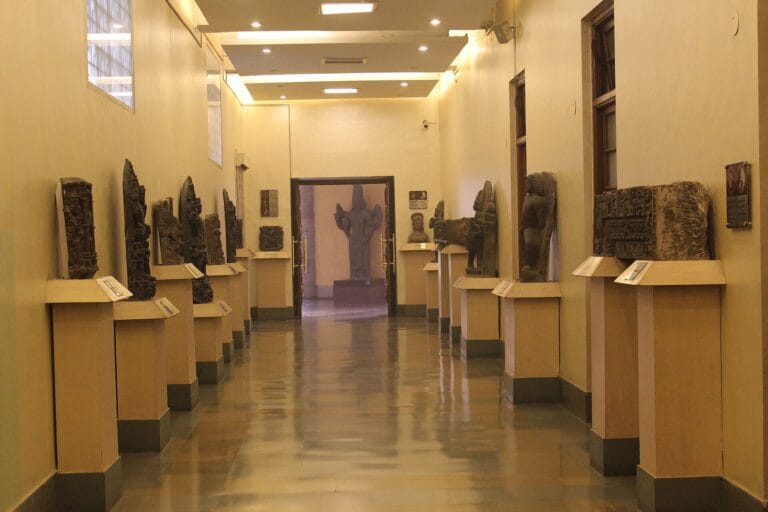
Medieval Indian art receives substantial attention, with carved temple sculptures from Khajuraho and other historic sites forming a highlight. These works, carved in stone and often conveying religious narratives, allow visitors to see shifts in aesthetic styles alongside changes in religious practice and patronage.
There are also galleries devoted to paintings, including Mughal miniatures known for their narrative detail and vibrant colors. These reflect the synthesis of Persian and Indian artistic traditions under various emperors from the 16th to 18th centuries. Alongside these, modern Indian paintings present the evolution of artistic expression through India’s colonial and post-colonial periods.
The museum’s weaponry section showcases a collection of arms and armor reflecting the martial traditions of different regions and eras, from ornate swords to firearms used during the British Raj.
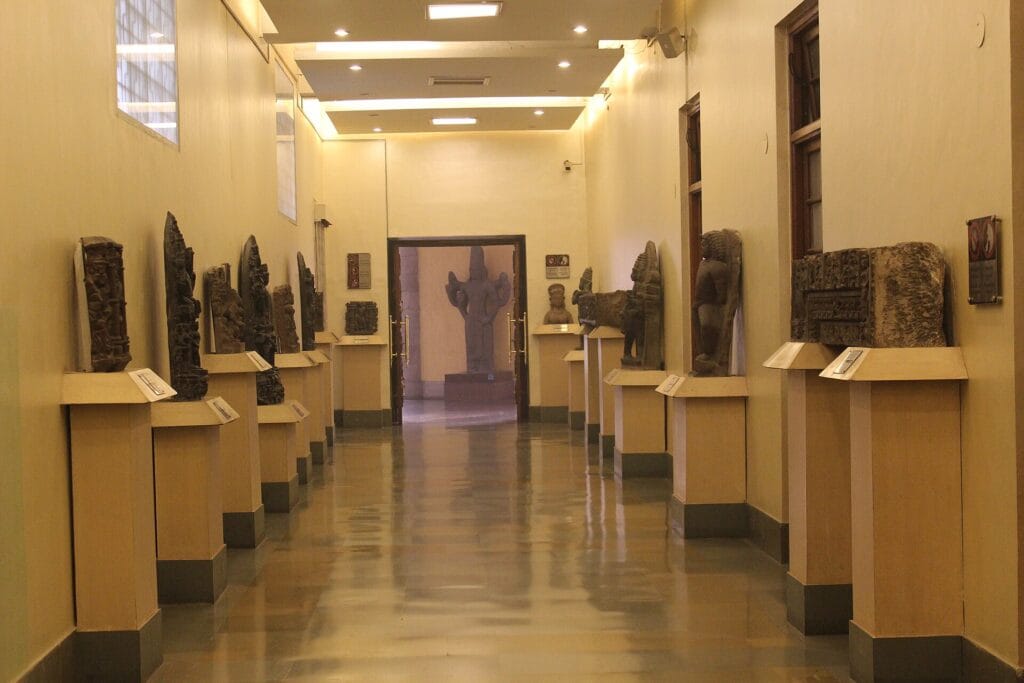
In addition, coin collections, inscriptions, textiles, and decorative arts provide a rounded picture of material culture. While the sheer quantity of objects covers many domains, some galleries may present a museum-styled density of objects, which can feel crowded or make individual items less prominent.
Building and Setting
The museum is housed in a large, purpose-built structure located on Janpath Road, near the India Gate roundabout, a central area of New Delhi. The building dates from the early post-independence period and blends elements reminiscent of classical Indian architectural features with mid-century modern design. The spacious layout includes multiple galleries spread over several floors, organized thematically and chronologically.
Its proximity to other cultural landmarks and government buildings situates it well within the capital’s institutional zone. The museum compound includes outdoor spaces for larger sculptures and installations, adding to the range of display environments. Access from major city points and public transport makes it convenient to reach, though parking and peak-time crowds may vary.
Practical Information
Current visiting hours, entrance fees, discounts, and ticket booking procedures are details best checked on the official website, since these can change. Accessibility provisions and visitor services such as guided tours or multimedia aids may also vary depending on scheduling.
Planning a visit benefits from allocating several hours, considering the museum’s size and the density of its displays. Photography policies and rules about touching or handling objects are defined on-site.
Why Visit
For those interested in Indian history or archaeology, the museum offers a solid, broad chronological overview with authentic artifacts that have shaped many narratives of South Asian culture. Its strongest feature lies in presenting a wide historical spectrum under one roof, making it a useful resource for a comparative approach—understanding shifts in art and society over time.
Some visitors accustomed to smaller, more focused museums might find the collection’s scale overwhelming or its layout less intuitive. The abundance of objects in certain galleries may complicate detailed engagement with individual pieces, so a prior idea of key periods or themes to explore can help.
Visitors drawn to ancient civilizations, Buddhist art, or the interplay of Indian and Islamic artistic traditions will find the collections particularly rewarding. The museum’s physical presence and location also place it conveniently amid other notable New Delhi destinations for a fuller day of exploration.
Information on programming, special exhibitions, or recent acquisitions is best followed through the museum’s official channels. This assures accuracy and helps plan visits around any temporary displays highlighting specific aspects of India’s extensive cultural legacy.