Musée Soulages Review
Rodez, France. The Musée Soulages in Rodez, France, occupies a distinct niche within contemporary art institutions. Established to celebrate the work of Pierre Soulages, a painter closely associated with the post-war abstract movement, the museum focuses…
Rodez, France. The Musée Soulages in Rodez, France, occupies a distinct niche within contemporary art institutions. Established to celebrate the work of Pierre Soulages, a painter closely associated with the post-war abstract movement, the museum focuses…
Best forMuseum lovers, culture travelers, first-time visitors
Review focusCollections, visitor experience, and practical planning
Context and Identity
The Musée Soulages in Rodez, France, occupies a distinct niche within contemporary art institutions. Established to celebrate the work of Pierre Soulages, a painter closely associated with the post-war abstract movement, the museum focuses on a single artist’s oeuvre, tracking his evolving use of black and light as primary materials. Rodez is Soulages’ birthplace and home for much of his life, making the museum’s geographic location a significant element of its identity. This local tie situates the museum not merely as a repository for art objects but as a cultural touchstone for the city and a point of regional pride.
The Musée Soulages presents a concentrated narrative centered on the artist’s long career, particularly emphasizing his signature “Outrenoir” (beyond black) series developed since the late 1970s. Rather than attempting to embed Soulages within a broad art historical survey, the museum chooses to spotlight him in depth. This decision shapes its programming approach and the expectations a visitor might reasonably hold—this is a place for focused engagement with one major figure’s work, rather than a general survey of 20th-century abstraction or French modern art.
Inside the Collection
The museum’s collection revolves almost entirely around Pierre Soulages’ paintings and lithographs, offering a wide chronological sweep that allows visitors to chart the progressive refinement of his visual language over decades. The core of the collection is Soulages’ exploration of black as a color and texture through thick, deeply incised brushstrokes that catch and refract light in varying ways. Early monochrome works share space with later, larger-scale canvases that serve as both pictorial surfaces and sculptural objects in their own right.
Visitors encounter a consistent thematic and material vocabulary in the galleries—rough black striations, intense texture contrasts, and an examination of light revealing itself on surface contours. This persistent focus invites viewers to develop an appreciation of nuance, subtle variation, and the sensory experience of black pigment beyond flat darkness. Surrounding graphic works show how printmaking techniques played a complementary role in Soulages’ practice, illustrating his interest in form and repetition.
While the collection is highly specialized, it is presented with enough chronological breadth and formal variety to avoid monotony. The works reveal different phases of Soulages’ career, from earlier softer abstracts through more architectural compositions in his later years. The museum’s decision to dedicate itself to this single voice provides clarity but also limits exposure to varied contemporary perspectives.
Architecture and Display
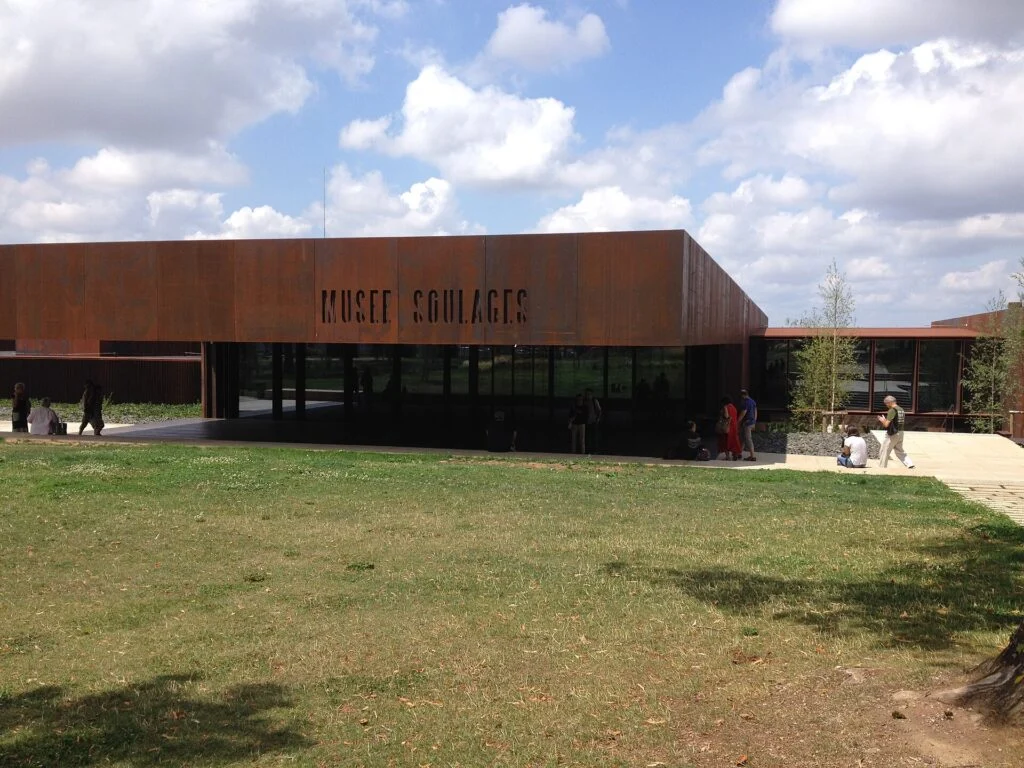
The building housing the Musée Soulages was designed specifically to accommodate the unique qualities of the collection. The architect’s focus on natural lighting, subdued tones, and spacious gallery layouts create an environment that accentuates the physicality of the paintings. Controlled light sources and window placements are crafted to optimize the reflective qualities of the textured black surfaces, an essential aspect of understanding Soulages’ work.
Concrete, steel, and glass dominate the architectural palette, creating a minimalist setting that foregrounds the artwork without distractions. The galleries are arranged in an ordered sequence that roughly follows chronological development but also allows for thematic nuances. The generous ceiling heights and open floor plans grant each large canvas room to breathe, avoiding visual overcrowding.
The display strategy is restrained: works are often isolated on plain, pale walls, and labels provide succinct contextual information without interrupting the contemplative atmosphere. This approach suits the meditative nature of Soulages’ paintings, giving visitors space to engage without competing sensory inputs. However, the minimal text and interpretive material may leave less experienced visitors wanting more introduction or background to the artist’s methods and intentions.
For Families, Specialists, and First-Time Visitors
The Musée Soulages primarily caters to adults with an interest in modern art, especially those willing to invest time in a sustained engagement with abstraction and materiality. Specialists can find value in the museum’s careful conservation of key works and the opportunity to study Soulages’ technique across decades. Art historians and students may appreciate the comprehensive representation of his “Outrenoir” style and its evolution.
For first-time visitors unfamiliar with Soulages or his context, the museum’s focused presentation may at times feel demanding. The insistence on black as the central element might challenge conventional expectations about color and form in painting; without a foundational understanding, some could perceive a lack of variety. Minimal interpretative content means that those new to Soulages might benefit from preparatory reading or an audio guide sourced independently before visiting.
Family visits could feel constrained by the formal tone and the subdued atmosphere, which does not encourage noisy exploration or casual interaction. Younger children might find it hard to engage visually with the uniformity of dark surfaces, and the absence of tailored educational programs or interactive spaces reduces appeal for this group. In this way, the museum leans more towards contemplative adult audiences rather than family-oriented design.
What Works Best
The museum’s greatest strength lies in its sensitive presentation of Soulages’ unique artistic language. The combination of architecture and collection forms a coherent experience where paintings are not just seen but physically felt through shifting light and texture. This sensory relationship invites extended visual attention, rewarding viewers with a repeated discovery of subtleties invisible at a glance.
The chronological-spatial organization enables visitors to observe the transformation in Soulages’ approach over time, highlighting consistency and innovation. The rigorous focus on a single artist avoids dilution of the narrative and ensures depth in understanding his materials and methods. For enthusiasts of abstract painting or monochrome exploration, this focus presents an unparalleled opportunity.
Moreover, the museum leverages its geographic context effectively, acting as a cultural landmark in Rodez. The local association lends authenticity and a sense of place that can enrich the visitor’s perception of Soulages not just as an artist but as an individual rooted in the region.
Practical Considerations
Visitors planning a trip to Musée Soulages should check official resources for current information on opening hours, admissions, and any access requirements or restrictions. The museum’s location in Rodez means it is best reached through regional transport options, and those traveling from larger French cities may want to consider connections in advance.
Due to the building’s size and the nature of the collection, the museum may not appeal equally to all audiences. Those expecting a traditional art museum’s diversity or casual family attractions might find the experience too narrow or quiet. The exhibition’s contemplative tone recommends allowing time to absorb the works gradually rather than rushing.
As with many museums dedicated to a single artist, the absence of a broad contextual framework within the galleries places some burden on the visitor to engage with supplementary material outside the building if desired. This is a modest limitation but worth noting for less familiar audiences.
Verdict
Musée Soulages offers a focused and carefully crafted presentation of Pierre Soulages’ work that will satisfy visitors with a genuine interest in modern abstract art and monochrome painting. Its collection highlights the artist’s lifelong obsession with black’s capacity to reflect and emit light, shown through paintings and prints assembled with a clear narrative thrust. The architecture and display reinforce this experience effectively, emphasizing materiality without distraction.
However, this specialization inherently narrows the museum’s appeal. Viewers seeking broader art historical surveys or lively, interactive environments might find it lacking. The limited interpretive content and quiet atmosphere create a space more suitable for contemplative visitors with some prior knowledge or preparation rather than casual tourists or families with young children.
For those prepared to engage on the artist’s terms, the museum provides a rare opportunity to experience Pierre Soulages’ artistic vision in depth, within a carefully designed setting that respects the ambitions of the work. Its regional significance adds a cultural dimension that complements the artworks themselves. Yet, prospective visitors should approach with measured expectations about the museum’s scope and style to ensure a rewarding visit.