Power Station of Art Review
Art Museums · Shanghai, China. The Power Station of Art (PSA) in Shanghai is a contemporary art museum housed in a former power plant, a transformation emblematic of Shanghai’s rapid urban and cultural development over recent decades. Opened in…
Art Museums · Shanghai, China. The Power Station of Art (PSA) in Shanghai is a contemporary art museum housed in a former power plant, a transformation emblematic of Shanghai’s rapid urban and cultural development over recent decades. Opened in…
Best forArt lovers, visual culture, architecture
Review focusCollections, curatorial focus, and visitor planning
Historical Context
The Power Station of Art (PSA) in Shanghai is a contemporary art museum housed in a former power plant, a transformation emblematic of Shanghai’s rapid urban and cultural development over recent decades. Opened in 2012, the museum was established as China’s first state-run public museum dedicated exclusively to contemporary art. Its founding aligns with Shanghai’s broader ambitions to establish itself as an international cultural hub, reflecting a shift in Chinese cultural policy toward more open engagement with global contemporary art practices. The building itself, originally constructed in the 1930s as a power facility, represents the city’s industrial past, now repurposed to serve a post-industrial, creative function. This physical and institutional transformation underscores larger debates about heritage, modernization, and cultural identity in China.
Operating under the Shanghai Art Foundation, the PSA functions both as an exhibition space and a platform for dialogue about contemporary art’s role in society. It is significant in terms of its scale, location, and institutional positioning, situated by the Huangpu River in the Pudong district, opposite the historic Bund area, placing it at a geographical and symbolic crossroads in the city. The museum also plays a role in hosting parts of the Shanghai Biennale, contributing to the city’s intensive calendar of cultural events. While ambitious in concept and scale, PSA reflects ongoing negotiations about the place of contemporary art within China's cultural system and public sphere.
What You See on Arrival
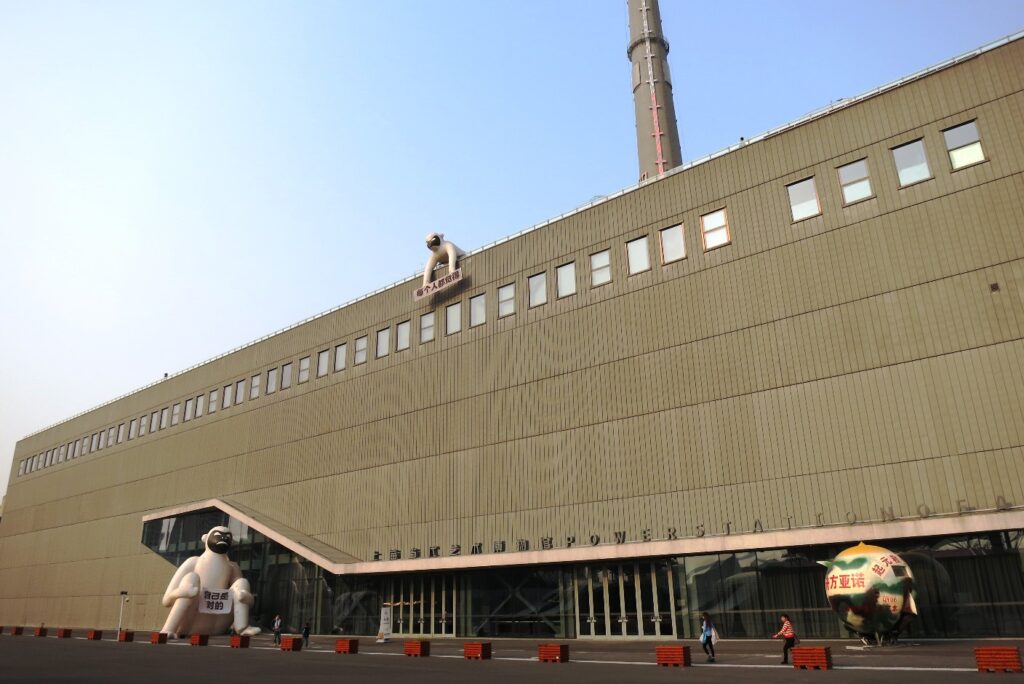
The Power Station of Art’s exterior immediately signals its industrial origins through the retained architectural features of the original power plant, including a massive brick façade and tall factory-like windows. This gesture grounds the museum’s identity in its former life, contrasting with the smooth, glass-heavy museum buildings typical of contemporary art venues around the world. The imposing scale and somewhat austere exterior provide a tangible sense of history and re-imagined purpose that prepares visitors for an experience rooted both in place and in transformation.
Upon approaching the entrance, visitors encounter a spacious lobby that retains the sense of industrial volume while serving a new function as a gateway to cutting-edge contemporary art. The openness of this transitional space and its sturdy materials—concrete, steel, brick—reinforce the sensation of moving from the industrial past into an art-present moment. The museum’s visual identity is deliberately blunt and straightforward, eschewing flamboyance for an architectural authenticity that challenges rather than comforts. This framing situates visitors firmly within a narrative of change and contemporary social engagement before they even enter the exhibition spaces.
Highlights and Key Exhibitions
The collection and programming at the Power Station of Art concentrate on contemporary issues, focusing on artistic production from China and around the world. As a contemporary art institution, it does not maintain a permanent collection in the traditional sense but operates as a dynamic exhibition platform with a strong curatorial emphasis on present-day artistic practices linked to social, political, and cultural concerns.
Visitors are likely to encounter exhibitions that engage with themes such as urban transformation, globalization, identity, and technology’s impact on society. These themes resonate strongly given Shanghai’s status as a megacity rapidly evolving in terms of infrastructure and demographics, as well as China’s ambivalent position within global cultural circuits. The PSA’s exhibitions vary in format, often including installation art, video works, mixed media, and performance elements. The museum’s size allows for large-scale projects that respond both to its cavernous industrial spaces and to demanding contemporary art techniques.
A significant part of the museum’s identity stems from its role as host of the Shanghai Biennale, one of Asia’s major contemporary art events. The Biennale programs reflect critical interrogations of society and artistic production and anchor the PSA within an international network of contemporary art discourse. This connection provides the museum with substantial international visibility and input but can also pose challenges in terms of balancing local cultural expectations with global contemporary art standards.
While well-suited to viewers engaged with conceptual and experimental contemporary art, the PSA might challenge those with interests limited to more traditional or historical art forms. Its exhibitions are often intellectually demanding and may favor artists and practices that require familiarity with recent art theory and cultural critique. Nonetheless, the museum’s endeavors usually include some accessible and visually compelling works to maintain a broader public appeal.
Visitor Experience
The visitor experience at the Power Station of Art is shaped fundamentally by the building’s unconventional layout and vast industrial scale. The vast interior spaces allow for freedom in exhibition design but can sometimes feel cavernous or unbalanced, depending on the scale and density of art installations. This requires careful pacing and spatial navigation, which the museum often supports through clear signage and strategic placement of works.
The museum’s approach to interpretative materials tends to align with international contemporary art museum conventions. Information panels, curatorial texts, and occasional multimedia aids offer substantial context, although the intellectual density of many exhibitions suggests that visitors benefit from prior knowledge or supplementary research to fully engage with the content. For casual visitors or those new to contemporary art, this may limit immediate accessibility.
Audience fit is generally geared toward an urban, educated demographic comfortable with conceptual art, as well as tourists interested in contemporary culture. Families with younger children or those seeking more traditional museum experiences may find the focus and presentation less immediately gratifying. That said, the Power Station of Art can be a stimulating environment for students, artists, and academics who appreciate the challenging ideas and experimental forms that define much of the museum’s programming.
Crowd flow can vary notably depending on concurrent major exhibitions or Biennale periods. At such times, visitor numbers rise and the space can feel lively, though not overwhelmingly crowded due to the building’s size. At quieter periods, the museum’s spaciousness can feel more meditative but also somewhat stark.
Tickets, Access, and Planning
Details concerning ticket pricing, operating hours, and accessibility options at the Power Station of Art should be verified directly through the museum’s official website or authorized channels before planning a visit. Policies and offers, including any discounts or special access arrangements, may change, and advanced booking could be necessary during peak exhibition periods or festival events like the Shanghai Biennale.
The museum’s location close to Pudong’s metro system makes public transportation relatively straightforward for most visitors. However, the surrounding urban infrastructure is complex, and first-time visitors would be advised to consider travel time carefully. For those planning an in-person visit, checking for any special calendar dates, closures, or additional health and safety measures is recommended for a smooth experience.
Additional visitor facilities such as cafés, shops, educational programs, or guided tours are frequently part of institutions of this scale, but confirmation should again be sought from official sources for the latest availability.
Final Verdict
The Power Station of Art holds a crucial place in Shanghai’s cultural ecosystem as a platform dedicated to contemporary art. Its repurposed industrial architecture situates the museum within a narrative of historical evolution and urban renewal, offering a physical and symbolic contrast to more conventional museum environments. For visitors interested in current artistic practices—especially those that engage critically with society, technology, and globalization—the PSA provides a challenging and stimulating environment.
The museum’s strengths lie in its bold architectural identity, its commitment to contemporary experimental art, and its important role in hosting the Shanghai Biennale. These factors combine to make it a notable venue within the international contemporary art landscape, especially within China. However, its focus on cutting-edge art and conceptual presentations means it is not equally suited to all audiences. Visitors unfamiliar with contemporary art theory or those seeking traditional art-historical narratives might find aspects of the museum less accessible or engaging.
Ultimately, the Power Station of Art exemplifies the tensions and possibilities of contemporary art in a rapidly transforming urban and cultural context. It invites audiences willing to engage intellectually and aesthetically with the present moment. Prospective visitors should prepare accordingly, ensuring they consult current practical information and approach the museum with an openness to contemporary art’s often complex discourse. The Power Station of Art is an institution where architecture, history, and contemporary culture meet, offering an experience shaped by both its past functions and its future aspirations.