Gansu Provincial Museum Review
Archaeology Museums · Lanzhou, China. The Gansu Provincial Museum, located in Lanzhou, China, serves as a crucial cultural institution dedicated to the preservation and presentation of the history, art, and ethnography of Gansu Province. Established in 1956, the museum…
Archaeology Museums · Lanzhou, China. The Gansu Provincial Museum, located in Lanzhou, China, serves as a crucial cultural institution dedicated to the preservation and presentation of the history, art, and ethnography of Gansu Province. Established in 1956, the museum…
Best forMuseum lovers, culture travelers, first-time visitors
Review focusCollections, visitor experience, and practical planning
Historical Context
The Gansu Provincial Museum, located in Lanzhou, China, serves as a crucial cultural institution dedicated to the preservation and presentation of the history, art, and ethnography of Gansu Province. Established in 1956, the museum has steadily evolved to accommodate the rich heritage embedded in this region of northwest China, which historically has been a crossroads of diverse peoples and cultures. Gansu’s position along the Silk Road contributes heavily to the museum’s collections and interpretive focus, reflecting the exchanges of commodities, ideas, and artistic traditions between China and Central Asia.
Over the decades, the museum has played a central role in chronicling the province's archaeological discoveries, ethnic diversity, and natural history. Many of its holdings originate from prominent archaeological sites in the region, which include both ancient Chinese dynastic artifacts and relics from nomadic peoples and minority ethnic groups. Gansu’s complex local history—marked by the coexistence of Han Chinese culture alongside Tibetan, Mongol, Hui Muslim, and other influences—presents the museum with a multifaceted curatorial challenge. This setting allows the institution not only to display items of intrinsic artistic and historical value but also to illustrate the broader contours of cultural interaction and adaptation in this borderland area.
The museum’s development over time has mirrored an increasing emphasis on accessibility and modern exhibition standards. Recent archival and display renovations suggest a commitment to scholarly rigor balanced with public education. However, like many provincial museums in China, the Gansu Provincial Museum reflects a blend of local pride and national narrative, which visitors should keep in mind when navigating its thematic presentations.
What You See on Arrival
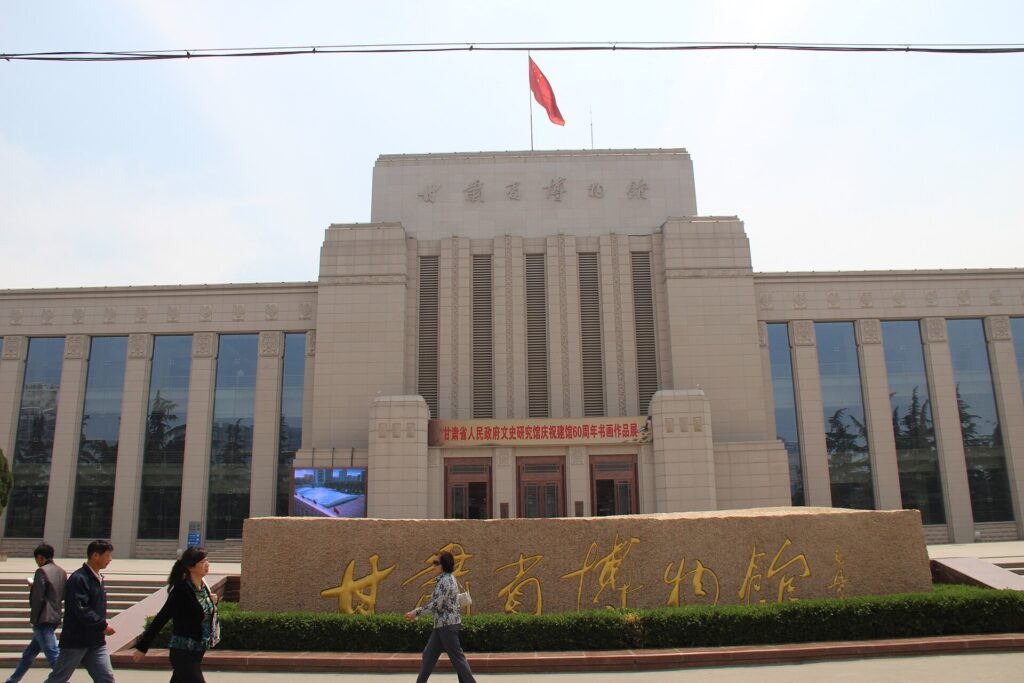
From outside, the Gansu Provincial Museum presents a formal, imposing façade that signals its institutional importance within Lanzhou’s cultural landscape. The architecture is functional with touches reflecting traditional Chinese motifs, particularly visible in rooflines and exterior decoration. This design choice anchors the museum firmly within its regional context, resisting attempts to mimic the sometimes more international or avant-garde styles seen in major metropolitan museums in Beijing or Shanghai.
The visitor approach is straightforward, with a clearly marked entrance and open plaza that leads into the main lobby. The lobby area typically functions as a transitional space, equipped with standard museum amenities and introductory displays. The spatial organization immediately informs visitors of the institution’s dual role: to educate about the province’s history and to foster an appreciation of its cultural diversity.
Signage in this space is present but often runs predominantly in Chinese, which may pose an initial language barrier for non-Chinese speakers. However, key descriptive panels and exhibit labels in bilingual formats tend to appear deeper into the galleries, offering increasing interpretive clarity as guests progress through the collections.
The museum’s layout is generally considered practical rather than experimental, facilitating a linear movement through its exhibits. This arrangement suits visitors who prefer to experience the museum’s content in a chronological or thematic sequence without needing to navigate complex floor plans. While the building does not claim architectural innovation, its modest style effectively frames the cultural artifacts inside without distraction.
Highlights and Key Exhibitions
The Gansu Provincial Museum stands out for its extensive archaeological and ethnographic collections, which together form the core of its exhibition program. A significant portion of the displays draws on finds from sites along the Hexi Corridor, integral to understanding the Silk Road's impact in northwest China. These archaeological pieces provide concrete evidence of early interregional trade and cultural transmission. Pottery, Buddhist sculptures, and ancient textiles are some of the objects that illustrate the multilayered history present in Gansu.
One of the most notable sections is dedicated to the Eastern Han to Tang dynasties, periods that saw considerable growth in both Buddhist art and commerce. The museum’s collection of statues, murals, and ritual items from cave temples such as those at Dunhuang and Maijishan help paint a vivid picture of religious and artistic life within these Silk Road centers. These exhibits reveal stylistic influences that blend Indian, Central Asian, and Chinese elements, highlighting the syncretism that shaped regional cultural expressions.
The museum also houses a fine array of ethnographic materials reflecting the lives and traditions of Gansu’s various minority ethnic groups. From clothing and tools to religious artifacts and musical instruments, these exhibits provide insight into the customs and social structures that continue to influence the region today. This focus on contemporary and historical human diversity adds depth to the museum’s narrative, distinguishing it from institutions that concentrate almost exclusively on ancient or imperial histories.
Additionally, the natural history collections spotlight the geology, flora, and fauna of Gansu Province. Though not as extensive or prominent as the cultural holdings, these specimens help place human history within an environmental context. They appeal to visitors interested in the intersection of nature and civilization, though the displays here might feel more utilitarian than immersive.
Despite the many strengths, the museum’s exhibitions can at times suffer from uneven interpretive detail. While some sections benefit from well-researched, clearly written panels, others offer only sparse context or rely on conventional explanations. English translations, when present, occasionally simplify or omit finer points that would enhance international visitors’ understanding. Lighting and display techniques tend to prioritize conservation and visibility but fall short of creating dynamic or evocative atmospheres that some contemporary museology strives for.
Visitor Experience
The Gansu Provincial Museum generally provides a calm and orderly environment suited to history enthusiasts, researchers, and those with an interest in regional cultures. Its audiences are often domestic visitors, including students and families, who come for educational purposes. Given the museum’s focus on provincial heritage, visitors with a specific academic or cultural interest in northwest China will find the exhibitions rewarding and informative.
Pacing through the museum galleries tends to be measured, as the displays are dense with artifacts and detailed labels that encourage careful examination. Visitors who enjoy reading and reflection will appreciate the space for thoughtful engagement, although those expecting fast-moving, interactive experiences may find the visit comparatively static. The absence of large-scale multimedia presentations or hands-on elements aligns with a traditional museum approach emphasizing display over participation.
Interpretive strengths lie in the clear thematic divisions within the museum, which help trace the chronological and cultural evolution of Gansu Province. These divisions aid comprehension by breaking down complex historical narratives into manageable sections. However, the lack of consistent bilingual support and more diverse interpretive formats might restrict the museum’s accessibility to broader international audiences.
The museum’s atmosphere, while formal, is not intimidating. It encourages visitors to explore quietly and at their own pace. Staff interactions, where noted in reviews, tend to be polite and informative, albeit often conducted primarily in Mandarin Chinese. Visitors bringing specialized historical or linguistic knowledge stand to gain deeper appreciation from the detailed collection descriptions and catalogues, usually published in Chinese.
In terms of limitations, the museum does not currently offer extensive digital resources to supplement the physical exhibits. For visitors who rely heavily on technology for navigation or background context, this could feel like a shortfall. Furthermore, due to the museum’s provincial focus, those seeking broader narratives of Chinese art or world history will find the scope narrower than what central national museums provide.
Tickets, Access, and Planning
Information regarding admission, hours, and additional visitor services should be confirmed directly through the Gansu Provincial Museum’s official channels before a visit. Public details on ticket prices and opening times are subject to change and vary with conditions such as holidays or maintenance closures.
The museum is centrally situated in Lanzhou, making it reasonably accessible by public transportation and taxi. Lanzhou is a regional hub, so visitors arriving from outside the province will typically connect through larger Chinese cities using domestic flights or trains. Within the museum, navigation is straightforward, and the physical spaces generally accommodate standard visitor flow without congestion during typical opening periods.
Accessibility for visitors with mobility limitations or special needs has not been extensively documented, so potential guests requiring assistance should investigate current facilities in advance. The level of language support, including guides and multilingual signage, remains limited, warranting preparation for non-Chinese speakers who wish for fuller understanding.
Visitors planning to focus on particular topics or artifact groups may find it worthwhile to allocate sufficient time. The density of collections and detail of explanatory materials reward sustained attention but may require selection when available time is constrained. The museum’s website may offer updates on any new policies, seasonal events, or temporary closures that affect visiting conditions.
Final Verdict
The Gansu Provincial Museum offers a valuable window into the distinct cultural and historical identity of Gansu Province and its place within wider Chinese and Central Asian contexts. Its substantial archaeological holdings and ethnographic collections form the backbone of exhibitions that underscore the region’s role as a Silk Road corridor and a meeting place of diverse peoples.
It is a museum best suited to visitors interested in regional history, cultural anthropology, and Chinese archaeology who favor detailed, artifact-rich environments over interactive or entertainment-focused displays. Though interpretive and linguistic accessibility could be strengthened, the Gansu Provincial Museum nonetheless serves an important educational role within Lanzhou and for visitors willing to engage patiently.
Limitations include a generally traditional presentation style, occasional gaps in bilingual support, and a lack of digitized or multimedia interpretative content. These factors may place it outside the primary itinerary for more casual tourists or those seeking modern museological experiences.
Overall, the museum stands as a solid representative institution of provincial heritage, distinguishing itself through the rarity and specificity of its collections. For those wishing to understand Gansu’s long and complex cultural narratives, it offers a concentration of material that is rarely found elsewhere. Prospective visitors are recommended to plan ahead with up-to-date information from official sources to maximize their experience.