Australian Age of Dinosaurs Review
Natural History Museums · Winton, Australia. The Australian Age of Dinosaurs museum in Winton, Queensland, is a specialized institution dedicated to the paleontological heritage of the Australian outback, with a primary focus on the Mesozoic Era. This period, which spans…
Natural History Museums · Winton, Australia. The Australian Age of Dinosaurs museum in Winton, Queensland, is a specialized institution dedicated to the paleontological heritage of the Australian outback, with a primary focus on the Mesozoic Era. This period, which spans…
Best forMuseum lovers, culture travelers, first-time visitors
Review focusCollections, visitor experience, and practical planning
Historical Context
The Australian Age of Dinosaurs museum in Winton, Queensland, is a specialized institution dedicated to the paleontological heritage of the Australian outback, with a primary focus on the Mesozoic Era. This period, which spans roughly from 252 to 66 million years ago, encompasses the age when dinosaurs roamed the region long before human settlement. Winton and the surrounding areas form part of the Winton Formation, a geologically significant site known for rich dinosaur fossil deposits dating to the Late Cretaceous period, approximately 95 million years ago.
Opened in 2002, the museum emerged from concerted efforts by paleontologists and local enthusiasts to properly excavate, conserve, and display fossils that have been unearthed in this arid inland region of Queensland. Unlike larger metropolitan museums that cover broader natural history topics, the Australian Age of Dinosaurs purposely zeroes in on the fossil finds unique to its region, providing context on the ancient ecosystems that once flourished in Australia’s interior. The museum thus plays a dual role as both a research facility and a public educational site, supporting ongoing digs and scientific studies while interpreting the dinosaurs’ story for visitors.
This focus fills an important gap in paleontology by highlighting species found only in Australia and illustrating how the continent’s ancient fauna differed from those on other landmasses during the Mesozoic. The museum has contributed to greater public awareness of this prehistoric heritage and has fostered regional pride in local scientific discovery. It also challenges common fossil narratives that tend to emphasize North American or Eurasian dinosaurs by offering insights into the paleobiogeography of Gondwana — the supercontinent that Australia was once part of.
What You See on Arrival
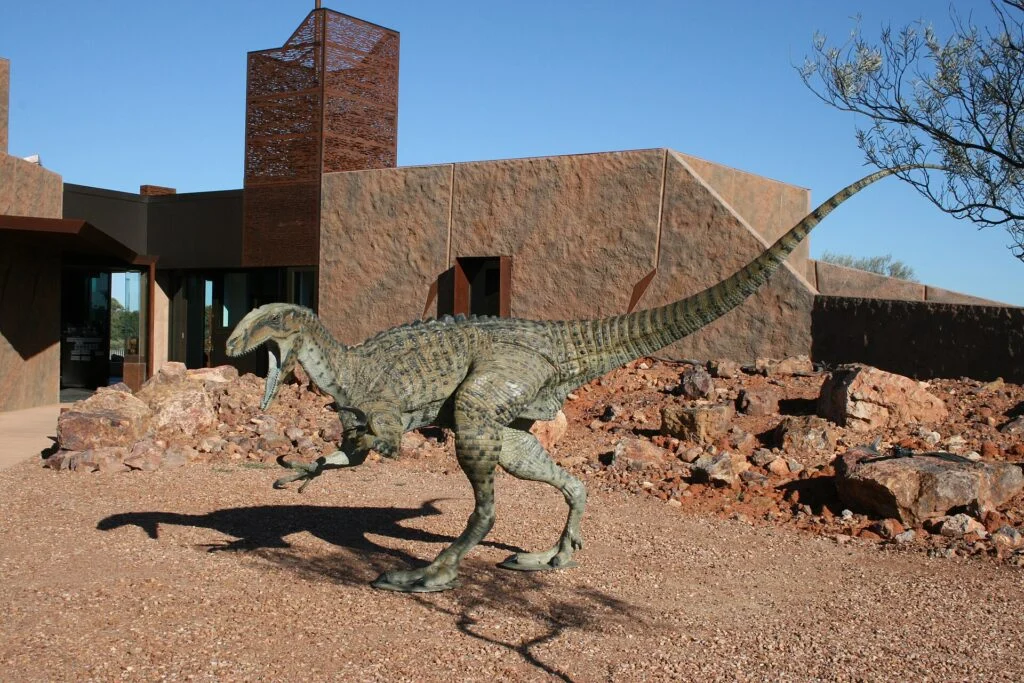
Visitors approaching the Australian Age of Dinosaurs museum first encounter a striking, purpose-built complex set amid the vast Queensland outback landscape. The architecture is functional with sweeping curved lines, intended to resemble dinosaur bones or vertebrae, immediately signaling the thematic focus before stepping inside. The external design cleverly anchors the museum in its subject matter and environment, linking the building visually to natural history without overt spectacle.
The museum entrance leads to a foyer that frames the visitor experience through graphic displays and signage emphasizing both the scale of the dinosaurs that once inhabited this region and the scientific rigor that underpins the institution’s work. A cast of a large dinosaur skull or partial skeleton is often placed near the entrance to instill an immediate sense of awe and to orient visitors toward the objects inside.
Overall, the arrival experience balances a sense of discovery with a grounded approach, framing the museum as a serious scientific center with an accessible narrative, rather than a purely entertainment venue. The remote location and architecture underscore the outback’s vastness and the depth of history embedded there, placing visitors in a mindset to consider geological time and evolutionary processes before entering the exhibition halls.
Highlights and Key Exhibitions
The core appeal of the Australian Age of Dinosaurs lies in its collection of original fossils and meticulously crafted replicas drawn from the Winton Formation. Central to the museum’s offerings is the display of bones from several species of large herbivorous and carnivorous dinosaurs that inhabited the region during the Late Cretaceous. The titanosaurian sauropods are among the standout specimens here, represented by some of the most complete and well-preserved fossils found in Australia. These giants, often exceeding 20 meters in length, provide insight into the morphology and scale of ancient Australian dinosaurs, a contrast to the more famous North American species.
Another highlight is the discovery and interpretation of the theropod dinosaurs from the region, including carnivorous species that shed light on the predator-prey dynamics of the era. The museum presents these specimens with detailed skeletal mounts alongside explanatory panels situating them within their paleoenvironment, supplemented by skeletal reconstructions and scientific commentary.
Beyond the fossils themselves, the museum’s dioramas and models illustrate the Cretaceous landscape of inland Australia. These exhibits aim to recreate the ecosystem in which these dinosaurs lived, showing not just the animals but the vegetation and climate inferred from geological and biological evidence. Such contextualization is essential for visitors to grasp the broader natural history of the region rather than viewing the fossils as isolated artifacts.
The museum also leverages its research activities by displaying behind-the-scenes footage and explanations of ongoing paleontological excavations. This approach helps visitors appreciate the complexity and patience involved in fossil recovery and preparation. It also highlights the scientific methods that separate rigorous paleontology from mere fossil collecting.
While the permanent exhibitions cover dinosaur anatomy, taxonomy, and paleoecology with some depth, the museum does not attempt to broaden its scope extensively to other prehistoric eras or non-dinosaurian fauna. This focus strengthens its specialization but may limit appeal for visitors interested in a wider natural history perspective or more interdisciplinary content.
Visitor Experience
The layout of the Australian Age of Dinosaurs museum supports a straightforward chronological or thematic route through the Late Cretaceous period as understood from the Winton Formation. The pacing is steady rather than hurried or fragmented, encouraging visitors to linger over individual specimens and their scientific explanations. Labeling and interpretive panels are generally clear and well-written, avoiding overly technical jargon without sacrificing detail, making the content approachable for a broad audience including families, students, and dinosaur enthusiasts.
Interpretive materials often incorporate comparisons with better-known dinosaur species from other continents, helping contextualize Australia’s unique prehistoric fauna. This comparative approach assists in situating the local discoveries within global paleontology, underscoring the relevance of these fossils beyond regional interest.
The museum’s educational programming and workshops complement the exhibits for school groups and engaged learners, though confirmation of current offerings should always be sought in advance, as these may vary seasonally or due to staffing. The institution’s remoteness and focused theme might make it more challenging for casual tourists who lack prior interest in dinosaurs, but those curious about Australia’s prehistoric past will likely find the visit rewarding.
In terms of accessibility and visitor amenities, information is best checked directly with the museum. Given its remote location, some visitors may need to travel long distances from regional centers, so planning is essential. The museum does not present itself as a large-scale visitor attraction with multiple facilities but rather as a research-driven institution with a specialized mission.
Tickets, Access, and Planning
Potential visitors to the Australian Age of Dinosaurs should approach their trip with careful planning given the museum’s rural setting near Winton, Queensland. Information on admission fees, operating hours, and availability of guided tours or audio guides is subject to change, so consulting the museum’s official website or direct contact channels is recommended to ensure the most current details.
Access to the museum typically involves travel through remote areas, where public transport options may be limited. Visitors relying on private vehicles or tour arrangements should verify local infrastructure and road conditions. The museum may offer limited parking on-site, but again, official sources should confirm this in advance.
Family groups, school parties, and individuals with specific accessibility requirements should also confirm support services and facilities before visiting. The museum’s primary focus on fossils and scientific research sometimes means fewer amenities compared to larger urban institutions, so visitors should consider their own comfort needs accordingly.
Final Verdict
The Australian Age of Dinosaurs is a focused institution with a clear mission: to uncover, preserve, and interpret the dinosaur heritage of inland Queensland. Its distinctiveness lies in its dedication to the Winton Formation fossils, providing a depth of detail on Australia’s Cretaceous period that is hard to find elsewhere. The museum presents its specimens with scientific credibility and educational clarity, making it a valuable resource for those interested in paleontology and natural history specific to this region.
However, the museum’s attained specialization may not appeal equally to all visitors. Those expecting a broad natural history or dinosaur-themed experience on the scale of major metropolitan museums might find the scope somewhat narrow, and the relative remoteness of Winton demands advance preparation and commitment from travelers.
Interpretation is generally solid and accessible, though the museum leans towards visitors already invested in dinosaur science or Australia’s paleoheritage. It is less focused on entertainment or interactivity, which could limit appeal for younger audiences unless accompanied by adults who can guide engagement with the exhibits.
Overall, the Australian Age of Dinosaurs stands as an important scientific and cultural institution in regional Australia. It delivers a well-curated, research-based glimpse into a unique chapter of Australia’s prehistoric narrative. It is best suited to travelers who are curious about paleontology beyond the standard dinosaur fare and prepared for a visit to a specialized site off the beaten track. Readers planning to experience it would do well to consult official sources for the latest details on access, tickets, and current offerings.